Writing about the past – and the present, too

Standard
cataphract1

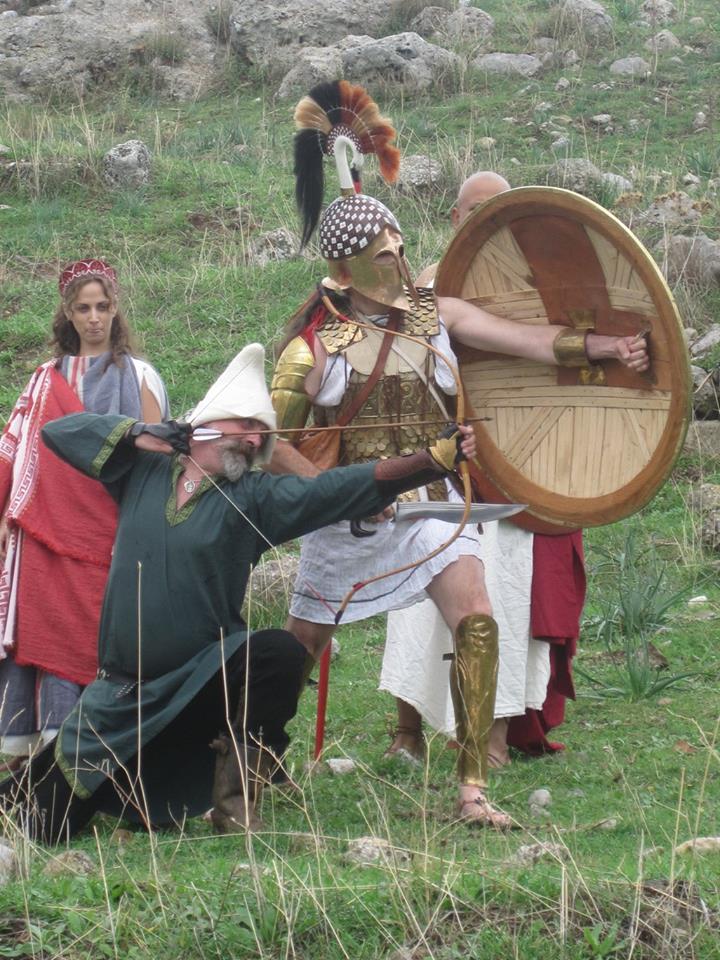
That’s my friend John Conyard of Comitatus

Sometime next fall, I plan to write a novel about Philopoemen, the so-called ‘Last Greek Hero,’ cavalry commander and strategos of the Achaean League in the time of Hannibal and the 2nd Punic War; a brilliant soldier, an innovator, and according to some, the creator of the concept of ‘special forces.’ He’s an exceptional character, and so is his ally and sometimes rival, the Roman Titus Quinctius Flamininus. The two of them are the subjects of a pair of biographies in Plutarch’s Lives’; the only pair that were contemporaries and friends (each of Plutarch’s lives is part of a pair, always one Greek and one Roman, always supposed to be similar men, but usually spread apart in time).
So, in the best tradition of Plutarch… while I write about Philopoeman, my friend SJA Turney is going to writer about Titus Flamininus. We will ‘pair’ our novels with interlocking narratives and probably even some shared scenes… like team-up comics. Maybe the two will be ‘unreliable’ about aspects of events… but mostly they will be a team… Greece and Rome…together, again. It’s an exciting idea; I love writing with a collaborator (I wrote eight books with my dad, you may recall) and it also allows me to explore a brand-new period in military history.
Brand-new, you say? Wait, Christian, haven’t you written a ton of books about ancient Greece? Don’t you have this thing wired yet?

Z5861
Well, first, no, I don’t. Having spent the last five weeks feverishly preparing roughly a hundred people to go recreate a very small part of the Battle of Marathon in 490 BCE. I have to say that really, I barely have a clue how late Archaic hoplite warfare worked. I could write a whole blog on my changing perceptions of hoplite combat in 490 BCE. And I will, in time.
Today, though, I’ll merely say that the very worst mistake a military historian can make is to posit that war didn’t change over a significant period of time; that’ Greeks are Greeks’ and ‘Romans are Romans’ is to deny the whole social process that goes with war. Stuff changes. People change.
War itself changes.

eb68e736d0b1e6fc1b991c04b7213df6
When the Athenians and a handful of Plataeans fought Marathon, both sides probably had armies of around 10K men. Ten years later at Plataea, when they fought for ‘all the marbles’ both sides might have managed to raise 50K each. There are higher numbers. I will not debate them just now. I’ll merely note that nearly all historians agree that Greece was fairly populous in 490 BCE, and also, rather poor. Three hundred years later, in 190 BCE, Greece was much less densely populated. There were fewer Spartans, to a level of actual demographic crisis. There were fewer Greeks, period, as far as we can see, and they appear, for complex reasons, to have had a higher standard of living, and perhaps more slaves. Who, of course, were not reliable for war. Athens had gone from an economic powerhouse with industry and shipping unrivaled int he Mediterranean to a philosophical but provincial town.

Rome, by contrast, had a very high population, a lot of relatively new ‘citizens’ and an ability to squander manpower and rebuild that was unmatched by, say, Macedon or the Ptolemies running the major Hellenistic empires. It wasn’t just that the shape of shields had changed. It wasn’t just the invention of chain mail; or Tarantine cavalry with shields, or charging lancers. Those are the sort of technological developments that gamers track (I’m one of them) but they are not really the determinants in war. Morale, logistical systems, factory production of weapons, and increasing professionalization had more to do with the changes in warfare.
A small case in point; the Spartans in 490 BCE lacked the political capability to conquer anyone outside of the Peloponnese. So they didn’t. Athens had to virtually rebuild her polity to rule an empire. On the ground, most Greek hoplites in 490 BCE expected to serve for a few DAYS, at their own expense, close enough to home that a slave could go get more food from home. This army cannot conquer ANYTHING. It can, at best, defend itself. No amount of blather about shield shape or hoplite armour can change the fundamental reality of the system… It is a citizen militia. A home guard.

Z7768
By 190 BCE Rome, Carthage and the Hellenistic Empires could sling fleets and armies around the Mediterranean basin with something akin to reckless abandon. Horse transports and gigantic grain ships and real logistics allowed the maintenance of armies larger than anything imaginable in the early fifth century to fight, win or lose, and be replaced if required. No one expected every soldier to own his equipment or train himself in the gymnasium (actually, some small states still did; they were hopelessly outclassed). Armies were very different. Men might serve for years; war might be a career. Our burgeoning sources suggest massively enhanced levels of actual strategy; we can see small unit tactics evolving as soldiers become more professional; and mainland Greece is a backwater. It’s a different world.
Can you tell I’m really enjoying learning about it?
At the same time, I want this book (pair of books) to have a distinct flavor that will be very different from other Historical Fiction, and the dual protagonists allow us to play with nuance and politics. Historical Fiction, at least, when involving adventure and conflict, tempts the author to contrasts; black and white, good and bad. War polarizes; even modern war gamers tend to ‘take sides’ and believe that ‘Rome is good/Carthage bad’ or some such.
And yet…

Greek_-_Chalcidian-Type_Helmet_-_Walters_542468
And yet, watching the world participate in a regional conflict in Syria (a backwater), we should be aware that war, however polarizing, almost never has ‘good guys’ and ‘bad guys.’ Or rather, there’s a spectrum. I doubt anyone in the west would seriously suggest that ISIS is anything but ‘bad.’ But when you look at Turkey and the Kurds, both allies of the west, and yet at daggers drawn; Russia and the Syrian government of the tyrant Assad, both adversaries of the west and yet, at least temporarily, sort of allies; Iran, perhaps the most efficient adversaries of ISIS, but in no way trusted by any part of the west… the USA, with a massive military of incredible capability, attempting to find ways to ‘influence’ Assad, maintain peace between Turkey and the Kurds, avoid conflict with a largely toothless but nuclear armed Russia, support ‘good’ anti-government Syrians but using airpower alone, for internal political reasons, to fight a ground war in Asia… That’s war.
That’s how war is.
We pretend that war simplifies, but in fact, there’s nothing simple about war; from logistics to relations between leaders and troopers, it’s all pretty complicated, and burdened, in fact, with all the nuance that makes Jane Austen’s novels work so brilliantly. (One of my best friends calls Patrick O’Brian’s ‘Master and Commander’ series, arguably the best military HisFic ever written, ‘Jane Austen for boys.’)
So I want to tell a story about Roman super-power attempting to deal with Carthaginian inroads into Greece; with resurgent Spartan ‘nationalism’ as a tool of distant enemies; of Macedon and Rome involved in a proxy war… a sideshow, and yet, to Greeks, a war that raised vital questions about what freedom really was, and sovereignty; where a single Roman who understood the complexity of the situation and the Greek mind managed to untie the Gordian knot for a while without too much cutting.
And I want to write about what makes a leader; how one grows, and what he does to keep faith with his people while managing his politics. Very modern.
And horses…
And the birth of Special Forces and small unit tactics…
See? All that, against a backdrop as complex and nuanced as modern Syria.
Simon and I think we can use Philopoemen and Flamininus to tell a very modern story, and keep you all on the edge of your seats.
Oh, by the way, we haven’t sold the idea yet, so if you love it, tell us, and if you hate it, tell us that, too. We need readers!

Craig's Attic

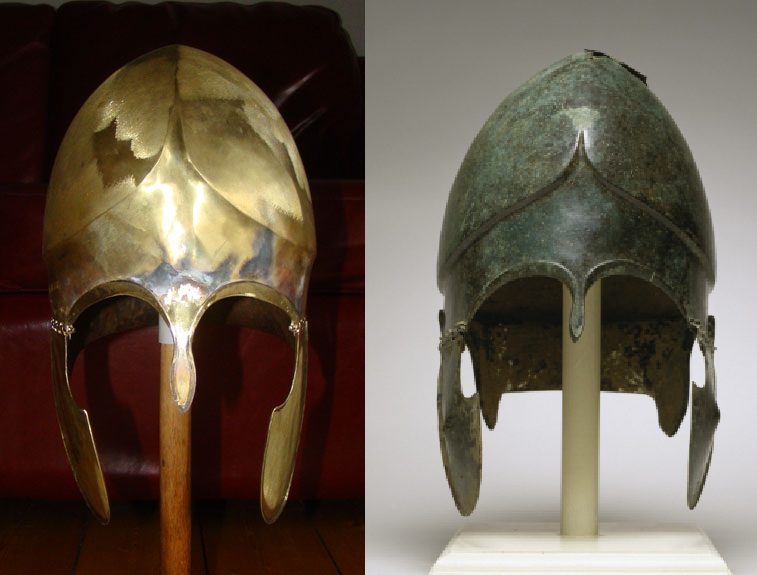
The original (Walters Art Gallery Baltimore) with the reproduction from Manning Imperial

And finally, Simon blogged about this today too. You can read his version here!

crest side

What the Walter’s helmet probably looked like, brand new. And I’ll be wearing it in 10 days, at Marathon!

And tomorrow, a Drear Wyrm blog!

Pen and Sword II LAST CHANCE

Standard

IMG_1185

On November 2nd, 2015, I will again lead a hardy band of adventurers through Greek history.  Well, and possibly some ouzo…

This year, following the recreation of the time of the Battle of Marathon at Marathon, Greece, (October 29th – November 1st, 2015) we will visit Athens for some great museums and possibly some examinations of the current refugee crisis; we’ll go to Corinth and see both wineries and fortresses (and the site of a coming Tom Swan adventure and a past Tyrant episode) and then we’ll take our beautiful and luxurious bus (it really is like traveling in a land yacht) through the Peloponnese to Nafplion.  For those interested, the Peloponnese is ‘Morea’ in my Red Knight books.  Nafplion has another superb fortress, as well as a fantastic museum full of Bronze Age through Medieval artifacts, great restaurants and is sometimes called the ‘Venice of Greece.’

We’ll also visit Sparta and Mystras (where Tom Swan is headed right now) as well as Olympia, home of the Olympics, site of several scenes in the Long War, and possessor of the best collection of Archaic Greek armour in the world.

Pen and Sword at Plataea in 2014...

Pen and Sword at Plataea in 2014…

We’ll also visit Delphi and the oracle, as well as the battlefield of Plataea (which we will cover in some detail, because I’m about to write a book about it…) and there will be daily swordsmanship classes from yours truly (Italian long sword this year) and probably some dabbling with spear fighting as well; superb food, a professional wine ‘steward,’ (actually another guest who’s volunteered, bless him) four and five star hotels (really, the hotels were amazing every night last year) and best of all, good fellowship.

Come and participate!  Cost is about 1200 euros plus your own airfare to Greece.  That’s for ten nights and eleven days; about $150 a day, with most of your meals provided.  There’s a great tour guide (besides me) with a PhD in Greek history; multiple Greek speakers, and…  it was the most fun I had last year.

If you are interested, please contact me immediately. BTW, I make no money off this.  It’s really just fun.  And who knows..you can end up a character… (see my last blog).  You can see a great many of the locations for all my books and stories, and you can help me figure out all the locations for the Battle of Plataea.  And in the area around Sparta, I’ll be looking for locations of Philopoeman’s battles for a not-so-secret future project.  Right, Simon? 🙂

Please come!

Christian

PS Just finished Tom Swan 14 and Tom Swan 15, now into the publishers; they are parts 1 and 2 of ‘Tom Swan and the Last Spartans’.  Meet Scanderberg, fight the Turks, deal with papal corruption.  All in a day’s work.

Today, when I complete this little blog, I start William Gold III ‘The Green Count.’

And after the tour, I’ll begin ‘Plataea,’ the culmination of the Long War.  Busy, busy.

Favorite Historical Period

Writing about Friends

Standard
Robert Sulentic in purple.

Robert Sulentic in purple.

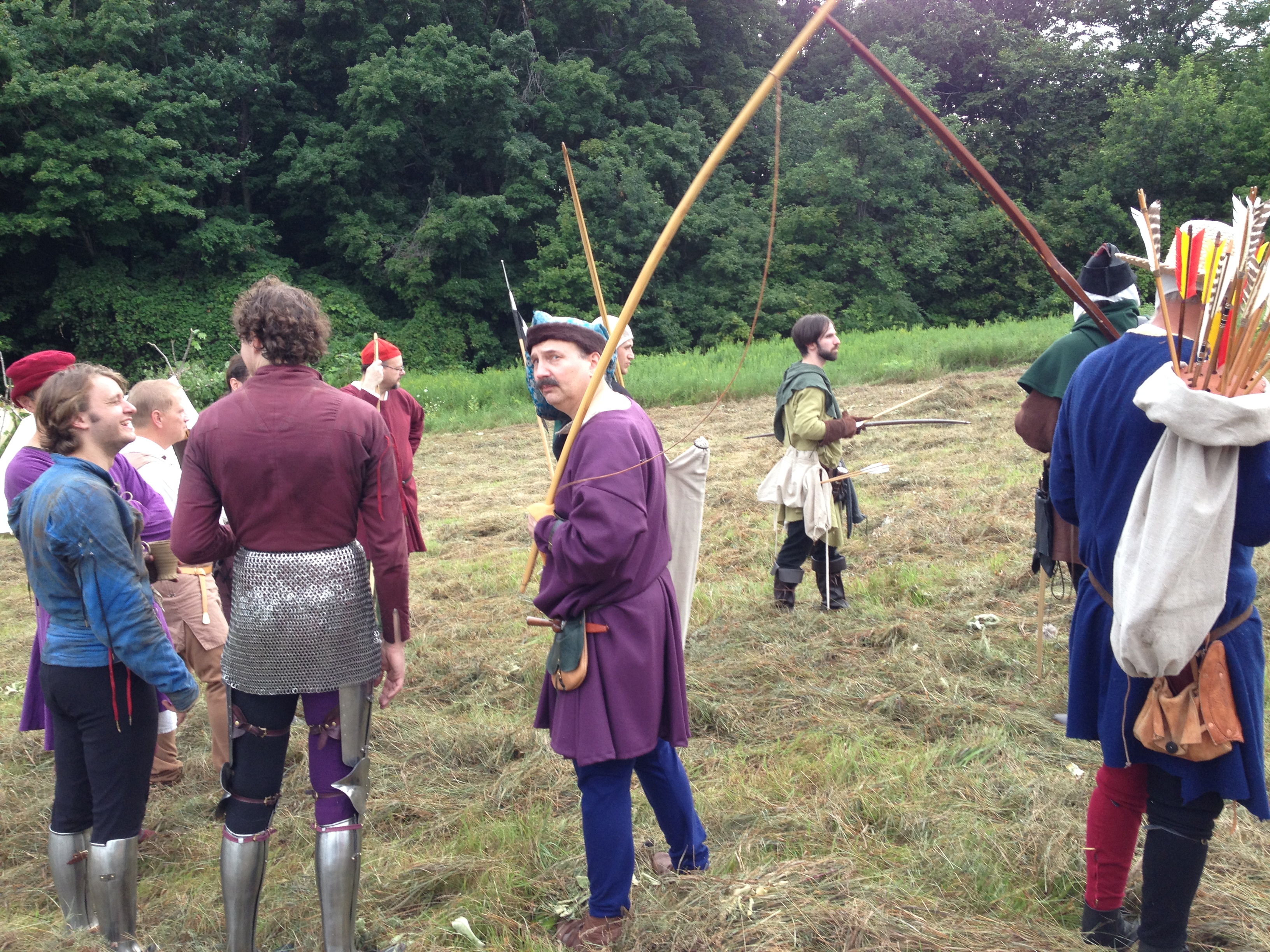
The archer in the purple cote is one of the best reenactors I know.  His name is Robert Sulentic, and he’s one of my oldest friends.  When he and another of my oldest friends, Steve Callahan, joined our Medieval ‘Compagnia’ I knew we had a going concern.

I think I’ll try and explain why, and then talk about how they, and other friends, influence writing.  But look at the picture and try and guess which character in the Red Knight is based on Robert.

Aurora Simmons

Aurora Simmons

This is my friend Aurora Simmons, featured elsewhere on my blog as a craftsperson.  Also one of the best reenactors I know.  Also a major influence on writing.  Again, have a guess which character she might influence.

Hint?

Look familiar?

So… here’s the thing.  Almost EVERY character in my books is based on a real person.  In fact, I can’t imagine how people write ‘made up’ people.  I will confess that when I started writing, I would klooge people together; I’d say ‘Well, that’s this person’s macho with that other person’s intellect.’

But that turned out to be very, very artificial.  It turns out that each person represents a sum of all their experience and genetics, and you can’t pick and choose.  In effect, we are what we are.  To be totally trite, beauty (and ugliness) carry consequences.

Scars carry consequences.

Killing people has consequences.

Participating in war has consequences, and committing war crimes on a regular basis has consequences, and having sex — good or bad, casual or committed, gay or straight — has consequences.

I’ve known people who’ve done all those things, including the war crimes.  I have, in fact, met whores with hearts of gold, but they were tough people who had managed to remain unscarred by horror.  I have yet to meet a person who committed war-crimes and is still affable and preserved any virtue.  Most are severe paranoids who justify their own sins by imagining the sins of others. And hating.

This matters, for the writing of character.  For the creating of ‘bad guys’ and ‘good guys’.  Before I go on, let’s look at good guys and bad guys a little.

Modern politics, you may notice, is a sort of theater of the real almost totally devoid of good guys and bad guys.  Now, I note that many readers like to imagine that some political viewpoints are superior to others, and I further note that modern day Americans (especially) have a habit of pretending that one side is ‘stupid’ while the other side is ‘right’ but I have to note that there’s no historical evidence to suggest there’s a sign of ‘good’ or ‘bad’ to any political party in history going back to Ancient Athens, but there’s an incredible amount of venality, greed, propaganda, and self-serving crap dished out by every political party that’s ever existed.  So in my fantasy worlds and in my historical, I try to eschew ‘Persians Bad/Greeks good’ because I don’t see a sign of that.  ‘French bad/English good’ is equally asinine.  I try to give Aristides and Themistocles equal time to be ‘great’ (and to spout crap) because that, to me, is how people work.

I have met two presidents and briefed one.  I have spoken to Margaret Thatcher; listened to her outline war policies and strategy to George Bush (she was at the time a private citizen).  I have listened to innumerable admirals and generals debate pretty major military decisions.  I’d love to meet the current pope and interview him.  Mostly for my Tom Swan writing.  He’s hardly the first liberal pope…  he’s in a great historical tradition.

But as usual, I digress.  Maybe I need a separate blog on bad guys.  What I meant to say is, ‘bad’ is a limiting factor, because when people go ‘bad’ as in child raping, war-crime committing bad, usually they just planted the seeds of their own destruction.  Not to mention that, unless there are very special circumstances operating, stupid, ignorant, bigoted people make poor leaders and usually get a knife in the back.

All that said, my ‘bad guys/girls’ don’t come from my friends.  or from people I disliked.  Sadly, they come from me.  Mostly, I think of what I dislike most in myself and embroider like mad, which is deeply annoying.  If you read ‘Alexander, God of War’ a lot of what’s awesome about Alexander comes from an incredibly gifted squadron commander I knew, but the dark, nasty parts are all me.  Mmmmmm.

But today was meant to concentrate on the ‘band of brothers and sisters’ with whom I generally surround my protagonist/s.  And this is where I get to ‘writing about friends.’  Because the protagonists friends are going to be the points of view through which we most especially see our hero or heroine, and because they reflect her and reinforce him and yet need to all have their own story and their own reference and motivation.  And this is where only real people can provide the delightful inconsistency and rich, confusing melange of behaviors that make characters fun.

Side note…  someone said in a recent amateur review that a particular character was inconsistent… I laughed out loud.  Maybe because I’m 53 I’ve discovered that most people are touchingly inconsistent and I want to say so in books…  but anyway….

Anyway, who on earth do you write about EXCEPT your friends?  Who do you know well enough to realize as characters?  Who do you know happy, sad, angry, calm, joyful, enraged…

Me and Greg Mele

Greg Mele.  Well, the green chap is me.

Friends, that’s who.  I sort of have a warning now, like, ‘You know, now that I’ve spent a week camping with you, I suspect you’re going to crop up in a book.’  Above, that’s me in Green with Greg Mele in red.  Actually, just at that moment, I guess he was the Red Knight.  Anyway, we’re friends now, and suddenly he’s cropped up in a book.  Not as the Red Knight.  And rather on purpose.  You can get to know people very quickly when you fight with them.  It’s very… intimate.

Red Knight 0816-33_zpskba8ndbr

And back to Bob.  Steve cleverly avoided being in all these photos…  anyway.  Bob contributed most of No Head, although he has contributed to Cully, with my author friend Mat Heppe.  (See, I still sometimes do the patchwork thing.  Hmm.)

Why does it matter?  Well, let’s try a few authorial thoughts.  A Mercenary company has hundreds of people in it, and if you render them faceless, it’ll seem wrong.  In fact, the process of command is literally not much more than knowing all the people who work for you, and little things, like the constant loans John Hawkwood paid out, and how much time he spent on ransoming his people, tell me he worked hard for his troops.  I want you, the reader, the get the casual intimacy of a well-run military unit; the way people begin to build identity on membership, on shared experience.  I can only do this with a big cast.

At the same time, the characters have to have some individuality.  How?  I mean, really, when you say ‘and then there are 200 archers’ how on earth do we give them individuality?  they are archers, for goodness sake.

Names help.  Cool names, that are short and easy to remember.  I really am not good at this, because I like historical names and I love Ancient Greek.  Sorry.  Really.  But all my archers are named after the stray cats in our neighborhood, and each name on the roster…yes, I have a roster… is associated with one of my friends.  This helps me in so many ways.  Short or tall?  Snappy dresser?  Shines his kit?  Treats his kit like crap?  Late for parade?  On time?  Temper?

See?  I just created a company of mercenaries.

Ok, it helps that many of my friends are military veterans, and it also, to be honest, helps that they’re all reenactors and they are patient with me…

Sorry I wasn’t kidding about cats, and if you think a second, there’s Bad Tom, Long Paw, No Head…

Guess which character HE is?

Guess which character HE is?

But No Head has Bob Sulentic’s body, his sense of humour, his interest in engineering, and in fact (I asked permission before writing this blog) I just borrowed the story of how he met his wife for No Head in book four.  This allows No Head to be more than a cardboard cutout of a character.  It allows him to live and breathe, to make decisions, have motivations, and I always have a yardstick by which to measure the character.

And then there’s killing your friends.  My buddy Jevon…

968811_10201860558498173_363709874_n

… he died in Washington and Caesar, and he was not pleased.

_MG_3929 sml

Jenny Carrier is not just a friend but the daughter of an old friend.  Her character got to die in childbirth.  I didn’t know at the time that she was pregnant.

Ok, that was dumb.

Luckily, they all still speak to me…  and go to reenactments.  And go camping.

Thanks, friends.  Without you, I’d have nothing to write.

Oh, last bit… Bob Sulentic came to the deed with a purple cote.  It’s very interesting, visually; authentic, but very visible.  Now No Head has one too.

See?

Catch and No Release — Fly fishing, writing, and the Wild

Standard
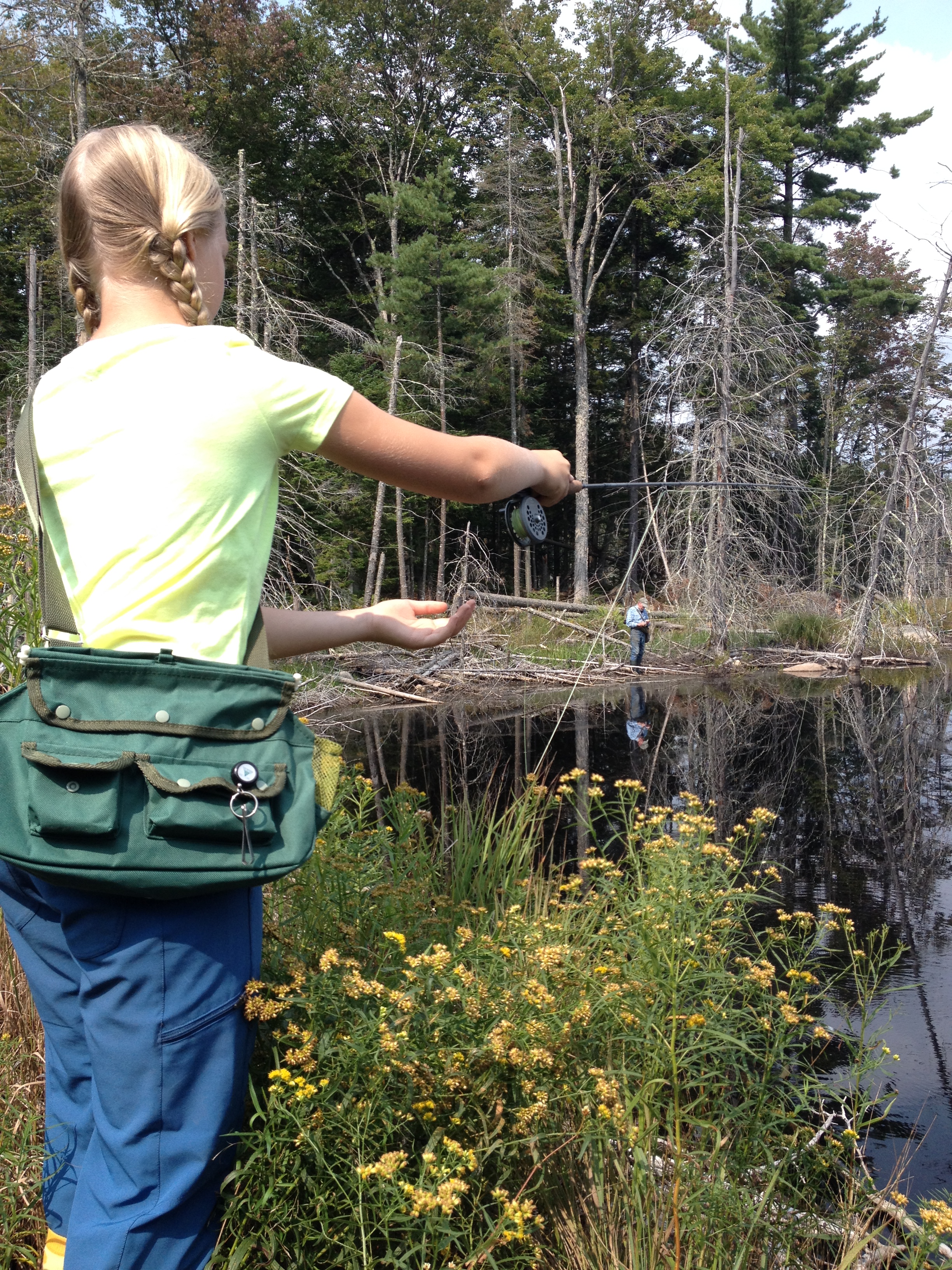
My father and daughter, fishing

My father and daughter, fishing.  Bea is standing on the abandoned beaver house.

Yesterday, I was standing on an abandoned beaver house, several miles deep in the WIld (the Adirondacks), teaching my daughter to fly fish in the ungroomed conditions of a totally wild beaver pond. (aside — right now, at least two of my friends are asking ‘where was I, Cameron?’ with blood in their eyes…)

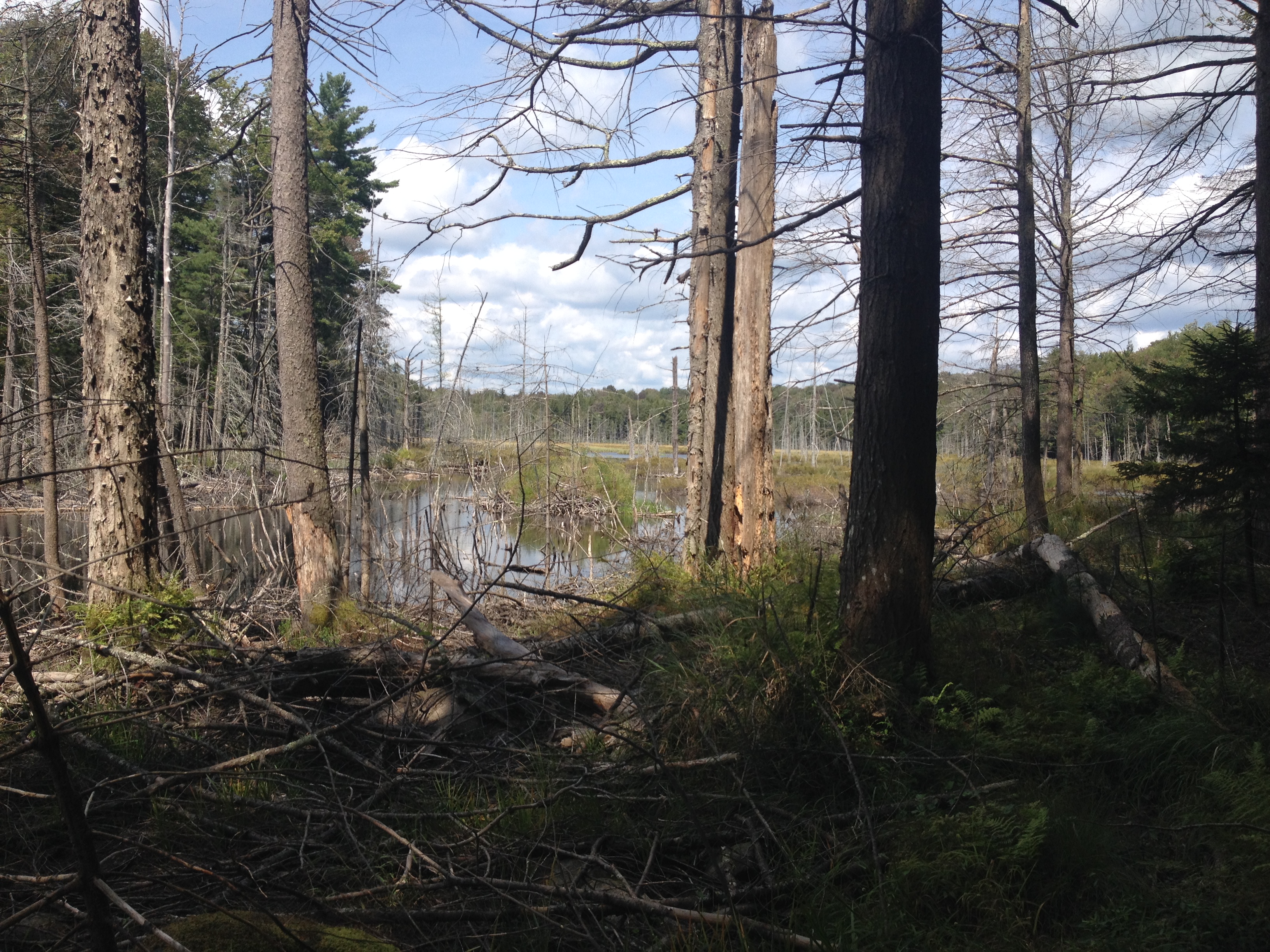
Mostly by luck, we stumbled on a pond caught in a particular moment in it’s transition.  The beavers are gone; they’ve moved upstream.  But the fifty meter long dam they built is mostly intact, and had held a serious head of water in the meadow; more importantly, this is part of an old recurring cycle in this little valley, and the beaver have been here before.  A cold, fresh, year ’round stream keeps the water clean.

So there are trout.  Spectacular, unstocked native brook trout.  At this time of year, they glow with vitality and the males have red bellies and all of them are fat and very, very tasty.  Finding this particular fishing spot took luck and years of hiking on the nearly trackless ridges of the southern Adirondacks, and next year, when the spring melt breaks the damn, the pond will be done.  I was there to have my daughter and my father spend time together.  By luck, we caught that moment…

But for two days in August of 2015, the fishing was…incredible.  For about fifteen minutes, any fly that hit the water was taken by these lovely, amazingly tough fish who are usually so shy and careful.  My hands shook with excitement, but my casting remained accurate.  It was incredibly like a good sword fight.  No, really. And there’s more allegory to come…

My daughter caught her second…and third, trout.  My father, a superb fisherman of some eighty plus years, caught trout until he was bored.

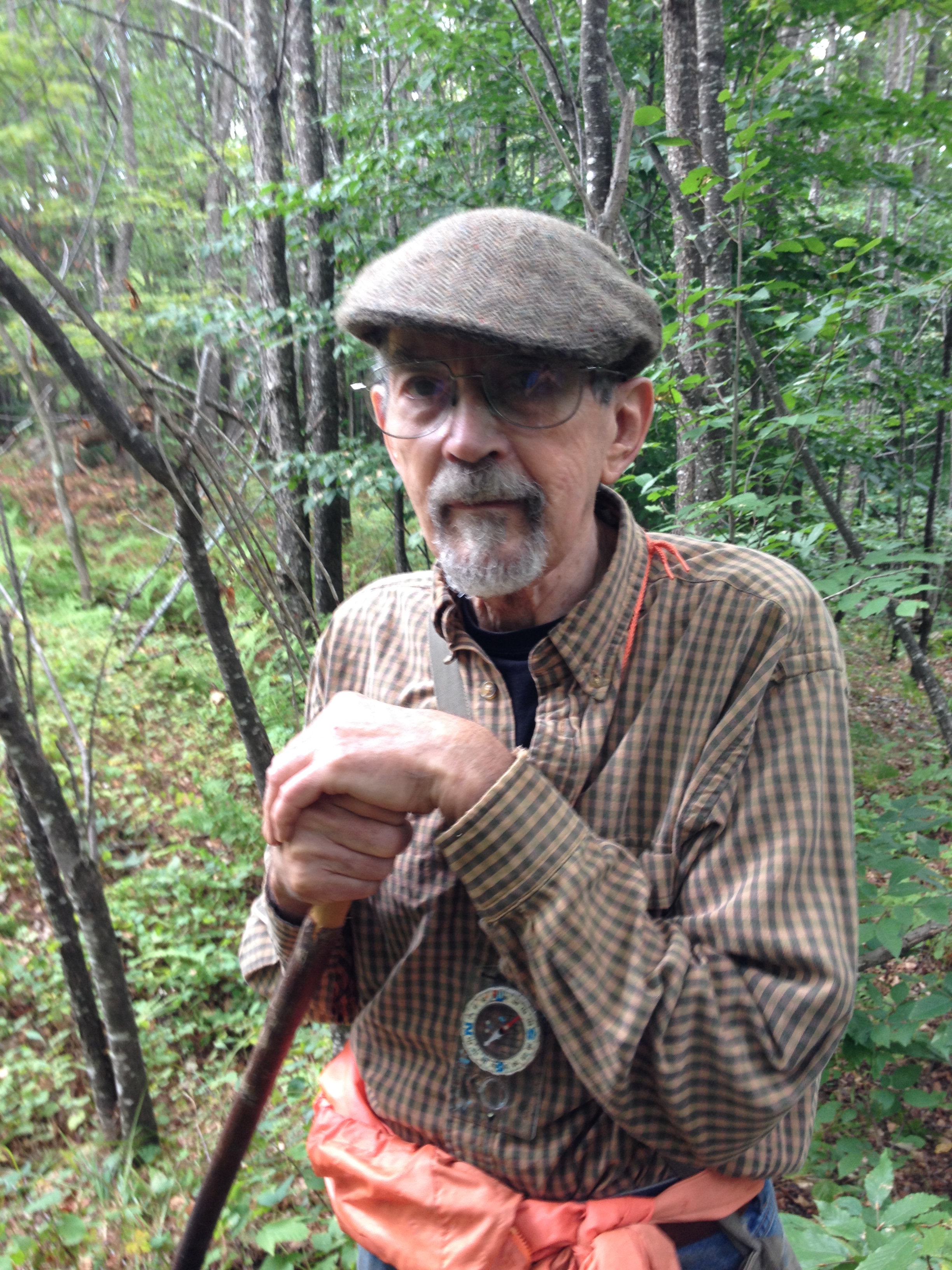
My father, author Kenneth Cameron, who in addition to having written more than twenty books is an avid and expert outdoors-man and fly-fisherman.

My father, author Kenneth Cameron, who in addition to having written more than twenty books is an avid and expert outdoors-man and fly-fisherman.

Myself, I caught five.  Three I returned, One swallowed the hook and had to be killed and one spectacular fourteen inch fish was lunch.  Dad killed two more twelve-inch fish.  Also for lunch.  Bea elected to eat her first completely solo catch, but we… ahem… dropped her fish in the water.  Not her fault.  Adults…  trying to help.

Anyway, my point is about the authenticity of experience and what ‘sport’ is.  Perhaps what I want to say applies to martial arts as well.  I suppose I will offend some trout fishermen, and I’m sorry.  I do not write to offend.

Aside… if you don’t fish… catch and release is a policy whereby fishing is only done to land the fish and the fish is then returned to the water with as little handling as possible.  The idea is to keep fish stocks strong, but in fact, so many fish die from being caught (in Yellowstone National Park, for example, fish are caught twelve to twenty times a year) and exhausted and handled that more fish have to be stocked every year.  Not native fish, but hatchery fish.  Who are, of course, quite easy to catch, as they’ve never been in the wild.

I do not understand ‘Catch and Release.’  I understand ‘catch and eat’ and I understand not taking too many fish.  The two I killed represent all the trout I will kill this year.  I put back others…carefully… because I didn’t want to eat them, but I wouldn’t fish if I weren’t going to eat.  I’d just leave the fish, or the deer, in the Wild.

To go to the trouble of walking several miles into the wild, to manage to catch fish in a beaver pond, which is a nightmare of deep and shallow, of underwater sticks from left-over beaver-feasts just waiting to take your fly; to catch a fish under these conditions, to drag it across the pool and LAND it (when it wants to swim under the sticks and break your line) and THEN let it go…seems odd, to me.  Why not just sit and watch the beautiful fish rise?  Why… pretend?

Adirondack beaver pond.  Note the casting conditions.

Adirondack beaver pond. Note the casting conditions.

Catch and release… on groomed rivers with tended banks and stocked fish put there so that fishermen can catch them…and release them…  is a sort of simulation of a nineteenth century aristocratic pastime, isn’t it?  It maximizes the display of equipment and ‘skill’ in fly-tying and presentation of the fly and use of the right, very expensive net.  And of course, no gets messy with blood, and everyone is far too rich to need to eat the fish.  It proves one’s social status without providing any danger or foolish degrees of difficulty.

Yes, I mean this as an allegory about certain martial arts.  But I mean it about fly-fishing, too.

Myself, I take joy in hunting and fishing, in being, however temporarily, an apex predator, and in consuming the result.  Few experiences in the world can equal the moment when a big trout takes the fly.  The fly you made; the cast you made.  But I can tell you one thing better; eating the trout you caught.  Of course, you have to get messy with the blood, and you have to confess to yourself that you killed something beautiful and wild.  To eat it.  And finding a wild trout pond in the wilderness is far more work than the fishing can ever really justify, unless you love the authenticity of the experience.

I imagine that this could all be said in some hyper-macho tough-guy way.  Actually, I don’t mean it like that at all.  To me, it’s simply honest.  This is who we were, certainly, and to some extent, who we still are. Predators. It helps me understand the past; it helps me understand why people kill people and animals.  It helps me create the Wild in my fantasy novels (where I’ll note that Ser John Crayford is an avid and authentic trout fisherman…. That’s not really a spoiler, but you’ll find a fishing scene early in Dread Wyrm).

About five hours after we caught all those fish, my daughter and I went for a late-night walk to see the full moon.  (In deep woods, you have to find a clearing to see the moon).  While we walked, coyotes bayed at the same moon, a chorus of predators, and then, to our surprise, something very large moved very quickly through the dark woods to our left.  A bear.  We were not seriously threatened.  Adirondack black bears are very polite.  But… we were not the only predators in those woods, and that is also a useful lesson.

We moved very rapidly back to our nice fire….

A good reminder.  The Wild is still out there.

They don’t catch and release.

The Deed of the Red Knight and ‘Messenger’ part II

Standard

Martial Arts

This week I help run my Mediieval tournament, with about 80 friends.  We’ll have archery and fighting in and out of armour, music, dance, a lot of cooking and a camp full of ‘pavilions, tents and booths’ to quote Villani.  I promise a full update when I return.    We’re at the Rose House Museum and all are welcome, Saturday and Sunday, 11 to 4 PM.  My friends from Schola Magdalena will give a concert at 4PM on Saturday, August 15th as part of the tournament… In the mean time, as promised…

The Messenger’s Tale
Part Two
Miles Cameron

Daar as Salaam – Pavalo Payam
The Abode of Peace was the fairest city in the world, or so Pavalo still thought many years later. It had problems – like heresy, vice, theft, riots and murder. A city with half a million souls did not escape the touch of evil. But Daar lay at the centre of the world – a magnificent city built atop the ashes of Rhuma’s ancient rival, Kartagho. And men said another city lay below that, a city of twisted tunnels and great menhir’s covered in lines that seemed to writhe like worms.
Daar as Salaam sat snug behind its two magnificent harbours on the northern coast of Ifriqu’ya, a vast land of desert and forest and steppe that stretched away to the south farther than most cartographers could imagine. The Abode of Peace – the richest city of trade in the known world, except perhaps Venike, its rival and ally – was protected from the vast and absolute sway of the Wild by a girdle of desert so wide that even the mighty Umroth and the Not-Dead could not easily cross it. All the same, the Sultan maintained powerful armies and mighty sorcerers to deal with the trickle of fiends and monsters who survived the journey – a trickle, but a relentless trickle that sometimes became a torrent, as if their arrival were some natural event, like flooding in the great Nilus to the east, the border between the Ruined Lands and the lands still held by men.
Pavalo Payam was one of the men who defended the city. He was tall and slim; his shoulders were broad and his waist was narrow, and the muscles of his arms and legs were like ebony: solid and hard. He was famous for his speed, his agility and his strength; his deep brown eyes sparkled with wit and he was a teacher of the Dance of the Sword. He had been taken by the Devşirme – the inspectors of children – when he was so young that his memory of his mother was a lost blur of warmth.
His master was not a swordsman. Pavalo ’s master was a great man – famous throughout the world and revered in his city. He had written three great books – a monumental commentary on the law; a treatise on the foolishness of the study of ancient philosophy; and a second treatise on the foolishness of failing to study the ancient philosophy. All three books were internally coherent, and each of them conflicted at some level with the other two – a paradox which most educated men found delightful rather than heretical. He had a great name to go with his greatness: ’Abū l-Walīd Muḥammad bin ’Aḥmad bin Rušd. Men called him Ali Rashid, and his followers, Rashidi.
He was a mighty worker of miracles, and some men thought he was a prophet. He also defended his mighty city from the assaults of the Wild, which he had studied throughout his life, and trained young men like Pavalo Payam to go south, into the Wild, and return alive, or East, into the Ruined Lands—for manuscripts and artifacts from the ruins of many pasts.
But now he was dying. His lungs were gradually filling with fluid.
Ali Rashid was a man of honour and he did not intend, at least at first, to use his arts to prevent death. His mind was clear on this – that to rob death was to open himself to evil. He also knew there was another path open to those of immense power – a sort of transcendence that left death behind. But he had also studied his necromancy. He knew the snares of the enemy.
Rashid loved Allah with the same gentle spirit of curiosity and respect that he loved Aristotle, and he didn’t want to become a petty god through apotheosis, either. He turned his back on transcendence at the end of a long life, and began to compose himself for death. He used his medicine and the hermetical arts to make himself as well as he could manage, and he made his preparations with the same resolution with which he had faced journeys to the ruins to the east or the south, or into the great Quen’ya, the highlands that he suspected hid some of the many secrets he had spent his life seeking.
He wrote a great many letters, and had a great many tearful conferences, not the least of which was with the Sultan, who had inherited the greatest magus in the world along with his great city and his mighty army and enormous fleet. The Sultan wept but left consoled, and with a list of excellent young men and women who could fill the master’s slippers.
Pavalo was aware of this, as he was aware of all the comings and goings of his master’s house. He was two weeks returned from the east, deep in the desert on the banks of the Nilus where he had protected twenty men who had dug a tunnel into an ancient library.
He sat in the yard in a light cotton shalvar and a gomlek of the cheapest material, working his long, slightly curved sword against a stone held by a slave. He had faced six ghulami – the Necromancer’s slave soldiers – who had begun the contest dead, and he had left them that way. But his magnificent sword – the only article of value that he owned, excepting his armour – an artifact of a bygone era, the joint creation of smiths and Hermeticists, had taken a deep nick, and the blade seemed to be very slightly bent. A bend so very slight that Pavalo only saw it the way a woman who lived on her beauty might sense the first signs of age under her eyes.
He used the stone sparingly. When the call to prayer came, he walked away from his sword and went to the mosque whose minaret towered over his master’s house. There he knelt on a plain carpet and made his devotions, his mind clear.
On the way back to his master’s gate, small boys followed him calling his name, and twice he stopped to duel with them – his bare hands against their sticks. In each case, grinning broadly, he’d slip in and slap them lightly on the back as he passed, and leave them smiling in childlike disbelief.
They called his name – Pavalo , Pavalo ! – at his back.
When he came to the gate, the master’s chamberlain, Boscar Effendi, was waiting under the awning. He’d worn the same offensive patchouli scent for all seventeen years that Pavalo had known him and was, despite the smell, honest and gentle and fair. The man was a Trinitarian heretic, but was otherwise inoffensive and civilized.
Pavalo, despite being a hero whose name was spoken with reverence throughout the city, was junior to the fat chamberlain who was unknown outside the gate. He bowed low.
Boscar returned his bow. ‘The master asked me to send for you as soon as you returned from prayers.’ He smiled. ‘I hope that you are unscathed by the many small assassins in the streets.’
Pavalo nodded. ‘Only just,’ he said. ‘How is he today?’
Boscar was not trained to face the Umbroth without flinching. He turned his head away and his voice was choked. ‘Fine,’ he said. ‘Dying. Oh, my boy – why will he not save himself?’
Pavalo had no answer. ‘I will go,’ he said, and put a hand briefly on the Christian’s shoulder. The fat man had taken a four-year-old boy from the Devşirme and had, in many ways, raised him. It was hard for Pavalo to see how old Boscar really was, and how afraid he was of their master’s death. And his own.
Pavalo had been trained to read men’s faces and bodies the way scholars read books, and sometimes he learned things he did not wish to about the people he loved.
He settled himself, and went to the workroom, which they all called the Chamber of Secrets, some in awe, and some with the humour born of long experience. There were no secrets there for Pavalo. His master lay on a couch surrounded by mechanisms and books and scrolls. The title – Chamber of Secrets – had once held great terror and great mystery, but Pavalo had now spent so much time there – it was really a whole wing by the south end of the courtyard – that he didn’t consider the title anymore. It was just a library.
His master was propped up on pillows, gazing through a glass window whose shutters were thrown wantonly back even though it was a hot summer day outside and all well-conducted houses were shut up like fortresses to protect what little cool air they had.
Rashid watched the world, as he had all his life.
He smiled at the black swordsman when the younger man glided into the room.
‘There is nothing more important for a human than to see what is, and not what we might suppose there is,’ he said.
Pavalo bowed. ‘The Holy Koran?’ he asked doubtfully.
Rashid laughed. ‘I think not.’
‘Aristotle?’ Pavalo asked.
Rashid shook his head. His mouth formed a smile that was almost a sneer – a firm negation.
‘Your own?’ Pavalo asked.
‘Ah! What flattery,’ Rashid said. ‘Thales of Miletus. Listen – the item you brought from Theves was worth—’ He paused to cough. ‘A great deal. Pavalo —’ He looked at the younger man. ‘Ah, I cannot excuse myself to you. Listen. I have a mission for you – a message you must deliver.’
Pavalo didn’t have to draw himself up to stand straight. But he loved his missions. He nodded agreeably.
‘You must take a message to a man who is, as far as my workings can see, dead.’
Pavalo nodded. ‘Yes, Master.’ In five years of desperate and dangerous missions, his master had never sent him to do anything impossible – merely a series of things that would have appeared impossible to others.
‘Do you remember the Frank who came, when you were a boy? You found him in the market?’ Now the master’s eyes bored into him like the eyes of an enemy in a duel.
Pavalo nodded. ‘Magister Harmodius?’ he said. He paused. ‘He is dead?’
Rashid lay back and coughed. ‘One set of my arts tells me he is dead; another suggests he is not. I would say, if I didn’t have other evidence, that he worked in the aether less than twelve hours ago. But the link between us is severed – has been for many years.’ He pushed himself up. ‘Infidel and unbeliever as he is – if he lives – he must be told what we have learned.’
Pavalo was not a mindless servant. He was deep in his master’s councils, and he paused. He remembered the Frank with pleasure – the man had lived with them for months, and left a houseful of friends. Which was odd, as the Frank had tried to kill him when first they met.
‘Why Master Harmodius?’ he asked bluntly.
Rashid sniffed delicately, took a difficult breath and snapped a working into the alembic by his head, and the glittering globe of filigree and crystal over his head began to turn – and to emit, rather than reflect, light. That was the only effect Pavalo could see.
‘Listen, boy,’ Rashid said. His voice was low. Pavalo had the notion that the rotating globe was some sort of shield or protection, but he was not attuned to the hermetical world – indeed, several of the master’s apprentices had said that he was unusually blind to it.
‘You know that I suspect that the world is not entirely as it appears,’ he said.
Pavalo smiled. The statement might have been his master’s true signature.
‘We study the world. A few of others – workers like me – use their observations to refine our knowledge of the natural world. Do you remember the phrase “Natural phenomena must have natural causes”?’
Pavalo nodded. ‘I do,’ he said. He didn’t add, I’ve only heard you say it every day of my young life.
‘I lead a group that studies these things.’ His master met his eye. ‘You know all this. You went to Cervilla for me, to Master Mamonades.’
‘Yes, Master.’ Pavalo knew that his master was a lecturer. Everything had to be traced to first causes.
‘Master Mamonades was killed by assassins. Two years ago.’ Rashid stroked his beard.
Pavalo knew a moment’s fear. ‘The same assassins as came for you?’
Rashid shrugged. ‘Friends of mine in Cervilla began inquiries, and most of them are now dead or have simply disappeared. While this is germane to the larger problem, it is not essential to your mission. Merely that Master Mamonades is dead, and thus he cannot receive the information I have learned. Only Master Harmodius seems available – only he is strong enough and wise enough to receive this. If he is indeed dead—’ Rashid shrugged. ‘Well I do not believe it. I believe he is hiding.’ He held up a scroll tube of plain cedar, and a ring with a marvelous faceted yellow stone.
‘The ring will take you to Master Harmodius,’ he said. ‘Look into it.’
Pavalo stared into the ring, and saw the merest flicker of aethereal light in one tiny facet. He nodded. ‘I go in the direction of the light,’ he assayed.
The old magister nodded. ‘I made it as bright as I could, seeing as you are so blind,’ he said. He smiled. ‘The scroll is the most important of the documents you brought from Theves. For what it is worth: the Necromancer does not know of it, but if he found out he would stop at nothing – nothing, you hear me? – to obtain it.’ His voice took on a grim note. ‘Nor would any other magister, great or small. The information on it—’ Rashid coughed.
And coughed. The coughing went on and on. At first the old man held up a hand for his listener’s patience, but eventually the hand went to his stomach.
Pavalo broke his reserve and went to his master’s side, but that only embarrassed the old man, who shook his head violently. Eventually, the coughing subsided. Pavalo poured lemon-scented water, and Ali Rashid drank greedily.
He raised his hand. ‘It is odd—and marvelous. I’ve had everything I’ve ever believed confirmed, and then discovered that this confirmation was not devoutly to be wished after all. Is it not strange? I have been guilty of hubris all my life, and look – my arrogance is justified.’ He coughed again and managed a smile. ‘Listen, boy. This is more important than me or you. It is, like many things, nothing – or it is everything. Take it to Harmodius. If for any reason you cannot . . .’ He shrugged. ‘Destroy it. Pressing three times, rapidly, on the lead bead in the cap here, will reduce this scroll to ash.’ He looked up. ‘Understand, boy?’
Pavalo nodded. ‘Yes, Master. I will not allow the Wild to stop me.’
Rashid sighed. ‘You know what, my young friend? It is not the Wild. It has never been the Wild.’ He looked out the window. ‘All my life, I have fought the Wild. And now . . .’ He shrugged.
Pavalo thought of the undead ghulami and their whirlwind of blows – their smell, their alien motions. Their connection to death. ‘Not the Wild?’ he asked.
‘The Necromancer is not of the Wild,’ Rashid said. ‘What if I told you that men came from the Wild? What if I said we have allies in the Wild, as well as enemies? What if I told you that good and evil have nothing to do with Man and the Wild? What if I told you that, severally and together, none of us started here—in this place, in this sphere—not the Umroth, not the winged assassins, and not men.’
Pavalo shrugged. ‘I would say I have had these thoughts before, and kept them silent.’
The two men were silent for a long moment.
‘Bring me your sword,’ the master said.
Pavalo went out into the yard, and reclaimed his sword from the rack on which he’d left it while he prayed. He brought it into the Chamber of Secrets, and found his master on his feet, wearing a robe.
‘Artifacts of the Golden Age are too precious to waste,’ he said. ‘Listen, my boy. I will endeavor to stay alive until you return. The ring will allow me to trace you. Perhaps I will be able to help you.’ He smiled to himself. ‘It is seductive, to have a great mission that requires me to live. I will do a dangerous thing. Let us see if I have the power to undo it later.’
Pavalo nodded. ‘So all I need do to keep you alive is to stay away?’ he asked.
Rashid put a hand on his shoulder. ‘The Necromancer was once like me – a great magus who loved god and served his people. And then his wife grew ill, and she was beautiful, and he saved her. In saving her, he learned something every great magus learns at a certain point; knowledge he did nothing with. But when the Umroth War began, and his king begged him to help, he used his arts to prolong his own life. He turned the tide against the Umroth, and saved Man. But in doing so, he became what he is.’
Pavalo thought for as long as it took him to light six tapers. ‘Yes,’ he said finally. ‘I understand.’
Rashid nodded. ‘Good. I need you to understand, and to help me be strong. I am only a man, after all. Now your sword. A Fell Sword,’ he said. He took the sword and held it aloft, then laid it on his workbench. ‘One of the Six. I wish I could show you what I see,’ he said. ‘Ah. And it was a mighty curse that did this damage.’ He raised his right hand, and even to Pavalo’s sight it became a ball of golden fire, perfectly spherical. And then it seemed to form the head of a mighty hammer which the master slammed down on the blade and made it ring like a bell.
The lights in the room flickered, even the actual candles. A Dervish juggling balls of fire in the Sherif’s harem was suddenly left without fire, and the mage light burning over the Sherif’s Holy Koran dimmed. Every practitioner in the city felt the surge of power and the consequent emptiness.
Rashid looked grey but he held the sword aloft again and Pavalo saw that it was once again straight and whole – the natural curve of the blade restored to its beautiful, wide point, and the blade sparkled with minute bolts of white lightning over its surface, as it sometimes did when he drew it from the scabbard.
‘That took enough power to light every fire and candle in this city, every night for a year,’ Rashid said. His skin was pale, but his eyes sparkled. ‘By the thousand names of Allah, how I love it.’ He grinned boyishly, and cut with the sword – at the web of hermetical workings that hung like a dew-coated spider’s web from the mage-lit ball in the ceiling. The sword slit the workings, and the severed half withered like delicate vines in the first hard frost and fell away, while sparks flew from the confounded ends that remained anchored, and then the whole complex working vanished. ‘You may encounter other weapons that cut in the aethereal as well as the real,’ the magister said. He seemed to shrink – his smile wavered. ‘Ah, Allah be praised even in affliction. I am old.’
He handed the sword to Pavalo . ‘Go now, and return quickly so that I may die before the temptation to live overcomes me,’ he said. ‘Or before the enemy eats my soul, whatever I have left.’

A day later, Pavalo Payam stood on the deck of a great ship of Venike, one of the Etruscan traders who came to Dar under the treaties. His three horses were in the hold; his leather satchel held his clothes and his bow, wrapped securely, his armour was sealed inside leather and packed into a wicker basket . The yellow stone burned on his finger, the sword hung at his side and the scroll was in a small bag that he wore at his waist, attached to his belt by fine steel chains.
The Venike gentleman who commanded the great vessel, Captain Parmenio, was only too happy to have a famous warrior on board – even a pagan one – on their journey across the great ocean, bound for Nova Terra and Harndon.

Harndon

The ship – much battered, and with the port side of her bow crushed in by a floating log – made Harndon in early spring, having been at sea without touching land for fifty-six days. They had sailed from Dar to Venike, and Venike to Gades, and lain there wind-bound for weeks. And when they’d finally put the bow out into the storm-tossed Outer Sea, an endless series of storms had blown them south, and then north. They had seen the west coast of Ifriqu’ya and the east coast of Occitan and the ice even further south.
The Veniken captain complained to his passenger that it was as if the daemons of hell wanted to keep the ship from reaching its port. And after Christmas, when the days were dark and the seas towered above the poop and men went on deck damp and cold and came back soaked and frozen, there was exhausted, terrified talk of killing the passenger for his religion.
But the Duke of Venike prized his relations with the Court of Daar as Salaam. The captain put on half-armour, and stood in the door of the main cabin with a long sword in his hand, and the sailors shrugged and went back to grousing and nibbling hardtack.
And so, bailing and pumping, with sailcloth so worn that gusts could rip the mainsail, they crawled into Harndon.
Pavalo Payam liked to imagine, as he did his exercises every day on the pitching deck, that he had bought his master half a year of life. And when he saw a great leviathan rear up in the endless deep and vanish behind them – the ship ripping down a long wave faster than a galloping horse with a fifty-knot wind at her quarter – he suspected that forces far beyond the usual were attempting to prevent his passage.
He prayed to God, and was preserved. And a few days before the heretics celebrated the rising of their dead god, moments after the damaged ship made anchor, he gathered a few meagre possessions and some mighty ones, coated himself in oil, and slipped into the Albin River. He swam ashore in the coldest water he had ever known, regretfully abandoning the one beautiful horse who had survived the journey.
He had to crawl up freezing mud that stuck like glue. He laughed a little, in a mad way, to think that he could die here having survived a thousand supernatural horrors. Drowned in mud flats.
I’m a fool he thought. I should have faced the customs officers.
But he mastered his shaking limbs and dragged himself ashore.
In late afternoon, a lighter man took pity on what he thought was a half-drowned sailor – got him into another waterman’s riverside house. The two men and their wives scrubbed away at the mud-covered, frozen man. It took them time to decide that the mud had turned his skin black, which started a hundred rumours in the port.
But their intentions were good, and he left warmer and better dressed than he had arrived, and he left them several roundels of pure gold. Later that night, when the lighterman’s wife found the gold under a candlestick on her kitchen table, she exclaimed aloud, and it rather added to the unsealy atmosphere of the whole.
Dressed in plain clothes and wearing a hood that hid his face, Payam slipped into Harndon. At the base of Cheapside, he withdrew his master’s ring, and looked at the spark.
Which, to his complete mystification, went out briefly. And then flared like a candle at the last of its wick. And then pointed firmly north.
He smiled. A meal, a horse, and a night’s sleep, and he would be away. He put a hand on the familiar weight of the Fell Sword at his side, and walked on. But the neighborhood was bad, and the light poor, and even as he walked he heard a riot come towards him. Riots were not so rare when the wheat crop failed around Daar, and he first put his hand to his sword, and then considered.
There was an alley to his right. A beggar—an armed beggar of some sort—lay dead, his boots protruding into the alley. The smell of urine was offensive.
Pavalo had a second sense for such places. He looked past the dead man as the sound of running and angry voices came closer. Someone was being hunted.
He reached up and found the place where the cheap roof joists of the last hut along the alley did not quite joint he wall where they overhung, and in one sinuous motion, he was up and crammed into the crack under the eaves. His sword refused his elegant solution and flapped against the wall and he had to fetch it in, balancing precariously on his hip—but he knew he was invisible to any but the most careful search.
He waited.

Continued in Traitorson Book 3 – The Dread Wyrm

The Dread Wyrm — American Cover, and a story you ought to read

Standard

11825748_1026171374094361_6412843765873709931_n

This is the US cover for ‘Dread Wyrm’ which is out October 15th, just released.  It will tie up a great many of the plots in the traitorson series, although, really, it’s only the halfway point.  There are five books, and as I keep saying, I’m just about done with book 4 (Plague of Swords, on page 445 today).

The thing is, though, that there’s a whole sub-plot which ended up on the cutting room floor in books one and two.  The stories from that sub plot have been on my various websites the last couple of years, but now that my traitorson website is gone (it cost way too much.  Apologies) I thought I’d put the stories here.  One this week, one next week.

Why?

Because Pavalo Payam — Ser Palomides, if you are an Arthurian fan — is a vital character (pivotal, even) and he was supposed to be ‘enigmatically’ introduced in Red Knight and then ‘grown up’ and moving towards Alba in Fell Sword.  His chapter was also supposed to tell the discerning reader that Islam seemed to have the same power in the aethereal as Christianity.  Discerning readers can detect some serious background cosmology, as well as another part of the meta-plot.  And some more historical and even philosophical references, just to keep you all entertained.  Here it is.  I’ve touched it up a little, mostly so that the names match the current style sheet.  Next week you’ll get Messenger’s Tale part II.  The rest of Pavalo’s tale is in Dread Wyrm and Plague of Swords and book 5, whatever we choose to call it.  Right now Fall of the Dragons is my fav, but who knows what 2016 will bring?

Anyway, this is free.  Hope you like it.

The Messenger’s Tale
Part One
Miles Cameron

Daar as Salaam – Ifraqu’ya

The abode of peace was the fairest city in the world, or so thought Pavalo. It had problems–like the ignorant pagan currently holding a knife under Pavalo’s throat.

He contemplated mortality. He was well trained to do so, as a slave of the city’s foremost legal theologian. he knew the limits that might be imposed on eternity, and he knew the law.
Neither seemed especially useful, just at the moment.
Luckily, theology was not Pavalo’s strongest suit. At a very young age, his physicality had been seen by the Devşirme–the inspectors of children. He was a Follower of the Dance of the Sword, and he knew fifty ways to kill a man. Sadly, he also knew what the dance master said about this situation.
There is no power on earth that will defeat a dagger at your throat or a crossbow pointed at your head. He contemplated the words of his teacher, and found them wise.
‘I have nothing,’ he said.
‘You lie,’ said the pagan, but he said it with a bored resignation that gave the boy some room for hope.
‘I cannot lie,’ said the young scholar. ‘I am a slave. I have nothing.’
The knife fell away, and the pagan stepped back–overwhelming monster to beaten stranger in a single movement of the knife. ‘Fuck this,’ the pagan said. Pavalo could smell the pork on him–an infidel, perhaps even a barbarian.
Pavalo’s heart pounded, and his hands shook slightly. His master studied this effect, and had a theory that the elevated feeling and strength that accompanied fear and strong emotion was a cosmic fluid generated by violence.
Why do I think of these things?
‘What’s in your pouch, then?’ asked the barbarian. Pavalo thought it odd–he’d relinquished his advantage and still thought that the boy would give in to him.
I could kill him.
But I’m pretty sure I shouldn’t.
In fact, Allah, his master, and his dance teacher were all much in accord about this.
‘I am a messenger,’ he said to the pagan. ‘The pouch contains my master’s message to–‘ he caught himself. The mere fact that his master might send a message to the leader of the heretical Taṣawwufis might be worth money to this desperate man–and might bring shame or discredit on his master.
‘Give it here, then,’ said the infidel.
‘I can take you to a ghahve khaneh and get you food and ghahve,’ Pavalo said. ‘But if you try to take my pouch, I will have to try to kill you.’ He said this with all the seriousness a twelve-year-old can muster.
The pagan looked him over. ‘Pah–I’m not much of a thief,’ he admitted. His mastery of the Avarse was beyond good, for a foreigner. ‘But I won’t beg.’
Pavalo tapped a foot impatiently. ‘I am commanded to deliver my message quickly,’ he said. ‘If you will await me here, I will return before the next summons to prayer and I will share my food with you–as a guest.’
The man leaned back against the white-washed wall, and Pavalo winced, because another man had so obviously urinated there not long before, and the brilliant sun hadn’t had time to make the body-water vanish.
Another thing which fascinated his master–the vanishing of liquids in the sun.
‘I suspect this is the best offer I’ll have all day,’ said the foreigner. He sighed. ‘I will slowly starve while I wait.’
‘Contemplate Allah,’ Pavalo said. And he ran.

# # #
The Taṣawwufi’am lived in a karavan sara by the Great Gate. They had their own mosque and their own teaching hall and their own kitchens where their food was prepared–in common–by the members of the sect. While they were terrible heretics who believed that mere men could directly contact the very soul of Allah and experience it for themselves–a contemptible thought, really, and steeped in the sort of ignorant illogic that Pavalo had been taught to distrust and despise–despite this, their relentless and cheerful good works, coupled with their fearsome reputation as warriors, caused the rest of the city to view them with a benevolent tolerance. And truly, as Pavalo considered their beautiful walls with verses of the Holy Koran painted in magnificent calligraphy, an endless tracery of devotion–truly, the abode of peace was a haven of tolerance for all men. Every sect of al-Islam had a home here and all the people of the Book; Yahadut disputed openly the origins of the cosmos with learned men of the university; there had even, once, been a pair of Trinitarian heretics, friars in coarse brown robes, preaching about the prophet Jesus in the souk, and they had been taken to the palace–for dinner. The Sultan of sultans insisted on tolerance. Even the followers of Ancient Zoraster spoke their principles of Light and Dark to tolerance.
And taxation.
There was an elderly dervish ion the gateway of the karavan sara. He bowed to Pavalo. ‘Welcome, mighty warrior, friend of the prophets, protector of the weak!’ he said.
‘I’m not yet thirteen years of age, and you can keep your flattery for a better man,’ Pavalo replied. ‘I have a message for your lord.’
The old man grinned, and revealed a full set of teeth. Pavalo was well enough trained to note that the old man was past sixty, and yet had the muscles of a well-trained man. ‘We have no lords here,’ he said. ‘Worldly power is often useful, but the titles are empty and vain.’
Pavalo gestured in frustration. ‘Yet you have a leader?’ he asked. ‘I have a message to deliver, and I do not seek debate.’
‘A pity, as I have no where else I must be, and I love to debate with an intelligent youth like you,’ said the old man. ‘Who knows, I might yet learn something.’
‘Who is your leader?’ Pavalo asked.
‘Allah is our leader,’ the man said.
Pavalo sighed. ‘Yes, I might have known that,’ he said. He shrugged. ‘To whom would my master address himself?’ he asked.
‘Very good!’ said the gatekeeper. ‘Now if we might establish who your master is, we might easily send you on your way. But you know,’ and the man’s mahogany face creased in a broad smile, ‘that Allah is your only true master.’
The boy smiled back. ‘That being the case,’ he said, ‘As he is my master and your leader, there is no need for me to deliver my message.’ He turned to go.
The man slapped his thigh. ‘Ah, my pearl of contentment. My master of the thousand and one names! You are the very paragon of reason.’ He snapped his fingers and held out his hand. ‘I will take the message.’
Pavalo looked at him a moment. ‘Are you Sheikh Muhammed ibn Fahd?’ he asked.
The man wagged his head from side to side like an especially intelligent cat. ‘I might be.’
‘You might not be, in which case I would be punished.’ Pavalo tapped his foot with impatience. How would his dance teacher deal with this wooly old man? ‘Haji, may I enter?’ he asked.
‘This gate is open to all,’ the old man said.
Pavalo walked in through the magnificent tall gate, with further Koranic verses written in cursive all along the walls and ceiling–here, the script had been placed on ceramic tiles, deep blue on shining white, and yet the gatehouse was cool and pleasant after the streets. In the courtyard, there were lemon and citrus trees, and the courtyard was dominated by a fountain. All around the edge of the court, save only at the graveled end where there was a stable, was a deep colonnade of arched openings, each pointed at the top and tiled in white and blue. The court was full of men, and even a few women–most of them talking, but a few in prayer or meditation. At the opposite end from the stable a man in a black wool kaftan and boots lectured to a dozen students in light linen robes and sandals.
The teacher wore a sword, and looked, to Pavalo, like a leader. The boy crossed the yard–and heard more heresy in fifteen paces than he’d heard in his whole life.
The man in the black kaftan raised his eyes form his pupils and smiled. ‘Yes?’ he asked.
‘Are you Muhammed ibn Fahd? Pavalo asked.
The man shrugged. ‘I beg leave to doubt it,’ he said.
‘Are you the leader here?’ Pavalo insisted.
‘Allah is the only leader here,’ the man said. ‘I am a poor Commander of Ten–a mere Ghulam in the service of the Sultan. A slave, like you.’ He nodded at the other boys. ‘I have seen something of the world, and I am teaching. Geography.’
‘Where is ibn Fahd?’ Pavalo asked with less courtesy than he usually managed.
‘Wherever you find him,’ said the soldier.
Pavalo wandered the courtyard for the better part of a quarter of an hour, and heard many things that might have delighted or annoyed his master, but no one would admit to being the lord of the house, or to being the notorious dervish, ibn Fahd.
He felt he was being made game of. After some time, everyone smiled at him. They were so friendly he wanted to scream, and he was sure they were hiding their lord, or teacher, or imam or whatever title would, like the opening of ʻAlāʼ ad-Dīn’s cave, cause the residents to tell him where to go.
But it also had the atmosphere of a test, and he knew one of his master’s tests when he came to one. So eventually he returned to the gate keeper.
‘May I try again?’ he asked.
The gate keeper smiled. ‘Always,’ he said.
‘May we reason together?’ Pavalo said.
‘If we must,’ said the old man. ‘Myself, I find Aristotelian logic unsuited the actual lives of human beings.’
‘You are ibn Fahd!’ Pavalo said, accusingly.
The old man shrugged, bored. ‘That was intuitive, and not at all reasonable.’
Pavalo nodded, more sure of himself. ‘Very well,’ he said. ‘My master has sent me with a message for Muhammed ibn Fahd. I am to deliver it to the man in person, and I believe that he is here in this karavan sara. Can you help me?’
The brown man nodded. ‘Yes,’ he said.
‘Will you help me?’ asked the boy.
‘Yes. Where does the reason come into this?’ he asked Pavalo.
‘I thought that you might make me prove my assertion that he was here,’ Pavalo said.
The man cocked his head to one side. ‘This is what they teach in the Kalam?’ He shook his hand. ‘But enough games, my young friend.’ He extended his hand. ‘I am ibn Fahd, and you have faithfully discharged you mission, although perhaps not as quickly as some–still, more quickly than others.’
‘I knew it was you,’ said the boy.
‘No,’ said the brown man. ‘You had a feeling it was me. But you distrusted it as you distrust all things of the heart–the more so as my presence here is so much a storybook solution. Something from as-Sindibād al-Baḥri, eh? Not very likely in real life.’ He smiled.
Pavalo sighed. It was as if the man could read his thoughts.
‘I can read your thoughts,’ said the man.
Pavalo nearly jumped out of his skin.
‘Run along home to your master and tell him that the answer is yes.’ The brown man tossed the scroll tube behind him, unopened.
Pavalo didn’t pause. He turned and ran.

# # #
Pavalo’s master was a great man–famous throughout the world, and revered in his city. He had written three great books–a monumental commentary on the law, a book on the foolishness of the study of ancient philosophy, and another on the foolishness of failing to study the ancient philosophy. All three books were internally coherent, and the each of them conflicted at some level with the other two–a paradox which most educated men found delightful rather than heretical. He had a great name to go with his greatness–ʾAbū l-Walīd Muḥammad bin ʾAḥmad bin Rušd. Men called him Rashid, and his followers, ‘Rashidi’
He was also a mighty worker of miracles, and some men thought he was a prophet.
When Pavalo returned from his errand, there were a dozen other slaves waiting in an antechamber outside the master’s Chamber of Secrets. The house was laid out, like most houses of the rich and powerful in Daar, in three sides of an open court filled with trees and fountains; one side was the barracks for servants and slaves, and the second side was the Master’s private home, with many rooms, and the third side was the workshop–the Chamber of Secrets. The truth was complicated, as it always was–the truth was that most of the slaves were allowed in the Chamber, and some, like Pavalo, were even allowed to train there and to use some of the simpler devices. There was very little in the Chamber that Pavalo hadn’t seen in action, and yet the place was redolent with secrets.
Pavalo bowed to Boscar Effendi, the chamberlain. ‘I have received an answer from the heretic ibn Fahd,’ he said. It was relaxing to report to the chamberlain, as it relieved Pavalo of responsibility for reporting to the master.
Boscar fingered his beard with a fat and heavily ringed hand. ‘To the Karavan Sara?’ he asked.
‘Yes, Effendi,’ Pavalo answered. Boscar knew everything about his household–who was on what errand, how long that errand should take, where one’s lessons took place and when a slave should be working and when learning, when a boy filched sweets or stared too long at a girl.
Boscar wore a heavy patchouli scent that Pavalo tolerated because he loved the man. Otherwise, it was horrid. He leaned over and his scent was overpowering. ‘Go and eat,’ he said.
‘Effendi, I met a pagan in the souk and promised to share food with him.’ Pavalo bowed.
‘Go with god,’ Boscar said, and smiled, obviously pleased. ‘Here is a silver dinar to share with this man. Invite him to dinner if he is suitable–the master loves foreigners, as you know. And do not proselytize, young Lightning Bolt. It is enough to feed him. You needn’t teach him, as well. You must make your own way to your dance master after you eat–the message will keep until dinner.’
The chamberlain exchanged bows with the slave, and the boy hurried back out into the sun.
To his amazement, the pagan man was standing almost exactly where the boy had left him. He went and took the man’s hand. ‘Come,’ he said.
‘Sorry, I starved to death,’ said the foreigner.
‘Truly, you stink like the dead,’ said the boy. Dead men appeared in his life frequently enough. Beggars died on the streets and lay where they died until someone came and took the corpse for burial–usually a man with something on his conscience–or the Taṣawwufis, come to think of it. They buried many of the poor.
The beggar smiled. ‘Where can a poor man bathe?’ he asked.
‘Can you read?’ asked the boy.
‘Many languages,’ said the beggar. ‘Many scripts.’
Pavalo led the man to a small aghzieh off the souk, run by a woman who served the Sultan’s slave soldiers and their women when they had loot to spend–and had a soft spot for small boys who liked sweets. She was convenient to his dance teacher.
He bowed to her. ‘Khanoom,’ he said, steepling his fingers. ‘This worthy foreigner seeks food. I beg it for him in the name of my master.’
‘And nothing for yourself?’ she said. She tousled his head. She was short, and very pretty. Pavalo had only recently begun to see girls and women as pretty–but it struck him that she was exceptionally pretty and wore no veil.
The pagan bowed and his salaam was elegant. ‘Khanoom, I respectfully beg for a crust of bread,’ he said.
‘By the prophet, dog of a Trinitarian, you stink like a dead mule,’ she said. She extended a hand. ‘I’ll send a slave to bathe you. Then I’ll feed you.’
‘And my master will invite you to dine,’ Pavalo said to the stranger. The man seemed taller and more confident every minute.
The foreigner sighed. ‘Failing to rob you may have restored my fortune,’ he said.
The foreigner had something, that was certain. He had charmed Ghazal, the khanoom, before Pavalo was out the door. He received a bath, a meal, alms, and a presentable outfit—shalvar that fit loosely on the legs, a plain white gomlek, and a brown kaftan. He made jokes, and he quoted both the Koran and the bible with facility.
He was, in fact, a delight, and Pavalo loved him the way a girl might have loved a stray kitten, but he was due to dance, and he left the aghziel with regret and slipped through the very narrow and very smelly alley behind, jumped the high, jagged glass-covered wall behind, dashed across Saliim Fahrsay’s yard before the dogs could catch him, went up the far wall, onto Farsay’s stable roof, ran three steps and jumped into space–
–and landed on the straw piled against one wall of the next courtyard–the dance teacher’s. He had other names, but like Allah, no one used his other names.
Pavalo was on time. He took off his street clothes, and donned tough cotton shalvar and a gomlek of the cheapest material. To prepare himself, he danced six of the simpler routines–four alone, and two with a sword in his hand. Around him, fifteen other children did the same–some faster, some slower, some with more routines and some fewer.
The teacher emerged and watched. The boy was immediately aware of the weight of the man’s gaze, and he was painfully self-aware for several steps and a thrust, and then he was back on his center, riding through the dance like a man riding a horse.
The teacher clapped his hands once.
Every child stopped. They turned together and bowed in silence, and the man returned their bows.
He gestured, and slaves came in with racks–and the foreigner was utterly forgotten. The racks held real swords, not the wooden ones they had hitherto used.
Everything in the class was rigorously hierarchical–the best performers were always served and trained first. Pavalo was surprised–and delighted–to discover that he was the fourth student to receive a sword. It was long, and straight, and the last fifth toward the point was slightly wider than the rest of the blade before clipping down to a wicked end.
. The sword was single edged and plain steel. The hilt was steel, the pommel was steel, and the grip was wound in steel wire.
The teacher took his own from a slave. ‘Today,’ he said, ‘we begin another essential part of the dance.’ He gestured with his sword, and a pair of slaves brought in a tripod that held a melon–of all things. The fruit looked incongruous.
The teacher struck the First Pose. ‘I cut,’ he said, and his sword cut down from his shoulder, passed through the melon without apparent effort, and he continued down to the Second Pose.
He looked at the children. ‘Do you understand?’ he asked.
Ali, the class leader, rose and bowed. ‘I understand,’ he said.
The teacher nodded. ‘Then come and cut,’ he said.
Ali cut the melon in a single stroke, and the two halves fell away. The boy beamed with delight.
The teacher stabbed one of the halves with his sword, caught it on the point, and held it up. Then he turned and held it to the class.
‘If the cut is true, the blade does not waver. See the curve? See the check–where the blade hesitated?’
Ali blushed and bowed. ‘My apologies, teacher.’
The teacher laughed. ‘By Allah’s ten thousandth name, boy–if you could already cut perfectly, what would I be here for?’
Slaves came in with melons–stacks of melons.
The cutting began.
Pavalo found that he could cleave melons with ease–that the cleaving of melons made sense of some of the dance’s more esoteric requirements for the motions of cutting. And with the delight of a twelve-year-old, he loved to watch the pieces fly.
Of course, the teacher only had four slaves of his own, so after he had cut until his arms were like lead and his wrists no longer truly controlled the blade–after his feet had danced the patterns until his calves burned–he got to scrub the melon bits and juice off the beautiful ebony floor.
Then he remembered the foreigner.
He ran back to the aghzieh. He scraped a knee on Farsay’s glass and had to kick a dog, and then he was bowing to the khanoom’s slave.
‘Your foreign dog has pleased the mistress,’ said the blonde slave, with a simper. ‘He is a great flatterer, and he eats like a horse.’
He sat in the mistress’s sitting room on an ebony stool. He was dressed like a simple scholar or a man of faith, and he looked so very different with his hair and beard cut that Pavalo took a moment to focus on him. In fact, he was quite young.
Pavalo took him from the Khanoom, who seemed loath to part with him, and led him through the streets.
‘You know,’ said the man, ‘in the west, some men believe that god pre-ordains all of our actions.’
Pavalo laughed. ‘Of course he does!’ he said. ‘What else can a person think? There is no god but god, and god is all. God made the world and the world is as it is.’
The foreigner shrugged. ‘I was not proposing to debate the theology of it, however much that might entertain us,’ he said. ‘I merely meant to say that today has been a revelation to me. When I awoke this morning, I lay where I had fallen when men took my last coppers and struck me on the head last night, and I thought that I was a dead man. Yet–in failing to rob you, I have suddenly come much close to my quest being accomplished than I was last night, before I was robbed.’
‘The will of Allah,’ said the boy.

# # #
Pavalo’s master was old–older than god, some of the slaves said when they mocked him–carefully. He had a long white beard and bushy eyebrows and wore the unrelieved black of a religious teacher. His cap was black, and was adorned with tens of thousands of stitches by the women of far-off Lamu. The stitches formed the letters of verses of Holy Koran.
Pavalo led the foreigner into the dining hall, and bowed to his master. His master had just entered the hall from the workshop, and two senior apprentices were with him, hands in their sleeves, walking with all the dignity that a twenty-year-old can muster.
His master turned toward him, smiled, and then everything seemed to happen at once.
The foreigner made a gesture–
His master turned and raised and arm–
Both men were suddenly hidden in glowing hemisphere’s of sparkling light. The master’s was the deep green of the true religion, and the stranger’s was the sickly golden-yellow of pus. Or the bright colour of new-minted gold.
All of the slaves and students threw themselves flat on their faces or crouched under tables.
‘Truly, I mean no harm,’ said the stranger.
The Master laughed. ‘You are most powerful,’ he said. ‘Why have you come in this way? You had only to knock on the door and declare yourself.’
‘I have had a particularly annoying few days,’ said the stranger. ‘I had not planned to arrive as a beggar at your door,’ he continued.
He lowered his hemispheric shield, and the Master instantly lowered his own.
‘Be welcome in my house,’ said the Master. ‘What is your name?’
The young infidel smiled. ‘I’m called Harmodius,’ he said. ‘I understand you have a copy of Maimonides’ Dalālatul Hā’irīn?’
‘Moreans call it Οδηγός για τον μπερδεμένο. In Galle, no doubt they say Dirige in Incertique?’ Master Rashid smiled and extended a hand, walking forward.
The foreigner owed deeply, albeit in the Frankish manner. ‘You are the very pillar of erudition,’ he said. ‘I don’t know what they say in Galle, because, to be truthful, I don’t think anyone there has ever heard of Maimonides. Or you.’ He shrugged. ‘But that is their loss, not yours, my lord.’
Master Rashid smiled even more broadly. ‘And I do have a copy. Would you like to see it?’
The foreigner bowed again. ‘Master, in my present circumstances, I cannot decide whether I want your food or your knowledge more.’
‘The two need not be mutually exclusive,’ said the master. He extended a hand, and a slave readied a chair for the foreigner as if he was the Sultan himself. But the master turned to Pavalo. ‘Where did you find this paragon of learning, young man?’ he asked.
‘In an alley,’ Pavalo said.

Pavalo Payam; Ser Palomides

This tale takes place years before the events of ‘The Red Knight.’ Pavalo will appear in much of the series, and his back story will continue to be published here and on my website at http://www.hippeis.com—so stop by for further additions. How does this slave boy come to be a great warrior? To ride with the Red Knight? To help solve the riddle of the fifty spheres? I hope you want to know.  And if you read these, you won’t be shocked when he meets a certain laundress in Dread Wyrm.  Part II next week.  Now back to work.

Out Reenacting!

Standard

Christian and Bea

I confess to being deeply flattered at the number of site visits when I’m NOT blogging.  (Wait… what does that MEAN?).  However, this is the very center of our reenacting season.  I’ve just been at a seven day tournament in Quebec (that’s me with my daughter Beatrice, and we’re helping squire Aurora Simmons for armoured combat, and no, she STILL hasn’t finished that helmet…)

In August I’m holding a tournament of my own, called the Deed of the Red Knight.  It is the weekend of August 14-16, and will be held at the Rose House Museum, a Loyalist historical site in Prince Edward County.  Please come watch if your vacation leads you this way.  Want to participate?  Contact me here or at ccameron at hoplologia dot org.

In late October, I’ll be in Greece, helping recreate the events around the Battle fo Marathon ion 490 BCE.  Immediately afterwards is the Pen and Sword tour, a 10 day tour of Greek sites and battlefields with me annoying the guide.  🙂  That will involve some demonstrations and reenacting as well. Still, I believe, seven seats left.  Interested?  Contact Aliki Hamosfakidou at Aliki@dolphin-hellas.gr  And BTW, yes, I know what’s happening in Greece and YES, it is all still there and still on.  Really.

In other news, I’m on page 400 of Traitorson 4, and I have just reached agreement with Orion for Chivalry three and four (that’s William Gold) in ebook.  There will be hardback editions in the USA and UK as well.

I’ll be back to blogging next week.  In the mean time, I’m out reenacting.  And working on kit.  And stuff.

The Baselard — Writing about fighting and craftsmanship and character

Standard

Pink hat...

This evocative illustration, from a manuscript of 1380 or so, probably done at a workshop in Northern Italy (which is much on my mind at the moment anyway, and more below) is, as you no doubt guessed, the 14th c. chivalric imagination of the seizure of Jesus by the authorities of Jerusalem in the Garden of Gethsemane.  Notable moments (for Chivalric lay piety, at least) include Peter resisting, having thrown one of the Romans (or possibly Pharisees) to the ground, and the fact that all the soldiers are imagined as knights.

One day I’ll write that blog, about imagination and history and how we imagine the past, but for now, let’s just examine daggers.  The man on the extreme left in a snazzy pink hat, has an ivory hilted dagger that occupies the space between a rondel and a baselard.  The man on the extreme right has a baselard.  And baselards were a particularly nasty form of fighting knife, often carried by German or Swiss soldiers, and featured in many period texts, from legal definitions to sermons against violence and luxury.  In Piers Ploughman, ‘Sir John and Sir Geoffrey hath a girdle of silver, a baselard or a ballok knyf with buttons overgilt‘ by which we know these priests are too rich and probably too violent.

So naturally, I had to have one…

Sometime in 2013, when I first went to Verona, I spotted a fantastic baselard in the Castelvechio.  As an aside, whomever decided to place an art museum in a fantastically complex late-fourteenth century fortress and palace earned my eternal approval…

Verona PC I 2013 072

Anyway, I found this amazing blade, which is supposed to have belonged to an English or German knight.  What I loved about it was the strengthened backbone, which answered, for me, the question (from my martial arts/historical fighting life) as to whether a dagger could parry a long sword.  The reenforced edge is down.

Original Verona

This, by the way, is a page from the Getty Mss of the ‘Fior di Battaglia, a late 14th or early 15th c. treatise of the chivalric fighting arts.  This page shows the use of a heavy dagger to parry a sword.  See why this is interesting?

    Il Fior di Battaglia, Italian, about 1410.     Ms. Ludwig XV 13

Il Fior di Battaglia, Italian, about 1410.
Ms. Ludwig XV 13

At some point in 2013, I commissioned one of these from Leo Todeschini.  I feel I must insert a warning here.  If you like weapons, or fighting, or kitchens, or the material culture of the past, you will almost certainly spend money shortly after clicking that link.  No.  I mean it.  You were warned.

No.  Really.

OK.  Let me admit to my addiction.  If I could hook my royalty payments directly into Tod’s bank account…

Never mind.  I asked Tod to build me the Verona baselard.  In the original request, I planned to have the hilt made of ivory.  Not elephant ivory.  Goodness, I had the distinct honour of spending some time with the Kenya Wildlife Service and I have actually stood in the middle of a herd of 300+ elephants and watched them move and eat.  I would be happy to use the dagger on the poachers, if requested.

But thanks to a fan, and now friend (this was and is one of the coolest parts of being an author of even a little fame) I received several pieces of 13000 year old (approx) mammoth ivory.  This is not fossilized, BTW.  It is simply incredibly old.  It looks exactly like ivory, feels like ivory, etc.  It has a few quirks.  First, it stinks.  No, really.  I’m told that the amount of time it spent frozen in ice did not prevent some very slow decay.  let me just say that I spent part of my misspent youth learning to do simple horn work with my mentor Erv Tschanz of Gen nis he yo Trading Post.  Many is the morning I can remember drinking coffee that I had left next to a power tool and which had a fine layer of horn dust over everything….mmmm…

Ivory dust is a whole new level of horn dust…it’s finer, and it stinks more.  Mammoths?  wow.  Even stinkier.  Warning…wear a mask.  And… don’t drink the cold coffee.  Yes.  Yes, I speak from experience.

Mammoth Ivory dust

Mammoth Ivory dust

Anyway… my eagerness to have the dagger trumped my ability to mail the mammoth ivory to the UK.  Enough said.

Eventually, Tod made me this superb piece.

_MG_3942 sml

There it is, on my hip, hilted in a nice wood.  Those two little tools sticking out are my eating kit…people did eat in the past, and that’s a knife and a pricker.

SO, all done, too bad about the smelly chunks of ivory in the basement.

Then, last year, on our fall hunt… that’s a deer hunt in 14th c. kit…

IMG_0384

I fell heavily on it, slid down a rock, and cracked the hilt.  I suspect every reenactor has a version of this story to tell.

After a lot of swearing, I decided, with advice from Leo Todeschini (warning!) to undertake the project myself.  I would remove the existing hilt (I’d already gotten rid of a major piece sliding down a rock) and replace the brass rivets with silver and gold, while replacing the wooden slabs with mammoth ivory.

NB:  I have some background in crafts.  This was not my starter project.

Leo told me how to get the slab handles off, and also how to take the furniture off the scabbard (another side note… I’m really quite a good leather worker, and the scabbard is the one thing I should probably have made myself, from scratch.  But I didn’t… and I love Tod’s.)  I had by this time decided to gild all the metal so that the knife and scabbard would be green and gold, like my coat of arms (see below).  So, under Tod’s instruction, I took a chisel and popped the handles off and then drove the rivets back through the tang.

Baselard 2015 025

It was about this point that I had that sinking feeling that I was in over my head.  I’ll talk about this more at the end, when I talk about crafting and risk, and how craftsmen think about projects.  And maybe let Tod talk a little.

The next step was to cut up the ivory I had.  Somewhere in there, I went online and priced my friends magnificent gift, because I already knew I didn’t quite have enough… or I had JUST enough.  What I learned… was that I could not afford any more.

Period.

No pressure, but this set of Mammoth ivory scraps is what you get…

There followed an immense amount of reverse jigsaw-puzzle assembly.  I would fit pieces, stare at them, and draw pencil lines.

At some point, looking online, I found this original baselard.

San Gio 10-2011 Basilard 2

What mattered to me SO MUCH about this one (hilt looks to me like horn) was that each side was put on in three pieces.  See the joins?  That gave me a period dagger whose lines I could follow.  I also liked the large rivets with designs.  I went out and commissioned my friend Aurora Simmons to make me one, central rivet in gold.

Then I took my smallest scrap bits of ivory that I had been given and re-hilted the bye-knife and pricker set.  It was good practice.  All went well.  No disasters.  Sigh.  Time for the big pieces.

1Mammoth ivory

Trembling in every limb, I cut my ivory.  One chance, no take backs, and there was one little bit that looked like it was too small.  Need to mention at this point that every piece I have (had) had a flat side and a wonky side.  I did not want to mess about getting anything else flat, (go ahead, take some hand tools and make something flat.  Call me when you get it flat.  And those of you who CAN do this know why it’s no fun.  Right?) so I went ahead with the ‘flat side down’ which still further limited my choices.  I had five pieces.  With something like brutal simplicity, I realized that I could cut one in half–split it, in fact…and have the right pieces.

I did that. It worked.  In the process of using a jeweler’s saw to cut a largish piece of ivory in half very slowly, I learned several  things.

1) 13K year old ivory has internal flaws and something very like rot.  And all sorts of tiny imperfections.  Surprise!

2) Ivory has a grain.  I knew this, but when, in impatience, I switched from a light slow blade to a heavier more aggressive blade and then cut while talking to someone, I looked down to see my saw had deviated a full 1/8 inch…just wandered off on a grain line.

3)  (all the news is not bad).  Ivory is tough and forgiving, at least where it is not rotten.  It has a REMARKABLE combination of hard/soft, elastic/rigid.  I came to understand very quickly why craftspeople loved it.

So…  I walked away, and wrote the first 100 pages of Red Knight IV, now called ‘Plague of Swords.’  I note that suddenly, lots of characters have things made of Umroth Ivory, which is the ivory of undead super-elephants.  Wonder why…

Several days later, courage restored, I traced markings, boldly, on my pieces, and began to assemble what I call my slabs… the two sides, each of three pieces.

3cut pieces

Close examination of this photo will show the hairline crack along the grain in the pommel (on the left).  Not good.  Remember, these pieces have a side and a direction.  They only go one way…  The hilt has real shape, and is narrower at the top and wider at the bottom, and so were my slabs.  One way, and one way only…

4cut pieces

It was about this time that I began to see, as I pressed forward, that almost every piece I had prepped also had a flaw.  Thinning one of the cut slabs revealed a deep crack that ran right through the piece.

I didn’t have another piece.  So…

I took ivory dust, mixed it with epoxy (really good epoxy, BTW) and filled the crack.  It will be visible in the final.  This is life.

5Assembly

That’s the ‘good side.’  It’s very pretty.  Sadly, it’s the side that will face my hip when I wear it…  yes, because now the curse of all the pieces that only go on ‘one way’ comes home to roost.

C’est la vie.

About this time, to raise my morale, Aurora arrived with my silver rod stock for rivets, my new flashy gold rivet, and my newly gilded scabbard furniture.

7metal

Emboldened, I moved on.  I was, in fact, gaining confidence.  A number of small but difficult sub-tasks went well.  I re-drilled Tod’s rivet holes to 4mm.  No problem.  A little luck came my way…. Tod’s rivet holes are not perfectly centered.  (NB, neither are the rivet holes on any medieval knife I’ve ever handled.)
3c2cff256b5cfee7647154080eccc1d4

See how off center those are?  Here’s the luck part.  I call this ‘craft luck.’  Tod’s slightly off center hole allowed me to drill without coming within 2mm of my crack.  If I put the rivets through the area with the deep crack…

So… I glued the prepared slabs to the tang for cutting and drilling.

8ready to rivet

That, as you can see, went really, really well.  I drilled very carefully, and I used three drill bits –the moment one felt dull, I switched.  I managed to inflict ONE very minor chip in twenty holes.  Also, my holes lined up.

Don’t laugh.  If the holes don’t line up, you fake the rivets with glue, lie to to your friends, and cry.

Instead, empowered by success, I decided to take a risk I had,. until then, thought I’d skip.

Yes, I am a huge fan of authenticity.  But, I fully confess, my concern for fracturing or splitting my 13K year old ivory was so great that I planned to tap my rivets through and polish them without peening.  I planned, in other words, to fake them.  I would use glue to hold the slabs to the tang.

But there and then, when the holes clearly lined up, I felt the music playing.  And this is where I write about character, and about writing, and about craftsmanship.  Because the music that plays for me when I take a craft risk is the same music that plays when I try something extraordinary in sparring, or other, more naturally adrenaline-filled parts of my current or past life.I asked Tod for his views on ‘craft risk’.

On the surface to others and even to myself, I am a very calm person who takes everything in his stride, but actually the subconscious tells a different story and in fact I know which the projects are that make me feel twitchy and those are the ones that are still hanging around after ages, because I keep finding reasons to not do it now. I have a complicated project… that should have been done and will tax me, but ultimately will be done and will be fine as experience has shown me that time and persistence and a wide skill set means you can pretty much make anything if you decide to, but still there is an unidentifiable niggle that holds me back. However what I have also found is that some jobs suit me and some do not and so looking at some work for example I know I cannot do that. Maybe because I don’t have the skill, but also because I don’t have the patience to learn the skill. The other aspect is just be brave; try it and if you can’t, then find someone to extricate from your hole and get them to sort it. I put sculpting into this category, I try and if I fail then I have a friend who can.

CGC note Yep.  If I dick it up, I call Aurora.

Is it all old hat? Well mostly yes, but still things have challenges, but mostly now they come down to making a job you know should be faster, faster. Money is what drives a commercial craftsman now, as it was back in the day. Yes I do it for love of the craft, learning, developing and all manner of reasons, and indeed pride.

The next quote from Tod I include on behalf of all high-level craftspeople everywhere.

Sorry to keep coming back to money, but that is the venal nature of work, but is it risky? Yes if you have a bill to pay tomorrow and that dagger has to right for a customer, but generally if a piece goes wrong, it rarely is completely buggered and so it still has value and usually is completely salvageable, but may not be what it was meant to be, so if you can wait to sell it until next month or next year then you still get your money and you just start again. As I said before, the real risk is usually in that quotes go wrong. If I am really uncertain of a piece I will tell the customer of my worries or suggest another maker that I know can do the job; that said I do tend to get many of the tricky jobs out there. In my situation, if I think a project is truly beyond me I will turn it down, but actually I can’t think of when I last turned a job down for that reason, the real risk is simply in not making money on it, or not doing the piece justice.

CGC note — I make stuff for fun, and to learn more about the past.  But the single most common complaint that I hear from craftspeople after ‘he never paid me’ is about customers who do not understand the risk factor in estimation and production, in time and in skill.  We have a joke in reenacting.  It has many variations, but here’s my favorite:

This weekend in my spare time, I will attempt to recreate an object in a matter of hours that took three different professionals from three different guilds forty hours to make.  Yes, this is my first time working (insert material).  No, I don’t have any extra.  Yes, it cost hundreds of dollars just for the raw materials.

For professionals like Tod, like Aurora, like Jeff or Jiri or Craig Sitch, they have a much wider and deeper range of base skills than most of us… but they still don’t know all the skills.  The dagger I’m recreating would have involved:

A tanner

a leather dyer

an ivory worker

a blade smith

a white smith (finishing and polishing the steel blade)

a goldsmith (gold and silver and possible even the riveting itself)

a leather worker (to make up the scabbard)

Right.  Have I raised the tension?  Back to the baselard…

I drove the rivets.  What the heck.  I like to do things right, and my feeling… an odd word, but an accurate one…was that all my holes went through ‘healthy’ ivory and that ivory was actually as forgiving or more forgiving than wood.
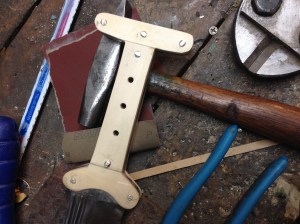
9riveting

Every rivet had its own burst of anxiety and adrenaline.  For each one, I measured a length of 4mm silver rod, cut it with the heavy sheers you can see int he top right, and then drove it with careful; taps into the prepared hole.  Then, with the riveting hammer (my grandfathers, BTW) I worked the protruding bit of metal until it swelled, then turned the hilt over and did the same on the other side.  Rivet by rivet.  I did the ones in the thinnest and worst bits of ivory first, down by the blade.  Then at the pommel.  No cracks.

So I did the rest.

Damn.  No cracks.

Which is to say, there’s still a large crack from phase III, and it will always be there.  But I didn’t inflict it.  It’s the result of 13K years in the ice of the Canadian north.

complete back

There’s the back of the finished product.

complete

And there is the front.  See the crack?  It is not perfect.

I’m afraid I love it anyway.  But I don’t have a customer waiting to tell me that he wants one without a crack.

BTW, see the gold rivet?  That’s my badge, or what the Japanese would call a mon.  Far right, below.

6-250 Cameron, Christian Gordon cu

So… what did I learn?

First, I learned twenty things for my current novel.  Umroth ivory, and ivory dust, now permeate the book.  The Umroth themselves, and their master… whoops!  spoiler…

But mostly I was reminded that craftspeople are risk takers, not stolid, dull people with limited skills.  In fact, most really good craftspeople can probably make just about anything, because what you eventually learn, as I think Tod was saying, is that you can make anything.  You can learn to learn.  You can pick up a new skill.  This takes a special kind of mind, and a special kind of daring.  As a sword teacher, I know that the first step to learning a martial art is to admit you know nothing and learn.  This is harder for some than others.  The same applies to making things.

I think I find craftspeople fascinating for dozens of reasons…my grandfather was one of them, and I worshiped him; I grew up making stuff with him and with my dad, who’s no slouch.  But more, as I grew to know them as a ‘breed,’ I realized what complex, brave people they are; how confident they have to be in themselves to face the reality of concrete success or failure every day.  You can tell yourself a poem is good.  You can’t hide the crack in the ivory.

And… my mages, in fantasy, are craftspeople.  They make things.  They assemble power carefully, they work with tools like ritual and memory palaces, and they need craft luck and brilliance and massive self-confidence to impose their wills on reality.

Like craftspeople do, every day.  The real magic.

Oh, yes, I learned one more thing, from my wife, Sarah.

The finished knife still stank of 13K year old dead mastodon.  But a little wintergreen oil, and it’s the best smelling dagger in my kit.

So much to learn.
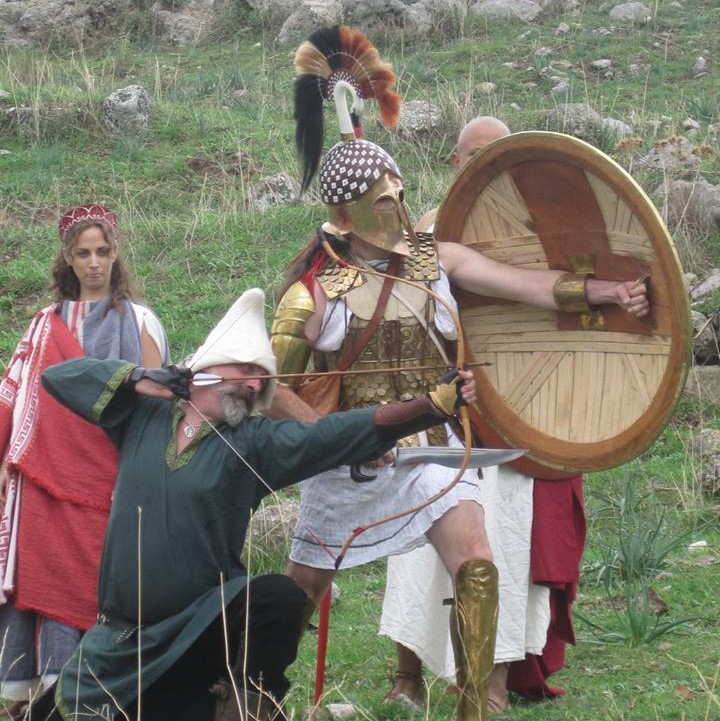
Writing about History: The Siege of Belgrade Part II

Standard
Hunyadi Janos

Hunyadi Janos

Last Friday, I finally completed the seven part epic that Tom Swan and the Siege of Belgrade has become.  In the end, the full story is roughly as long as the Red Knight, or almost 200K words, or roughly as long as Alexander, God of War.  Part 6 will be out June 17, and Part 7 will be out in July or August at the latest and includes, among other things, the longest combat scene I think I’ve ever written.
I suspect that Tom Swan and the Siege of Belgrade is some of my best historical writing.  It was very difficult, and involved complex reconstruction, timeline creation, investigation of period sources, and lots of staring off into space, smoking the occasional cigar, and staring at maps.  And Google Earth.  I think I have stared at the ground around Belgrade for more hours than I’ve looked at hiking routes in the Adirondacks.

The last time I wrote, I examined some of the historical problems, but this time, I thought instead I’d examine more from the writer’s point of view.  What are the problems in an historical novel?  And how do you solve them?  How do you write one?

I’m going to start rather where I left off the last time, with problems…  First, some statements.  You may disagree, but these are ‘conditions’ of my writing.  These frame the way I do research and…well, everything.

1) I have little time for modern nationalism.  It certainly has no place in the past, at least to my historical eye.  So I don’t see Turks as the ‘bad guys’ and I certainly don’t see Hungarians or Christians or even Englishmen as the ‘good guys.’  Tom Swan and his friends are the protagonists… it’s their show, so to speak.  But that may not make them ‘good’ or even ‘right.’

The siege through Turkish eyes....

The siege through Turkish eyes….

1a) The corollary to this is that I’ll spend more time exploring the protagonists POV, and that may even involve issues that make the reader uncomfortable.  As the Siege of Belgrade progresses, Swan becomes more religious and even begins to make time to pray.  This is not some Christianizing missionary work on my part, but rather my observation of soldiers in similar situations.  When on crusade, the ‘crusade’ message seeps through.  Men at war seek to justify their own, sometimes horrible, actions. Religion helps.

2) I seek to explain to the reader the ‘how’ and the ‘why’ of significant events.  I’d like this to be fun and entertaining… it is not a history lesson.  But I want to get the history ‘right’ and if I speculate, I want those speculations based on the best evidence available.  Oh, yes, and sometimes I get this wrong…  Anyway, 3 and 4 are really corollaries of this.  But sometimes, they are their own thing… literary themes, not just historical ‘facts’ or even opinions.

A fifteenth century image of prostitution -- Saint Mary Magdalene...

A fifteenth century image of prostitution — Saint Mary Magdalene…

3) In this novel, I wanted to address the role of women as whores and laundresses with Medieval armies.  I wanted to give women a ‘voice’ that was not the voice of the victim or servant or ‘girlfriend’ and yet I needed that voice to be authentic and not ‘modern.’  In the end, I again found that voice more realized in texts from late Medieval Christianity than texts from modern feminism, although I tried both.  That is not to say that this is ‘my’ belief about women, their role, or their choices….

The heroism of Titusz Dugovics.  But did this really happen??

The heroism of Titusz Dugovics. But did this really happen??

4) If you happen to be from Eastern Europe, especially Hungary, Serbia, Albania, Romania, Turkey or even Poland or Russia or Ukraine, the events of the 1456 Siege of Belgrade are central to your ideas and basic chronology of history, and the heroes and villains of the piece are mythological figures.  On the other hand, if you are American, British, Scots, Irish, Australian, Kiwi or Canadian (like most of my readers) these events are ‘news’ and I’ll wager that I have readers even now who don’t know who ‘wins.’  I have duties to both sets of readers.  In my view, I owe the Eastern Europeans a respectful examination of the events with which they are familiar, but I also owe the English speakers a comprehensible entry into a very complex tale.

Saint Mary Magdalene 1450

Saint Mary Magdalene 1450

5) And finally… Like Hamlet, I believe that ‘There are more things in heaven and earth, Horatio, Than are dreamt of in our philosophy. ‘ There is an element of magical realism to Tom Swan that will seem almost insignificant to Fantasy readers, but I find it essential and I think that it helps the reader to be ‘in the moment’ for the period.  The Head of Saint George is real.  The Ring of the Conquerer has magical powers.  And was that Saint Mary Magdalene appearing to Tom?  I don’t offer Gandalf like spells, but I want the reader to enter into the mind of the day, if even in a very small way…

Each of these points can be debated, and other writers might well find different paths, but I thought some readers and perhaps a few writers would like to see me explore why I did what I did.

The first element has to do with Tom Swan as a character.  Tom Swan is English because that makes him more approachable by an English-speaking audience.  There were Englishmen (and Scotsmen and Irishmen) everywhere in the military world of the fifteenth century, and they got as far afield as Hungary and Italy.  But they weren’t common, and they had a budding civil war of their own at home.  However, I suspect that if Tom was Tomas Suane of Genoa, or Tamás Sovány of Buda, most English-speaking readers would find it harder to ‘get into’ the character.

And once you make this call for the protagonist, you’re stuck with it.  Thomas is now the captain of a company, because I felt that was the best way to give him the ‘view of the battlefield’ that would allow the reader to make sense of the Siege of Belgrade.  I admit that there’s another possible version where Tom is a foot soldier or a simple courier and neither he, nor the reader, ever meets Vlad Tepes or Janos Hunyadi, and the actions of the siege remain a misery of tension and terror without the protagonist or the reader having a clue to the tactics, strategies, and intentions of the contestants.  Such books often appeal to me, and I might write one eventually, but to me, that’s a kind of story better told about Gettysburg or Isandlwana so that most readers need little or no explanation of the historical events themselves…

And I’ll stay with the character and ‘Englishness’ of Tom for point four, as well.  An Eastern European reader will note at least one action performed by an English archer (one of Tom’s) that is usually ascribed to the Hungarian or Serb or Wallachian or probably Croatian hero Titus Dugovics who died throwing the first Turkish flag bearer off the walls of Belgrade.  Sam Cressy just shoots him off, and there probably was never a Titus Dugovics, who looks remarkably like an 18th century scam…. I’m Scots in my ancestry, so I’m very inclined to love romantic 18th century scams (Bonnie Prince Charlie, anyone?) but this sort of alteration is again, inserted to give action to the protagonists and their friends.  No slight is intended to the thousands of heroic Hungarians, Serbs, Wallachians, Albanians, Greeks and Germans who died at Belgrade… on both sides…

Point two… my desire to teach the reader a little history, may be my worst habit.  I’ve gotten bad reviews because of it, I suspect it sometimes harms sales, and I can tell you that it keeps me up nights worrying about how to make a character arc or a plot work without lying about the history… But… I believe in history.  I would agree with many critics that history can be full of lies, distortion, racism, culturalism, sexism and other forms of crap, but it is simply the recorded memory of the human race, and without it, we’re… like anyone else in a relationship, who suddenly has no memory of who did the dishes last Thursday.

Lately there’s been a whole lot of rather left-brain criticism of history which seems to devolve down to the notion that people often lie in recording their stories, thus, history is all lies, and no one can ever tell what happened in the past.  This sort of always/never thinking is convenient for politicians and bad academics who want to pretend for the purposes of a paper that Hildegard of Bingen and Margery Kempe were contemporaries, but it’s really no harder to work through human error and bad record keeping to sort the Siege of Belgrade in 1456 than it is to figure out what the hell the Canadian Government is doing in Iraq.  That is to say, it takes a little work, but it is hardly impossible and with a little luck and a little help from archaeology, it’s possible to settle some home truths, often uncomfortable and always complex.  And oh, BTW, I laughed a great deal when I discovered that the Onion, which makes me laugh anyway, had an article about Barrack Obama comparing the fighting with ISIS to the Siege of Belgrade.  No, really.  Find it yourself.

OK, here it is.

Just for the record, I think it would have been funnier if it had been about the Siege of Constantinople. Buy me a beer if you don’t get that and I’ll explain…

I wrote a whole blog on the research for 3) above. (here) There’s still more to say…

Anyway…  the process.  That’s what I started out to discuss, and then I blathered.  Of course I start with character, and that’s why I blathered about Tom Swan and his nationality.  And the next step is a detailed reconstruction of the history.  I see this as being very much like reconstructing a period garment or a sword or a recipe… I do research, I look at other people’s research, I learn a lot of new terms and obsess on some details, and finally I can see how the history worked.  And once I have that, I have the frame of the story and often I have some essential incident too. But incident is not plot.  This is an essential issue which I think many writers miss; in fact, I’ve missed it form time to time.  If I create a character and tell the story of the American Revolution by having him be present at every battle…

….I don’t really have a good story.  I may have a great character, and some great fight scenes…  but it won’t be satisfying.  I recently helped judge an Historical Fiction contest, and the biggest single ‘error’ committed by many aspiring writers was to simply place their character(s) in important battles.  Odd, because I doubt that most of us would place our characters next to the creation of, say, important art works (interesting idea, though) or monuments.  I can see a story in which the character was present for the signing of Magna Carta… but there’d have to be some other action…

And so with battles or sieges or almost anything.  The history may be the frame; some incident from history may fit perfectly into the story, but the story needs to have its own plot.  The story might be ‘How Tom Swan learns to command’ or ‘How Tom Swan learns that he doesn’t really like being in command.’  That’s a story.  But the story is not the Siege of Belgrade.  That’s the background.

Leon Battista Alberti

Leon Battista Alberti

Usually, by the time I understand the history, a story has written itself for me.  This is a difficult process to explain, and it’s even more tangled with Tom Swan because instead of a single book 500 pages long, I write Tom Swans in installments and each one has to stand (at least for while) alone.  Each one needs a story, even while also telling an historical story…  So, for example, the first three installments of ‘Siege of Belgrade’ are actually about the sheer complexities of something as international as ‘crusade’ in the mid-fifteenth century.  That’s the ‘History story.’  But Tom Swan doesn’t know that… he’s trying to survive the Malatestas, match wits with Leon Battista Alberti, get the girl, and raise a company of lances.  And maybe save Venice…  He’s trying to have a career in renaissance Italy, which is a sort of plot all by itself.

And the second half of the story, when we move to the Hungarian plain and the fighting, has to have the same feel.  It is not enough to relate the course of the fighting.  It has to be a story… the same story it was in Venice and in Rome.  Surviving a papal election is as much part of Tom Swan’s ‘experience of the crusade’ as storming a gun emplacement in the Turkish lines on July 21st, 1456.  And reconstructing experience so that the reader has a feeling of having ‘been there’ is, for me, what Historical Fiction is about.

And, oh by the way, I’m at page 100 in ‘Plague of Swords,’ which is Book Four of the Traitor Son’ or ‘Red Knight’ series.  Now… back to work.  That is, real work…

Writing about history–and trying to live it, too

Standard

I thought I’d try a different media.  This video was made by my friend Allan Joyner of Allan Joyner Productions.  The music is by Schola Magdalena .  The thoughts are almost entirely my own.

And by the way, I’m all to aware of the many inaccuracies the camera catches, despite all of our best efforts.  Reenacting is always, at best, a compromise.  But there’s a lot we can learn from it, anyway.