Writing about Craftspeople — Aurora Simmons

Standard

Iphone late May 2015 005

Aurora SImmons

It is not all about weapons and armour.

Alright, I know a few of you are reeling in shock, but honestly, the recreation of the past doesn’t actually require weapons and armour at all, and fascinating as some of us may find martial arts, tactics and strategies and the material culture of conflict, really, there’s so much more.  People lived, loved, ran races, lounged on couches, and wore clothing and jewelry and ate food.

Lived, as I said.

I happen to have the pleasure of knowing a great many craftspeople.  Rather like the blog I wrote about Hannah Lowe and people who train and practice hard, craftspeople are often very different.  They have very rugged and sometimes stubborn personalities.  They can focus–incredibly–for long stretches without boredom.  I know a few craftspeople, and I suspect J.R.R. Tolkien did too… the dwarves may represent a stereotype, but it is also an archetype.

I know Erv Tschanz, who I think of as one of the most gifted all-around craftsmen I’ve ever met (one of my mentors) who has built rifles and knives and such, but whose specialty is horn work.  You know–cow horn?  The plastic of the pre-modern era?  You can carve horn, but you can also, to some extent, mold it, and people made air-tight boxes and powder horns and drinking horns and almost-clear horn panes for lanterns and any number of other things.  Horn can be quite beautiful, too.

But, as usual, I digress.  I know quite a few armourers (and both Jiri Klepac and Jeffrey Hildebrandt have graced these pages), and a dozen rifle-makers who recreate 17th to 19th century black powder rifles.  I know quite a few superb amateur (and professional) tailors, and a marvelous tinsmith (Carl Giordano) and a marvelous copper smith and some amazing blacksmiths, including Jymm Hoffman, who I’ve known since we were pretty young. Or so it seems to me. And leather workers–I know great leather workers on three continents.  My current favorite is Davide Giurissini in Italy… and there are some amazing craftsmen in Italy. And really — only looking at their websites in depth can do justice to the superb stuff these people can make.  The skills of the past are not lost.  They are very much alive.

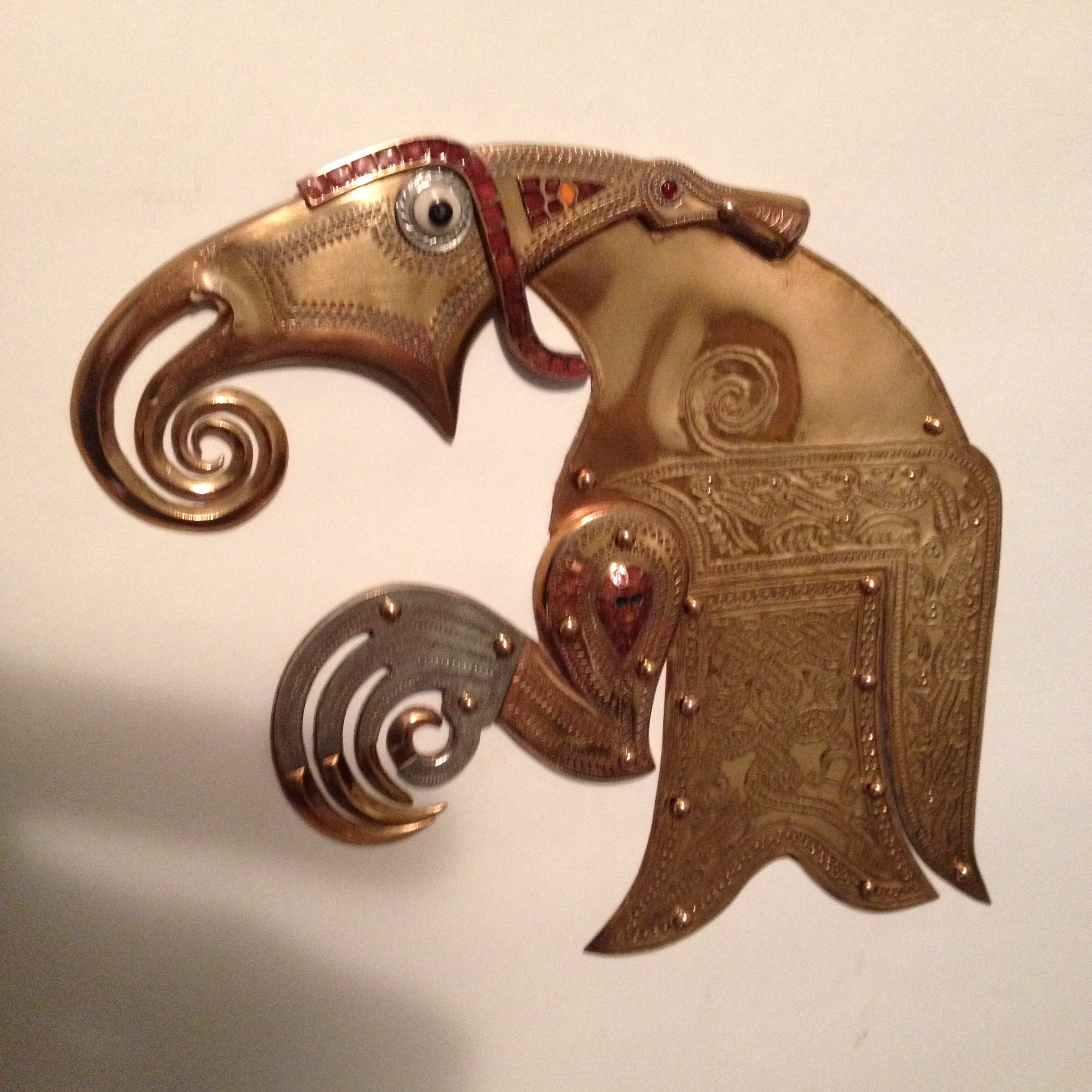
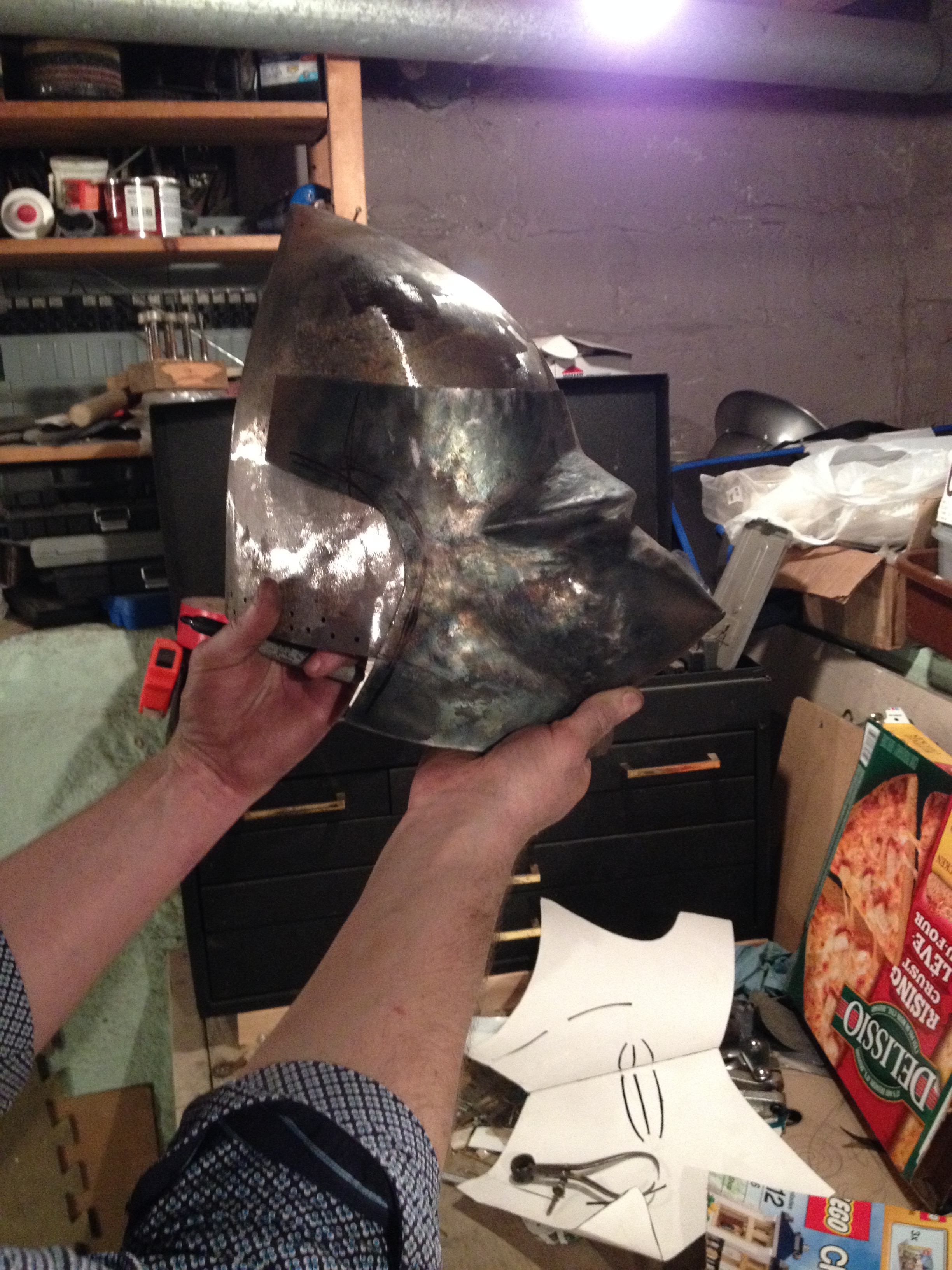
But today’s focus is on my friend Aurora Simmons, who despite her age can perhaps rival Erv Tschanz for her all-around skills.  She’s a trained jeweler and goldsmith, but her skills include embroidery, leather work, sewing, weaving, and a general willingness to try almost any craft-related task from gilding to mosaics.

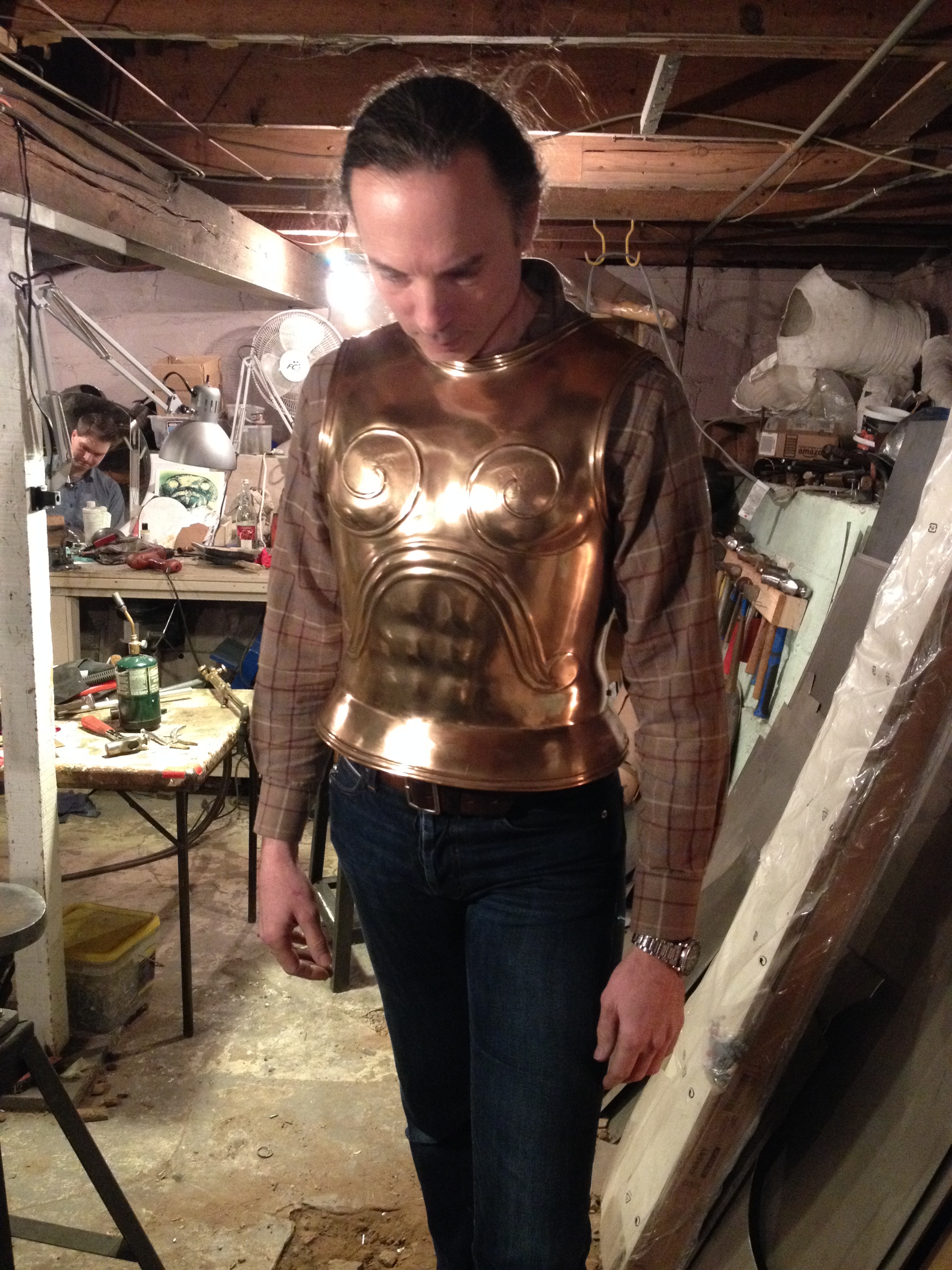
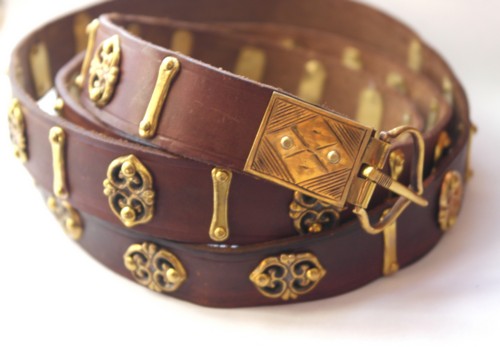
Aurora’s specialty is the recreation of period metalwork.  This last week, she’s been in my shop finishing a knight’s belt for my friend Marc Auger…
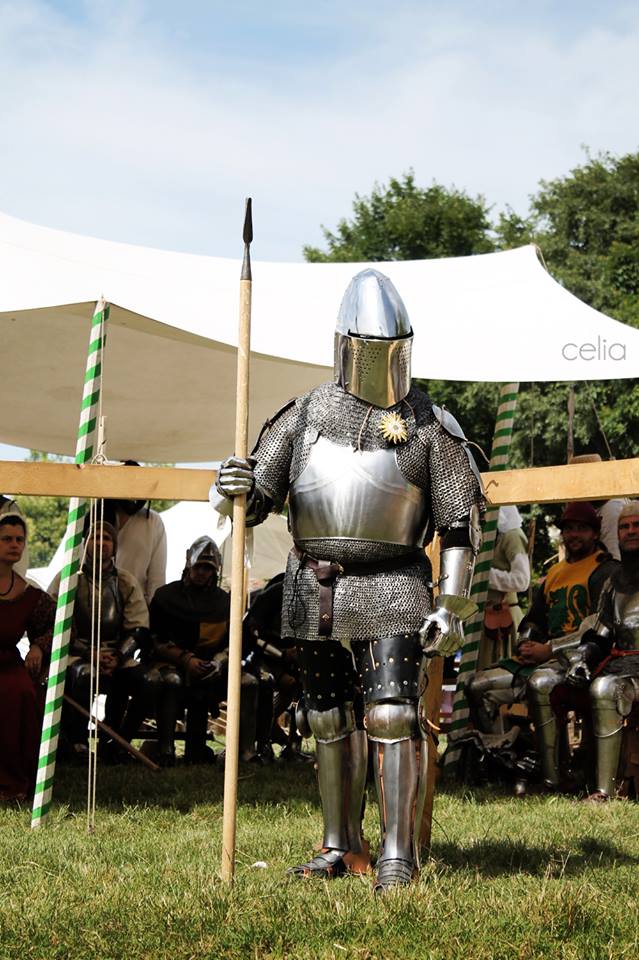
Marc Auger fighting in Verona Italy in 2014 as part of the Torneo del Cigno Bianco

Marc Auger fighting in Verona Italy in 2014 as part of the Torneo del Cigno Bianco

A knight needs a belt.  The very term ‘a belted knight’ is probably a holdover from the habit of Roman soldiers that by wearing a belt studded with metal they marked their military status.  Medieval knights called themselves ‘Miles’ and probably imagined that they were ‘modern’ legionaries.

I think I’ve slipped into digression again.  One of the greatest difficulties in recreating culture–especially high culture–in any era is the sheer diversity of hand-made, tailored or custom-produced items that were used to mark status.  It is extremely difficult for reenactors to make ‘bling’ and have it look correct.  In some cases, the materials themselves are no long available (furs and ivory) and in some cases, the very factors that made them status markers in the fourteenth century make them prohibitively expensive today… like gold.  But a third factor is the simple cheapness of historical hand labour.

I can remember standing in a small shop in Bath, in the UK, and looking at a mid-18th century handkerchief.  This small square of linen had a superb provenance–we knew exactly who had owned it.  It was made of a square of superbly woven, very light linen with no flaws.  The seamstress who made it pulled threads from the edges; then cut narrow (3mm) tapes of linen and stitched them up the back, pressed them flat with an iron, and re-wove the tapes into the pulled thread work.  I am a fairly expert sewer.  I frankly can’t imagine the work–the sheer work–and expertise involved.

By the way — that handkerchief did not belong to a duke or a duchess or a king or even a knight.  It belonged to a banker’s clerk.

Expert labour was cheap.

Understanding this is at the root of what I call ‘reenactor despair’ where you finally realize that you may never, ever be able to make even a simple garment as well as a person who lived in 1350 or 1750 or 550 BCE.  They had a lifetime to master skills that we try to reproduce in an afternoon.  They didn’t just have sword smiths.  They had a blade smith, a white smith (you all know the difference between a black smith and a white smith, right?) for finishing, a hilter who built the hilt, and quite possibly a jeweler to work the gold and silver and make the wire. When modern reproducers work to make the crafts of the past, they often have to duplicate the work of three or four experts.  This defeats most of us.

Not Aurora Simmons.  She seems to master all the skills.

Back to Marc’s belt. Knights wore belts–belts that became increasingly elaborate and may, in fact, have been influenced by Greek, Serbian, and possibly Mongol styles.  I’ll take this moment to recommend a really well-researched book on late fourteenth century material culture and the effect of luxury and fashion on banking and, well, everything, by Susan Mosher Stuard…
gilding the market

Anyway… Some months ago, we all fell in love with the ‘Saint Graal’ manuscripts.  You can find the online digital version here.  The original was painted and penned in about 1380, in northern Italy or France.  It’s like an upper-class costume bible.
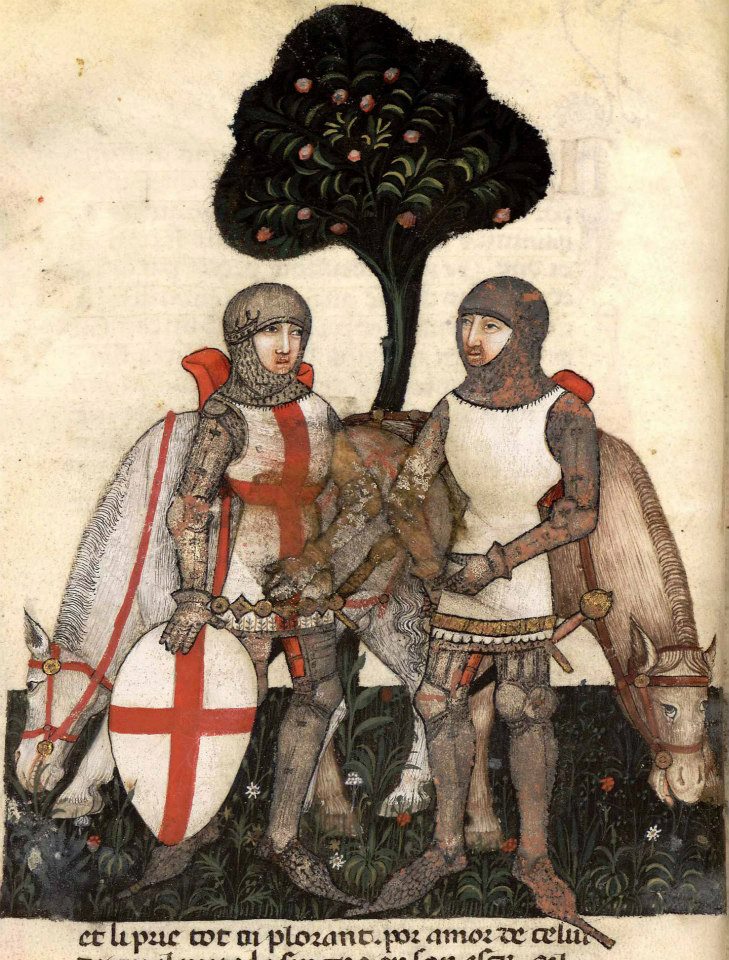
Queste del Saint Graal Tristan de Léonois Milano Italy 1380-1385

After searching through a number of sources, the best of which is probably the wonderful ‘Dress Accessories c. 1150-1450’ from the series ‘medieval Finds from excavations in London’…
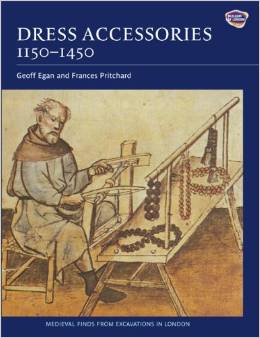
dress accessories

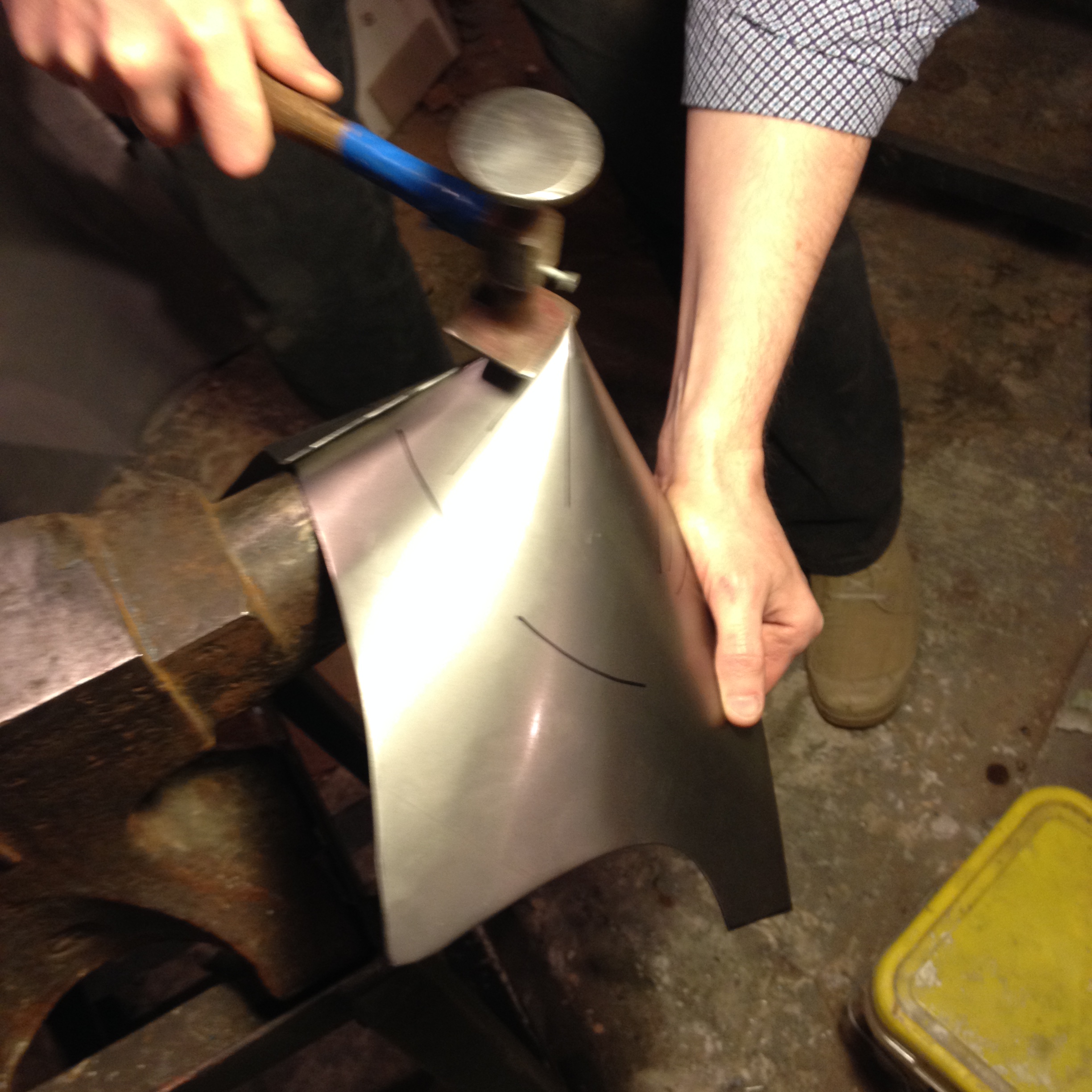
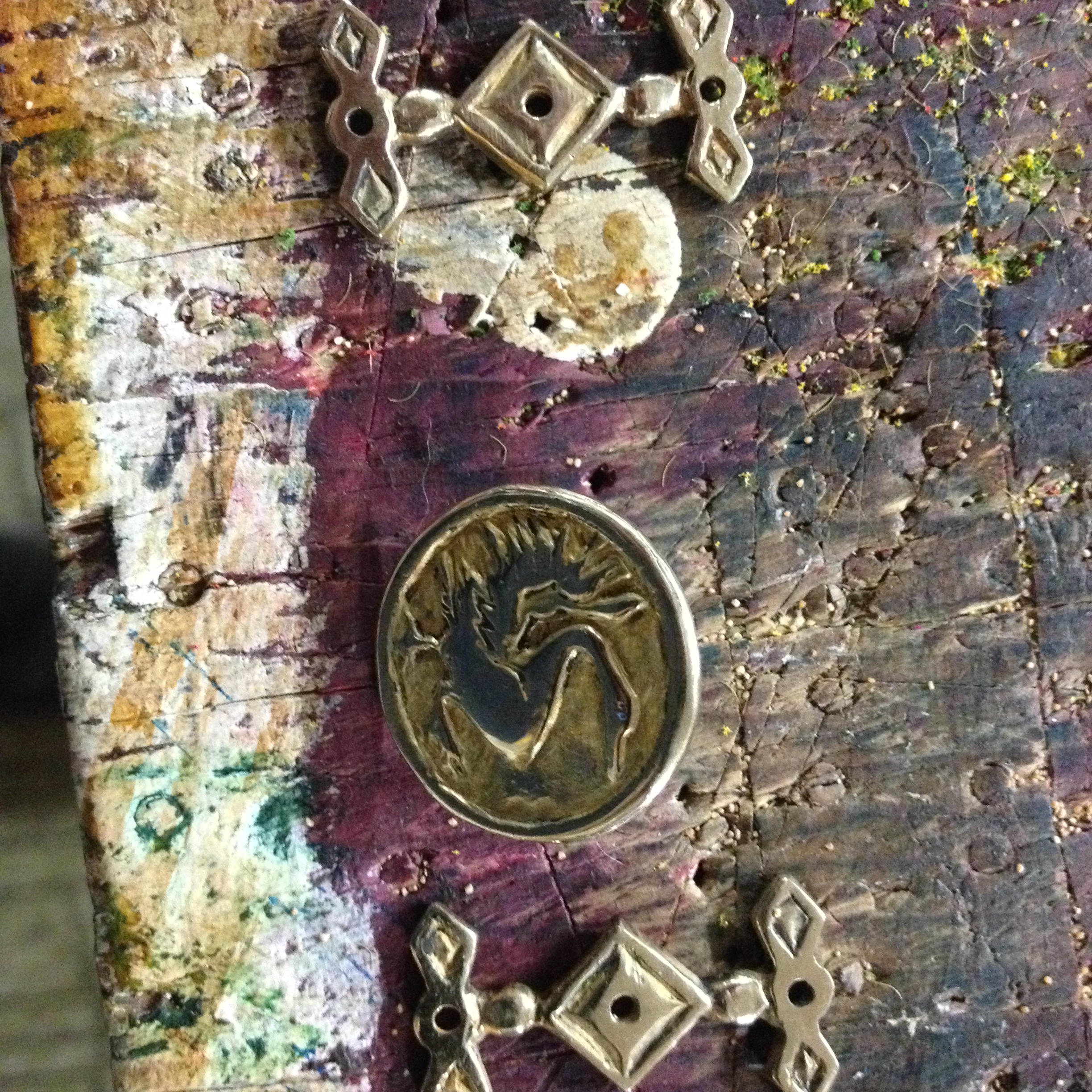
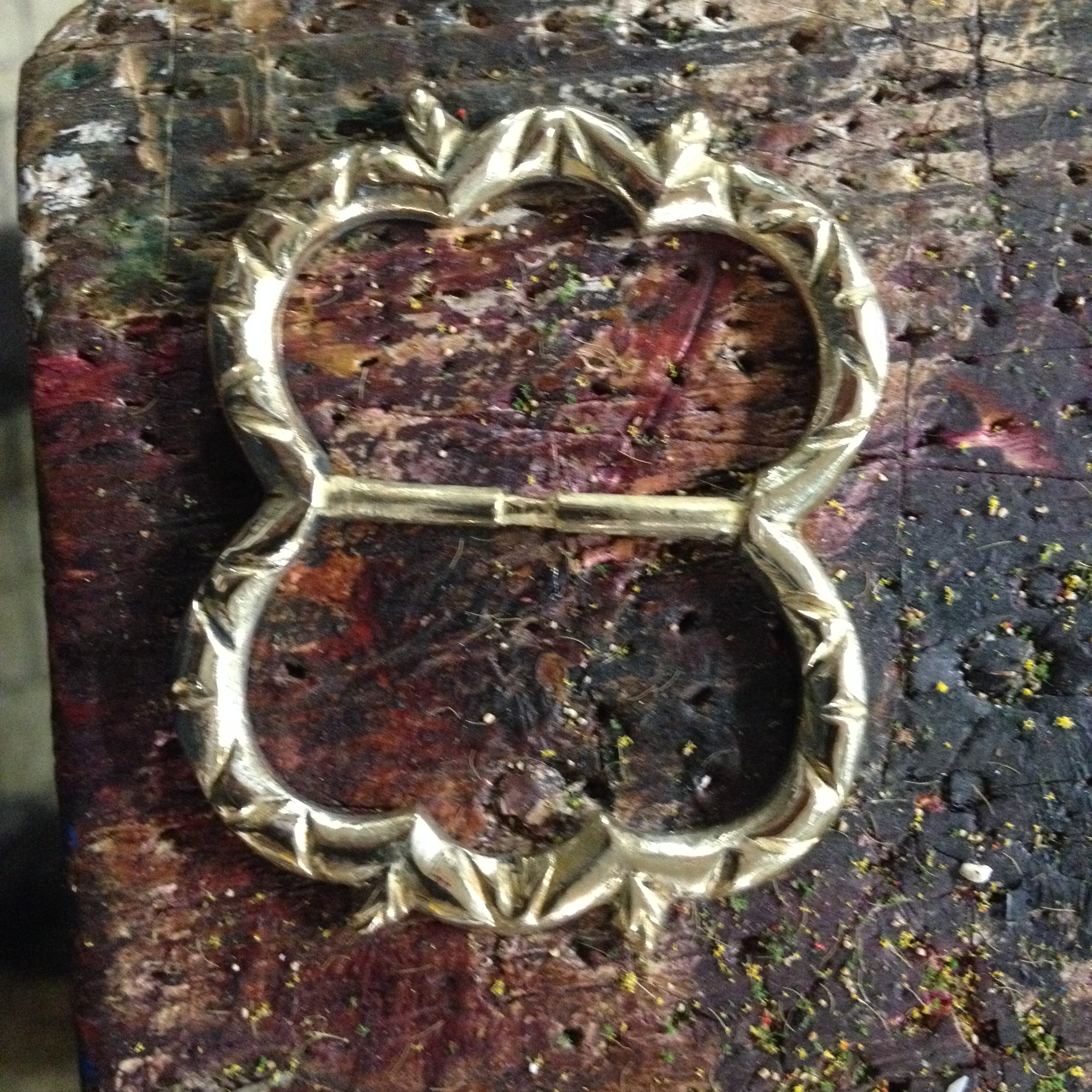
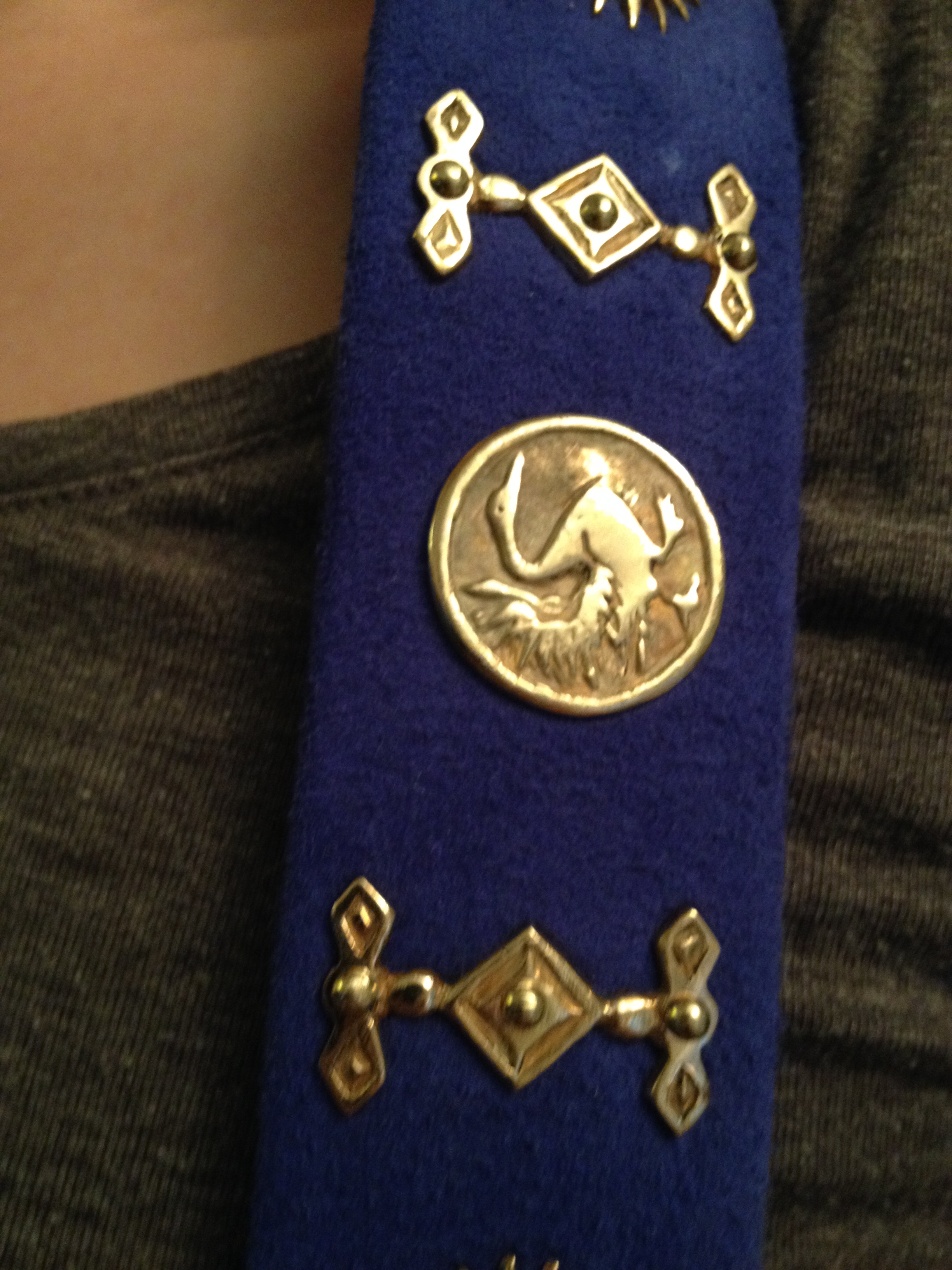
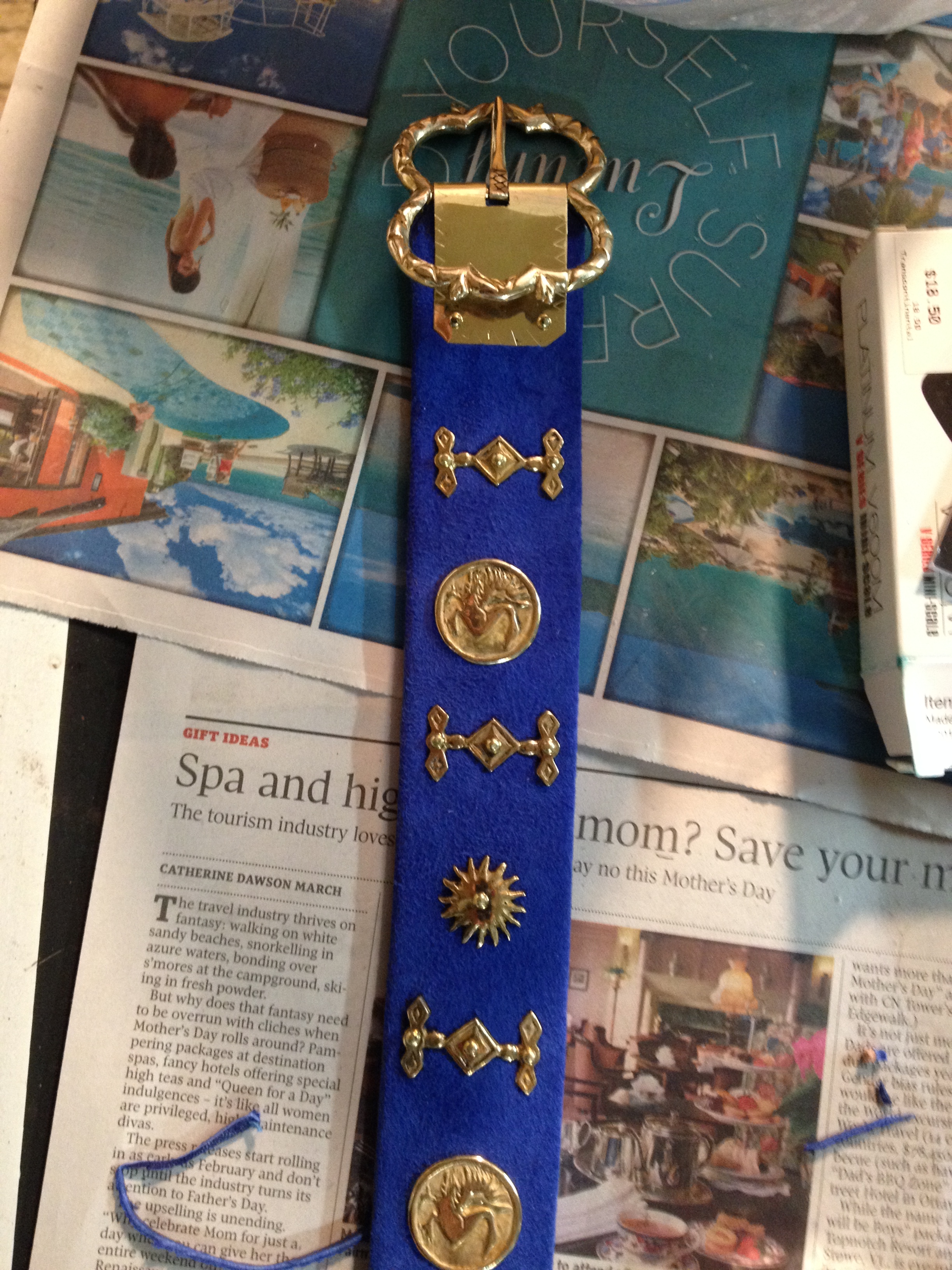
Aurora then began to deign the belt fittings, basing hers on originals–but incorporating Marc’s coat of arms and the details of his heraldry, as would have been done.  Then she carved the pieces in wax, cast them into brass, and finished them.
Iphone late May 2015 012

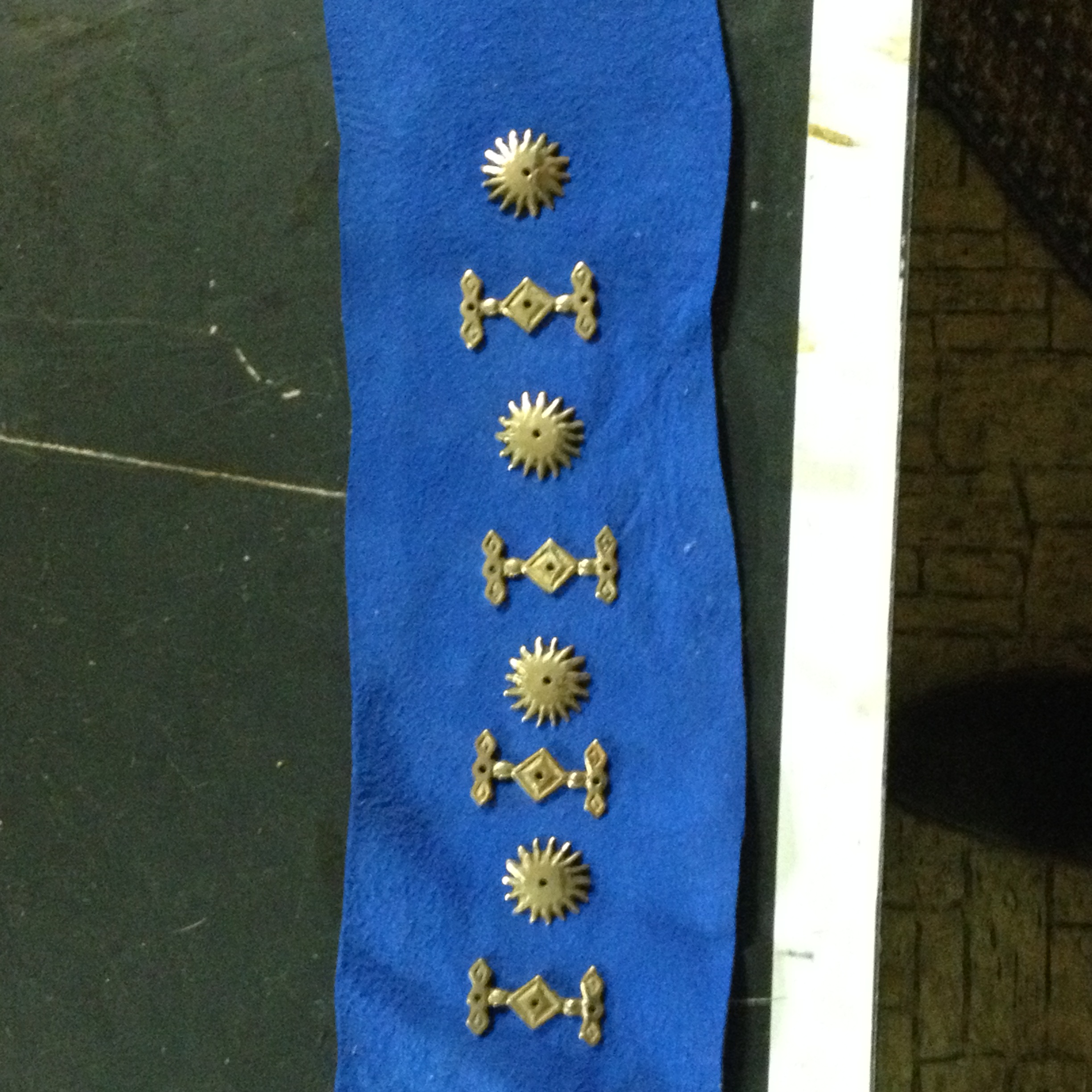
Then, piece by piece, she riveted them to a leather belt she made, exactly as would have been done by a Medieval belt maker, using a decorative outer piece of deerskin to contrast the belt fittings.
Iphone late May 2015 011

And then, when everything was sewn and riveted, she closed the back, and there it is.  A mere forty or so hours of work.
Iphone late May 2015 008

Oh, by the way, a belt like this costs about $800.00 CAD and Aurora would be happy to make you one.
Aurora and belt 004

Or almost anything else you can think of–Ancient Greek, Medieval, Renaissance or  Modern.
Aurora and belt 008

Aurora can speak for herself on her background:

I starting seriously making things in high school at age 16. A friend taught me the basics of chainmail and I was hooked. I spent many long nights maintaining my tenuous hold on sanity staying up until 2, watching Firefly and making chainmail. Bras, shirts, bracelets, you name it. I learned new weaves with an insane hunger. I worked with titanium, silver, stainless,
anodized aluminum. There was so much creativity available in terms of colour and variety. I was fortunate enough to go to an alternative school that allowed me to make chainmail in class, which was great because it really helped me concentrate.
SAMSUNG CSC

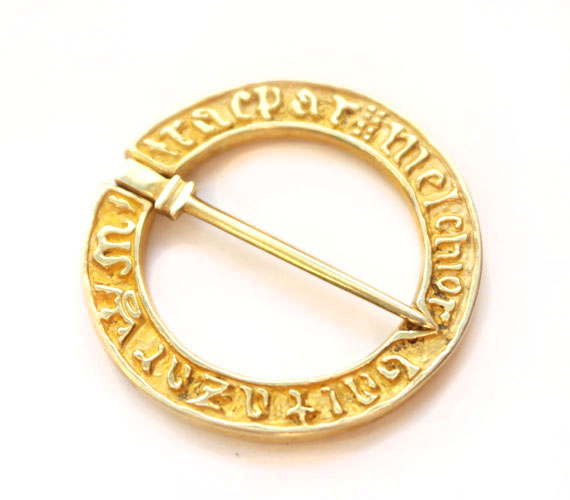
14th c. brooch with the names of the three wise men

Then I got into sewing. I would buy patterns from Fabric land and blast my way through them. Slowly teaching myself to tailor. But I have to say I wasted some expensive materials learning the hard way.
1609721_1444974482444652_2430421581406928612_n

When it came time for post secondary education, I bucked my mothers wishes and went to George Brown for jewelry arts, instead of one of the universities I had gotten into. It was a great, highly technical program, only sullied by long power point lectures that I mostly ignored, and occasional program politics which I also largely ignored.
I loved silver-smithing the most. Moving large amounts of metal into sculptural forms was incredibly satisfying, and gave me the foundation that I was later to use for my forays into bronze and brass armoring. I also loved chasing and repoussé, something I don’t get to do much of now, since it’s generally too labor intensive for people to pay for, not unlike embroidery.
SAMSUNG CSC

I love making pretty much anything I put my hand to. I love sewing and making clothes as well as working with metal, but I loved making furniture and wood working too, back when I got to play with that stuff in high school.
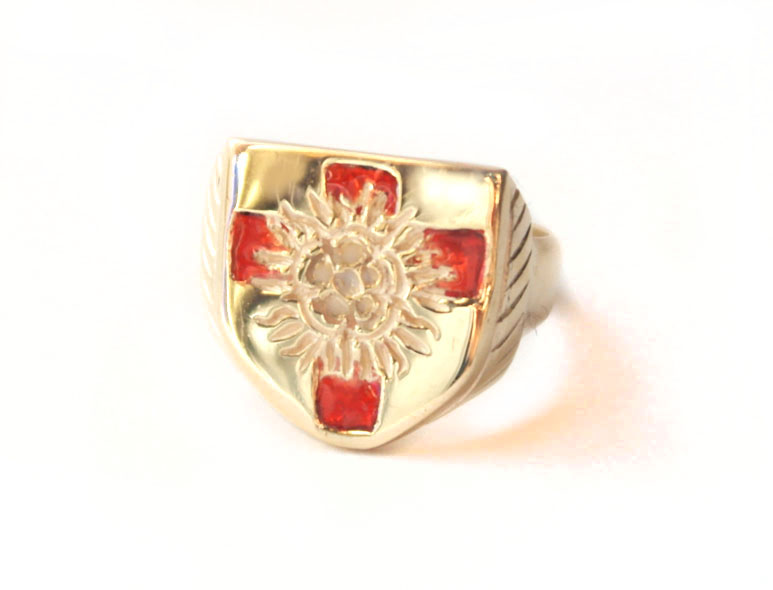
This one is mine--I wear it everyday.  CGC

This one is mine–I wear it everyday. CGC

Crafting always helps me feel saner, except when it makes me want to break things. There is something so uncompromising about working with the physical world. If something is crappy, it’s obvious. Everyone can tell.
Sometimes you can fix it, sometimes you have to start from scratch and you have lost hours of work, and maybe hundreds of dollars of materials. There is no negotiating with a broken gemstone or a wedding deadline. I love the challenge. I love tackling new, bizarre projects. It gives me a real thrill. I guess it’s partly the risk of serious failure that’s exciting. But also, finding success on a project that is really and truly challenging
is incredibly rewarding.
SAMSUNG CSC

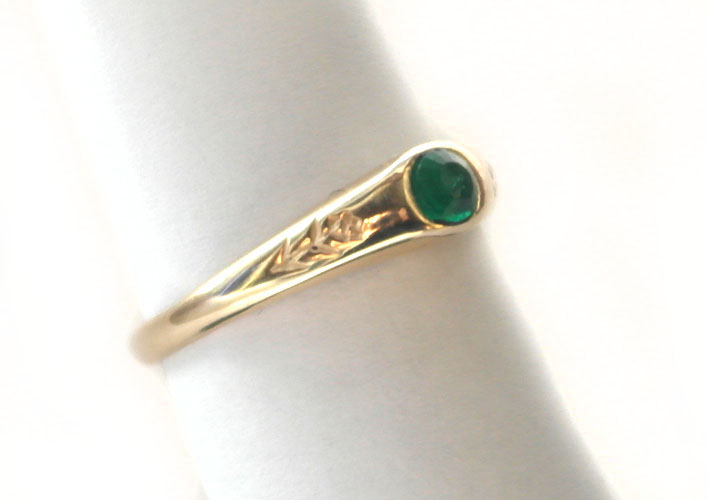
A Medieval ring

Making things that people love is also a big part if it for me. Knowing that someone is going to wear something I made every day, usually in the case of rings, is very encouraging. I guess there’s a feeling that I will live on in some small way, especially with jewelry, because it’s so lasting. I know when I make someone something valuable, there is a high chance that there children and grandchildren will have it, or they might even want to be buried with it, which is special in a different way. Maybe
that’s a little morbid, but I love the idea of existing through the ages, incorruptible, silver and gold. even if my name is lost, my work will still exist. A little part of me.
Crafts people are often forgotten. Our names are not remembered in the same way that a fine artist might be. But the work is there no matter what. All the artisans who worked on a Byzantine mosaic names may be lost, but their work is a living testament to their fierce commitment to their craft, maybe
to their god. Their reality is tangible, even centuries later.
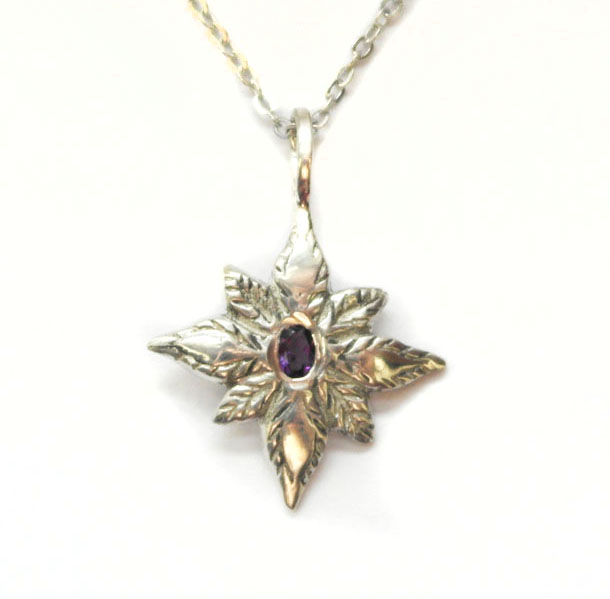
I don’t get there mostly. I think I make usually about 4 or 5 things a year that I really feel that way about. Where I look at it and it warms me to know I made it.
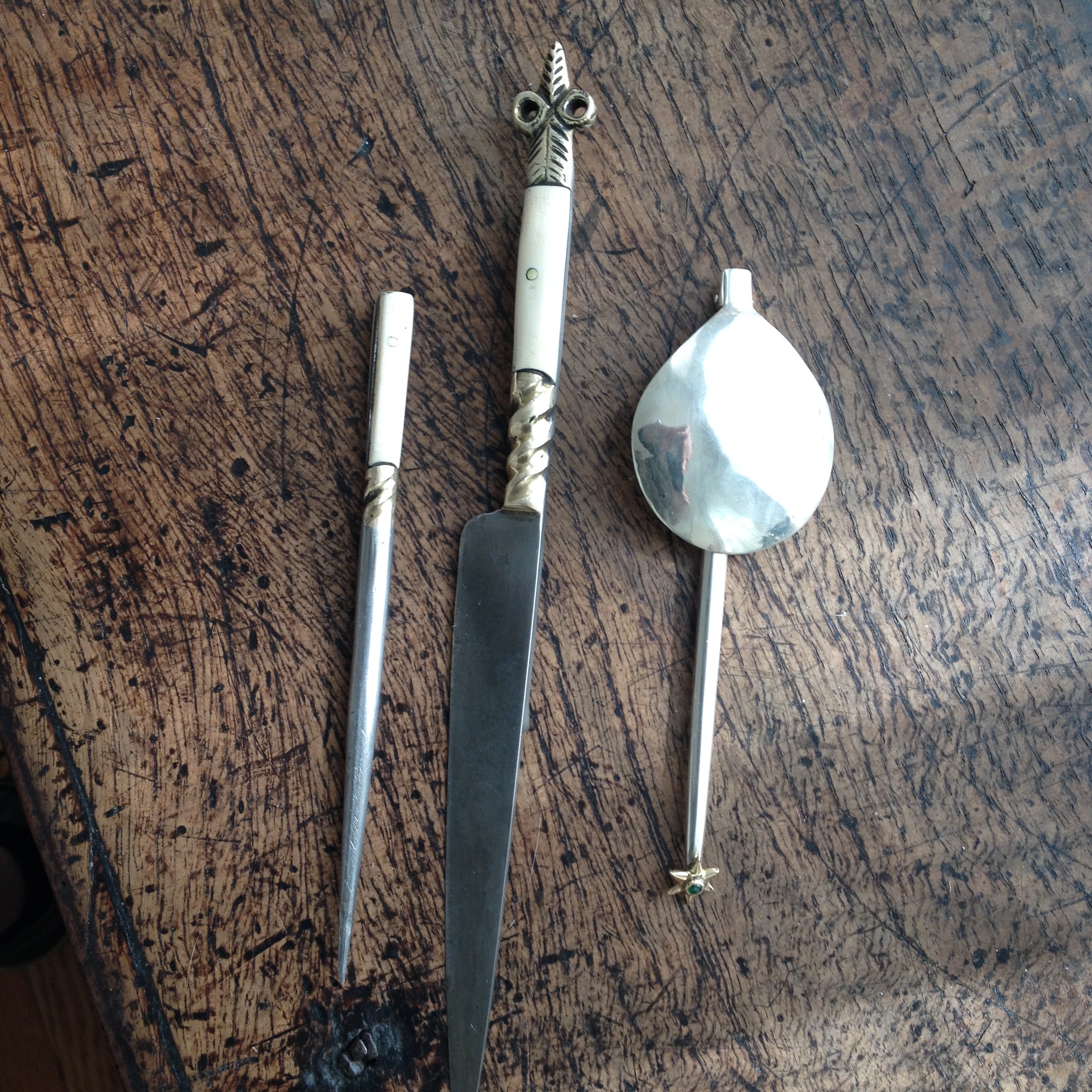
14th c. folding silver spoon by Aurora.  Pricker and knife set by Leo Todeschini of Tod's Stuff

14th c. folding silver spoon by Aurora. Pricker and knife set by Leo Todeschini of Tod’s Stuff

But those times are good, they make a lot of the wasted time and lost money worthwhile. But I couldn’t stop even if I wanted to. Few things are better than making something. I consider myself a complete addict. I spend all my extra money on craft supplies. I loose sleep, and cause myself physical pain. I spend time doing it that should be spent doing other things.
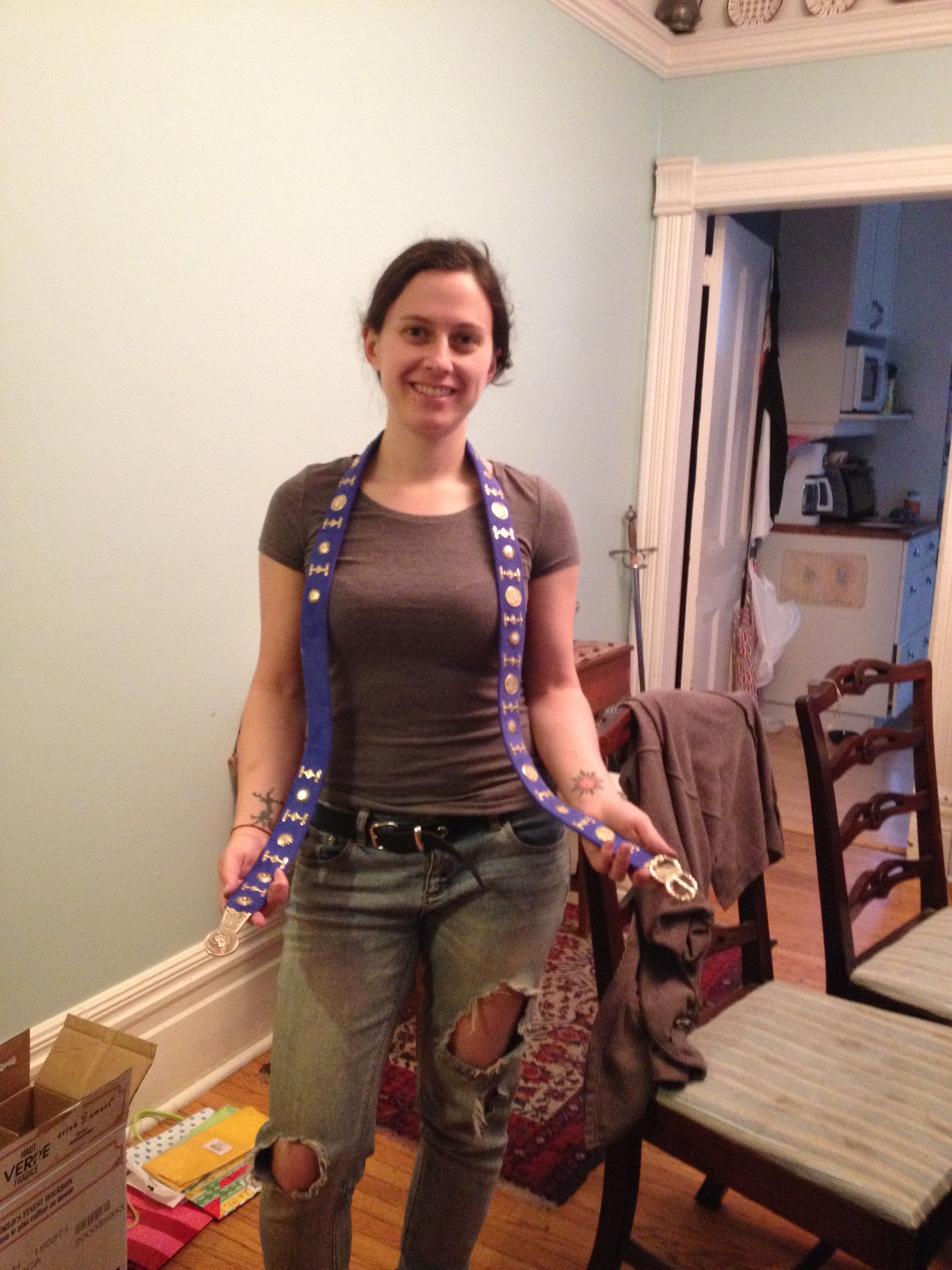
Aurora and belt 002

Aurora can make almost anything, and you can see more of her work at her ‘Handmade Revolution‘ website.

And in closing… for those of us who are writers, or readers, let’s remember how important crafts and craftspeople were to the world of the past.  People had to make–everything, but they were not ‘barbarians’ and they had remarkable levels of expertise.  Beautiful objects–the very best–were traded so widely as to move from the far east to the uttermost west.  And the people who could make such things had status.  And character.

I’m finishing Tom Swan 13 this week, and then I’ll be back to writing Red Knight IV, ‘Plague of Swords.’

Pen and Sword Tour II

Standard

IMG_1185

Last year, fifteen intrepid readers (seventeen at one point, but that’s a long story) joined me in Athens and spent eleven days touring mainland Greece.  This is us at the Lion Gate at Mycenae.

Look, I’m biased, but it was incredible.  For about ten years, my friend Aliki Hamosfakidou of Dolphin Hellas had egged me on to run an author-based historical tour, and I had… resisted her.  I imagined–heck, I don’t know what I imagined, but let me tell you what I didn’t imagine… I didn’t imagine the best tour of my life with fifteen instant new friends who all shared my passion for Ancient Greece.

So, of course, we are going to do it again.  This fall.  The tour will start the day after the reenactment of the Battle of Marathon

Favorite Historical Period

And we’ll follow the itinerary below.  Prices and fees and stuff are at the end.  Here’s my unpaid advertisement.  The company last year was excellent.  The food was very good, the hotels, wonderful, and the scenery and historical sites so breath-taking, so (literally) awesome that we began to mutter ‘look, another incredible view. How do they do this?’ and ‘Wow, another battlefield.’  We have our own bus, which may sound lame, but proved to be like having a small, and supremely comfortable land-yacht.  With excellent wifi.  Finally, as a many, many-time veteran of visiting Greece, the tour is cheaper than almost anything you could arrange on your own.  Oh, and there’s me, if you think that’s good, and a full day of demonstrations of Ancient Greek weapons and tactics (and Persians ditto) at Plataea!  Oh, and I teach a sword class every morning.  Free.

IMG_1077

This is our class at Delphi, complete with breath-taking view and massive hangover.

See?  You want to come.

We have roughly 30 slots, and I suspect 14 of them are already spoken for.

ITINERARY (Option A)
Day 1 (Nov. 2, Monday): Each guest will be arriving separately. Individual transfers to the hotel by private taxi (maximum 3 persons). Overnight in Athens. Meals: –

Day 2 (Nov. 3, Tuesday): The day begins with a walking tour of the Acropolis and its monuments: the Theatre of Dionysus, on the site where Aeschylus, Sophocles, Euripides and Aristophanes gave their plays to the city; we then follow the peripatos, the ancient track around the Acropolis, before climbing the sacred rock to view the city’s most renowned artistic and architectural achievements. Passing through the great gateway of the Propylaea, we will see the fabled temples of Periclean Athens – Athena Nike nestling on the rock’s shoulder, the Erechteion with its patient caryatids and the incomparable Parthenon. We will then visit the New Acropolis Museum where you can see some of the finest ancient treasures a mere stone’s throw from where they were found. Lunch break (own arrangements). In the afternoon visit the National Archaeological Museum, a bona fide powerhouse of a museum. In the evening, we will have a welcome dinner in a local restaurant. Overnight in Athens. Meals: breakfast, welcome dinner
Day 3 (Nov. 4, Wednesday): We will first visit “Olympias”, a replica of an Athenian triereme. These illustrious vessels played an imperative role during what is regarded as one of the most important battles of antiquity, the naval battle of Salamis. We will stop to view the straights where the battle between an Alliance of Greek city-states and the Persian Empire was fought in 480 BC. We will then set out to the Peloponnese. We will make a short stop at the late 19th century Corinth Canal, the cutting of which arguably transformed the Peloponnese from a peninsula into an island. We move on to visit Acrocorinth, the Acropolis of Ancient Corinth and according to many, the most impressive fortress of the Greek mainland. We then continue to Nemea, an area renowned for its wine production. Here we will have the first wine tasting of the trip. Our end destination for the day is Nauplion, a most attractive town, one of the best preserved and once a capital of the newly liberated Greek state. Overnight in Nauplion. Meals: breakfast, lunch, wine tasting
Day 4 (Nov. 5, Thursday): In the morning, we make our way to Mystras, the capital of the medieval Despotate of the Morea (an alternate name for the Peloponnese). Among the most important of all Byzantine sites, its ruins, comprising a castle, city walls, the Palace of the Despots and a whole range of elaborately decorated churches and monasteries, make for an unforgettably atmospheric visit. After lunch, we stop at the Acropolis of Sparta, which still bares traces of the past glory. Return to Nauplion for the night. Overnight in Nauplion. Meals: breakfast, lunch
Day 5 (Nov. 6, Friday): In the morning we visit the vast Bronze Age citadel of Mycenae, King Agamemnon’s capital in Greek myth, with its Cyclopean walls and the Lion Gate. After lunch, we set out for the eastern Argolid, stopping to cross the world’s oldest standing bridge (of Mycenaean date) before reaching the Sanctuary of Asklepios, the God of Healing, at Epidauros. The site, set in peaceful scenery that might be the secret of its therapeutic qualities, features the best-preserved ancient theatre in Greece, praised for its superb acoustics and perfect proportions. Overnight in Nauplion. Meals: breakfast, lunch
Day 6 (Nov. 7, Saturday): In the early morning we will visit the superb Archaeological Museum to admire its important prehistoric collections, including the Dendra Panoply, one of the world’s oldest surviving suits of full body armour. We then depart for Tiryntha, famous for its Cyclopean walls and palatial ruins. In ancient times the sea level was higher and therefore closer to the raised hillock on which the citadel was built making it almost impregnable although it is only 26m above sea level. Time permitting, we will also stop on the way at Mantinia, the stage of two important battles. The first battle, in 418 BC, was the largest land battle of the Peloponnesian War. On one side were Sparta and its remaining allies, and on the other were Athens, its allies, plus the cities that had revolted against the Spartans. The second battle, in 362 BC, led to the fall of Theban hegemony. In that battle, Athens and Sparta were allied. Thebes won the battle, but its greatest general, Epaminondas, was killed in the fighting. Our end destination for the day is Olympia. Overnight in Olympia. Meals: breakfast, lunch, dinner
Day 7 (Nov. 8, Sunday): In the morning, we tour the superlative site of Olympia. The great sanctuary of Zeus, famous for the quadrennial festival and athletic contests in honour of the God, established in 776 BC. The vast site, set amongst olive trees and between two rivers, includes temples and sanctuaries, but also the training grounds and gymnasia used by athletes and the venerable stadium, according to legend founded by the hero Herakles (Hercules) himself. The excellent site museum contains a vast collection of ancient Greek weaponry and armour, the wonderful sculptures from the Temple of Zeus and the Hermes of Praxiteles, one of the very few surviving works by one of antiquity’s greatest sculptors. We then depart for Delphi, enjoying en route a lunch with wine tasting at a local winery. Overnight in Delphi. Meals: breakfast, lunch
Day 8 (Nov. 9, Monday): The pan-Hellenic sanctuary of Delphi, where the oracle of Apollo spoke, was the site of the omphalos, the ‘navel of the world’. Blending harmoniously with the superb landscape and charged with sacred meaning, Delphi in the 6th century B.C. was indeed the religious centre and symbol of unity of the ancient Greek world. We will explore in detail some of the prime monuments of the site, including the Temple of Apollo, the Treasury of the Athenians, the Altar of the Chains and the Tholos. The afternoon and evening are at disposal. Among other things, people can attend a short ceramics workshop or go horse riding or hiking through the antique olive grove of Amfissa. Overnight in Delphi. Meals: breakfast, dinner
Day 9 (Nov. 10, Tuesday): Drive back to Athens, stopping en route at Cheronia and Platees (we could perhaps also include the museum in Thebes). Back to Athens. Farewell dinner & overnight in Athens. Meals: breakfast, lunch, dinner
Day 10 (Nov. 11, Tuesday): Individual transfers to the airport & departure. The airport is 30kms from the city centre and takes about 40 minutes.

ITINERARY (Option A)
Day 1 (Nov. 2, Monday): Each guest will be arriving separately. Individual transfers to the hotel by private taxi (maximum 3 persons). Overnight in Athens. Meals: –

Day 2 (Nov. 3, Tuesday): The day begins with a walking tour of the Acropolis and its monuments: the Theatre of Dionysus, on the site where Aeschylus, Sophocles, Euripides and Aristophanes gave their plays to the city; we then follow the peripatos, the ancient track around the Acropolis, before climbing the sacred rock to view the city’s most renowned artistic and architectural achievements. Passing through the great gateway of the Propylaea, we will see the fabled temples of Periclean Athens – Athena Nike nestling on the rock’s shoulder, the Erechteion with its patient caryatids and the incomparable Parthenon. We will then visit the New Acropolis Museum where you can see some of the finest ancient treasures a mere stone’s throw from where they were found. Lunch break (own arrangements). In the afternoon visit the National Archaeological Museum, a bona fide powerhouse of a museum. In the evening, we will have a welcome dinner in a local restaurant. Overnight in Athens. Meals: breakfast, welcome dinner
Day 3 (Nov. 4, Wednesday): We will first visit “Olympias”, a replica of an Athenian triereme. These illustrious vessels played an imperative role during what is regarded as one of the most important battles of antiquity, the naval battle of Salamis. We will stop to view the straights where the battle between an Alliance of Greek city-states and the Persian Empire was fought in 480 BC. We will then set out to the Peloponnese. We will make a short stop at the late 19th century Corinth Canal, the cutting of which arguably transformed the Peloponnese from a peninsula into an island. We move on to visit Acrocorinth, the Acropolis of Ancient Corinth and according to many, the most impressive fortress of the Greek mainland. We then continue to Nemea, an area renowned for its wine production. Here we will have the first wine tasting of the trip. Our end destination for the day is Nauplion, a most attractive town, one of the best preserved and once a capital of the newly liberated Greek state. Overnight in Nauplion. Meals: breakfast, lunch, wine tasting
Day 4 (Nov. 5, Thursday): In the morning, we make our way to Mystras, the capital of the medieval Despotate of the Morea (an alternate name for the Peloponnese). Among the most important of all Byzantine sites, its ruins, comprising a castle, city walls, the Palace of the Despots and a whole range of elaborately decorated churches and monasteries, make for an unforgettably atmospheric visit. After lunch, we stop at the Acropolis of Sparta, which still bares traces of the past glory. Return to Nauplion for the night. Overnight in Nauplion. Meals: breakfast, lunch
Day 5 (Nov. 6, Friday): In the morning we visit the vast Bronze Age citadel of Mycenae, King Agamemnon’s capital in Greek myth, with its Cyclopean walls and the Lion Gate. After lunch, we set out for the eastern Argolid, stopping to cross the world’s oldest standing bridge (of Mycenaean date) before reaching the Sanctuary of Asklepios, the God of Healing, at Epidauros. The site, set in peaceful scenery that might be the secret of its therapeutic qualities, features the best-preserved ancient theatre in Greece, praised for its superb acoustics and perfect proportions. Overnight in Nauplion. Meals: breakfast, lunch
Day 6 (Nov. 7, Saturday): In the early morning we will visit the superb Archaeological Museum to admire its important prehistoric collections, including the Dendra Panoply, one of the world’s oldest surviving suits of full body armour. We then depart for Tiryntha, famous for its Cyclopean walls and palatial ruins. In ancient times the sea level was higher and therefore closer to the raised hillock on which the citadel was built making it almost impregnable although it is only 26m above sea level. Time permitting, we will also stop on the way at Mantinia, the stage of two important battles. The first battle, in 418 BC, was the largest land battle of the Peloponnesian War. On one side were Sparta and its remaining allies, and on the other were Athens, its allies, plus the cities that had revolted against the Spartans. The second battle, in 362 BC, led to the fall of Theban hegemony. In that battle, Athens and Sparta were allied. Thebes won the battle, but its greatest general, Epaminondas, was killed in the fighting. Our end destination for the day is Olympia. Overnight in Olympia. Meals: breakfast, lunch, dinner
Day 7 (Nov. 8, Sunday): In the morning, we tour the superlative site of Olympia. The great sanctuary of Zeus, famous for the quadrennial festival and athletic contests in honour of the God, established in 776 BC. The vast site, set amongst olive trees and between two rivers, includes temples and sanctuaries, but also the training grounds and gymnasia used by athletes and the venerable stadium, according to legend founded by the hero Herakles (Hercules) himself. The excellent site museum contains a vast collection of ancient Greek weaponry and armour, the wonderful sculptures from the Temple of Zeus and the Hermes of Praxiteles, one of the very few surviving works by one of antiquity’s greatest sculptors. We then depart for Delphi, enjoying en route a lunch with wine tasting at a local winery. Overnight in Delphi. Meals: breakfast, lunch
Day 8 (Nov. 9, Monday): The pan-Hellenic sanctuary of Delphi, where the oracle of Apollo spoke, was the site of the omphalos, the ‘navel of the world’. Blending harmoniously with the superb landscape and charged with sacred meaning, Delphi in the 6th century B.C. was indeed the religious centre and symbol of unity of the ancient Greek world. We will explore in detail some of the prime monuments of the site, including the Temple of Apollo, the Treasury of the Athenians, the Altar of the Chains and the Tholos. The afternoon and evening are at disposal. Among other things, people can attend a short ceramics workshop or go horse riding or hiking through the antique olive grove of Amfissa. Overnight in Delphi. Meals: breakfast, dinner
Day 9 (Nov. 10, Tuesday): Drive back to Athens, stopping en route at Cheronia and Platees

Pen and Sword at Plataea in 2014...

Pen and Sword at Plataea in 2014…

. Back to Athens. Farewell dinner & overnight in Athens. Meals: breakfast, lunch, dinner
Day 10 (Nov. 11, Tuesday): Individual transfers to the airport & departure. The airport is 30kms from the city centre and takes about 40 minutes.

Min. Number of Paying Participants 20 (9 already signed as of 15 May)
In single room EUR 1370
In double/twin room EUR 1195
In triple room (adult) EUR 1150
In triple room (child under 18) EUR 1057

The prices are per person, in EURO, net to you and include the following services:
– 9 overnights in good 3* superior & 4* hotels (3 in Athens, 3 in Nauplion, 1 in Olympia, 2 in Delphi).
– Breakfast in the hotels everyday
– 4 dinners (1 at the hotel, 3 in local restaurants, including the welcome and farewell dinner) & 6 lunches (1 in a winery, 5 in local restaurants)
– 2 wine tastings in local wineries
– A/C modern bus of maximum 40 seats for the program (day 2 through day 9) with free WiFi
– A/C Mercedes taxi for the arrival & departure transfer (day 1 & day 10) with max. 3 persons per taxi
– Professional licensed English-speaking guide for the program (day 2 through day 9)
– English speaking escort for your two dinners in Athens
– All expenses of the driver and guide (meals, overnights, insurance, overtime) during the mainland tour (Day 3-9)
– Tolls, fuel & parking expenses

Also note that the Euro is down, and that if you want to stay in beautiful hotels, you probably couldn’t beat these prices per day–without a guide, a bus, historical fencing, and companionship…

Want to come?  10% deposit to Aliki.  First come, first served, and we cap at 32.  BTW, I feel I need to say I make no money from this whatsoever.  But it is REALLY fun.  And again, I am there, all the time.  That can be fun or really dull…

Aliki Hamosfakidou <Aliki@dolphin-hellas.gr>

Writing about Fighting: Practice and Exercise

Standard

Hannah

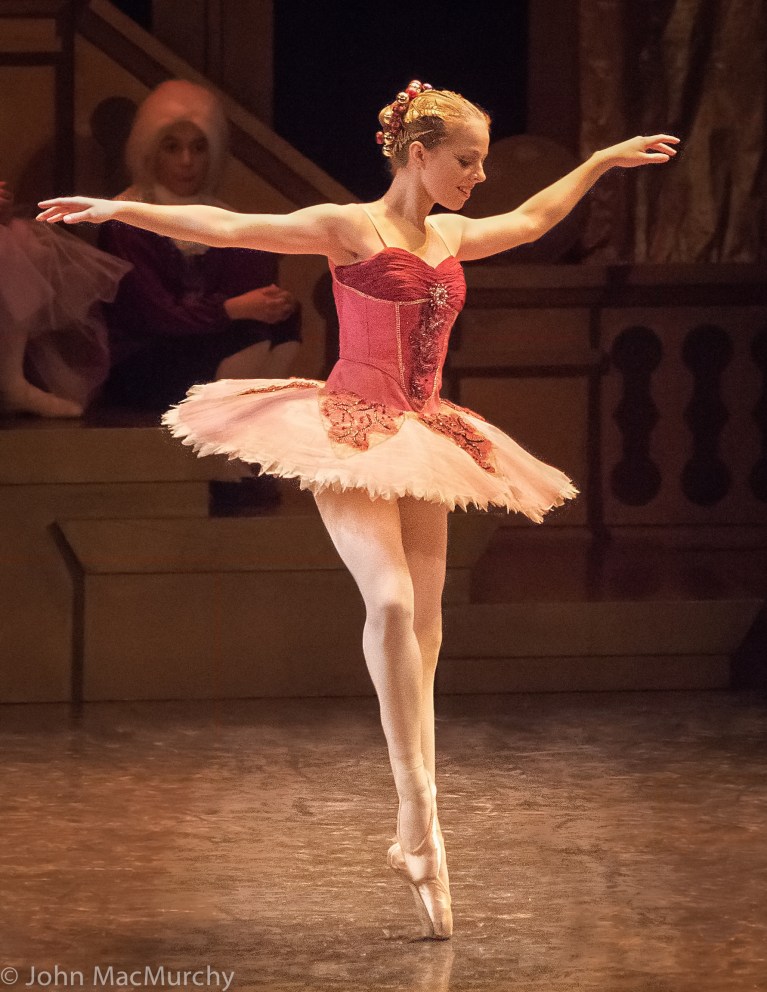
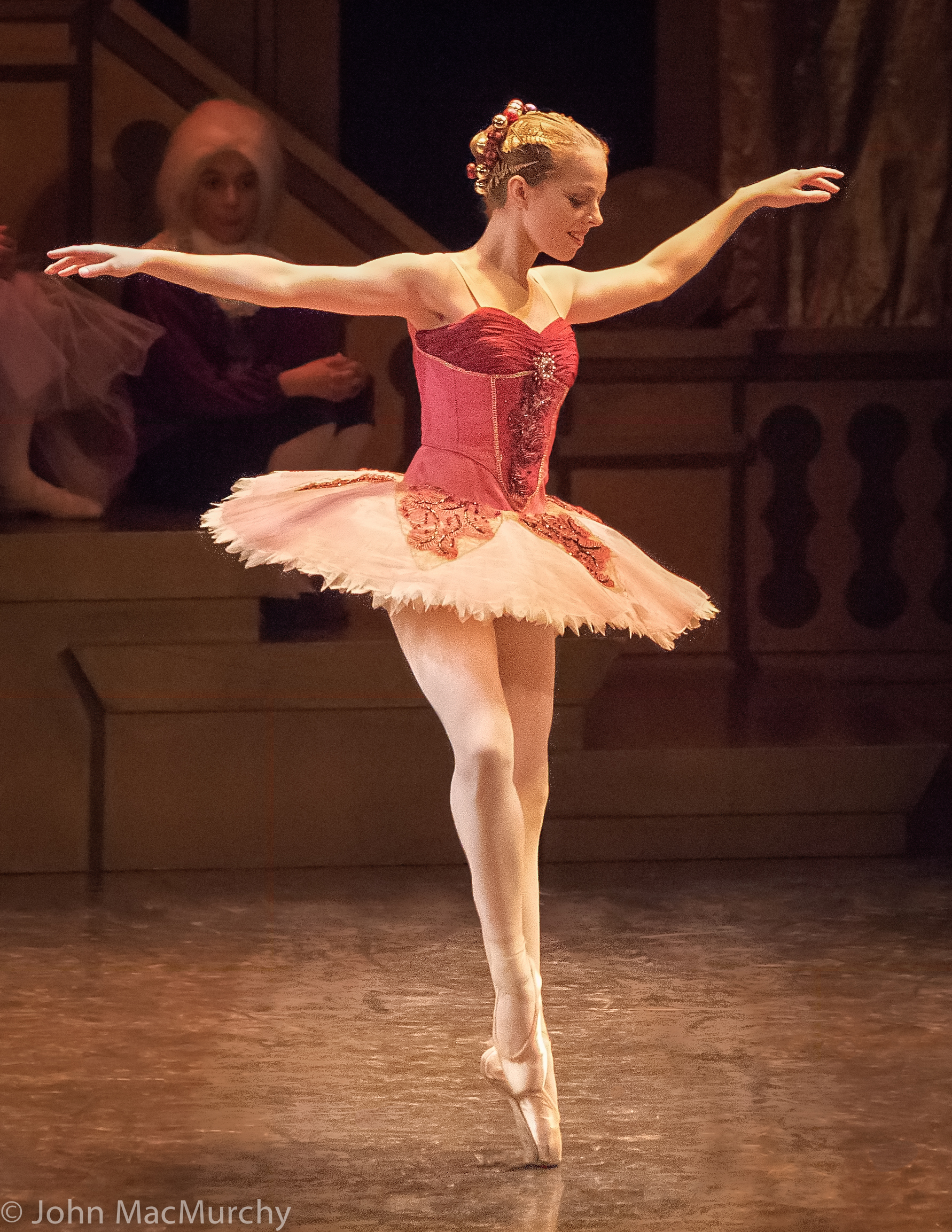
You must be asking yourself what this fourteen year old ballerina has to do with martial arts, fighting, and history?

In fact, I suspect that almost everyone who swings a sword or reenacts can stop reading.  I suspect that everyone trained in any sport or physical art can look at this young woman, and guess what today’s blog is about, and what I’m going to say.

By the way, this is Miss Hannah Lowe of Toronto.  She is a passable Italian longswordswoman, and an effective arming sword fighter as well.  And from her and some other young people I have the honour to train I have learned some dramatic and important–in in some cases, disheartening–lessons about history, and about fighting.

Hannah has been dancing since she was three years old.  By fourteen, she has reached a stunning level of proficiency; if you saw her dance the role of the Sugar Plum Fairy in the Nutcracker, you’d know that she’s nearly at the level of a professional.

Vittorino Da Feltre, the father of Italian humanism (one of them) and the architect of Humanist education, as well as Vergerius and others recommended that young men learn to swim and to dance (some of the humanists were dead set against dancing, but let’s leave them to their stodgy lives) and the Ancient Greeks were devoted to dance.  Both cultures–Medieval/Renaissance and Archaic Greek–were devoted to gymnastics.  Several educators suggest that children swim, dance, and do gymnastics until they are twelve, and at that age, start the art of arms.  As a sword teacher, I was lucky to find Hannah and my daughter Bea at about this age.  Think of them as my experiments in teaching the children of the past (aristocratic children, anyway… see below.)

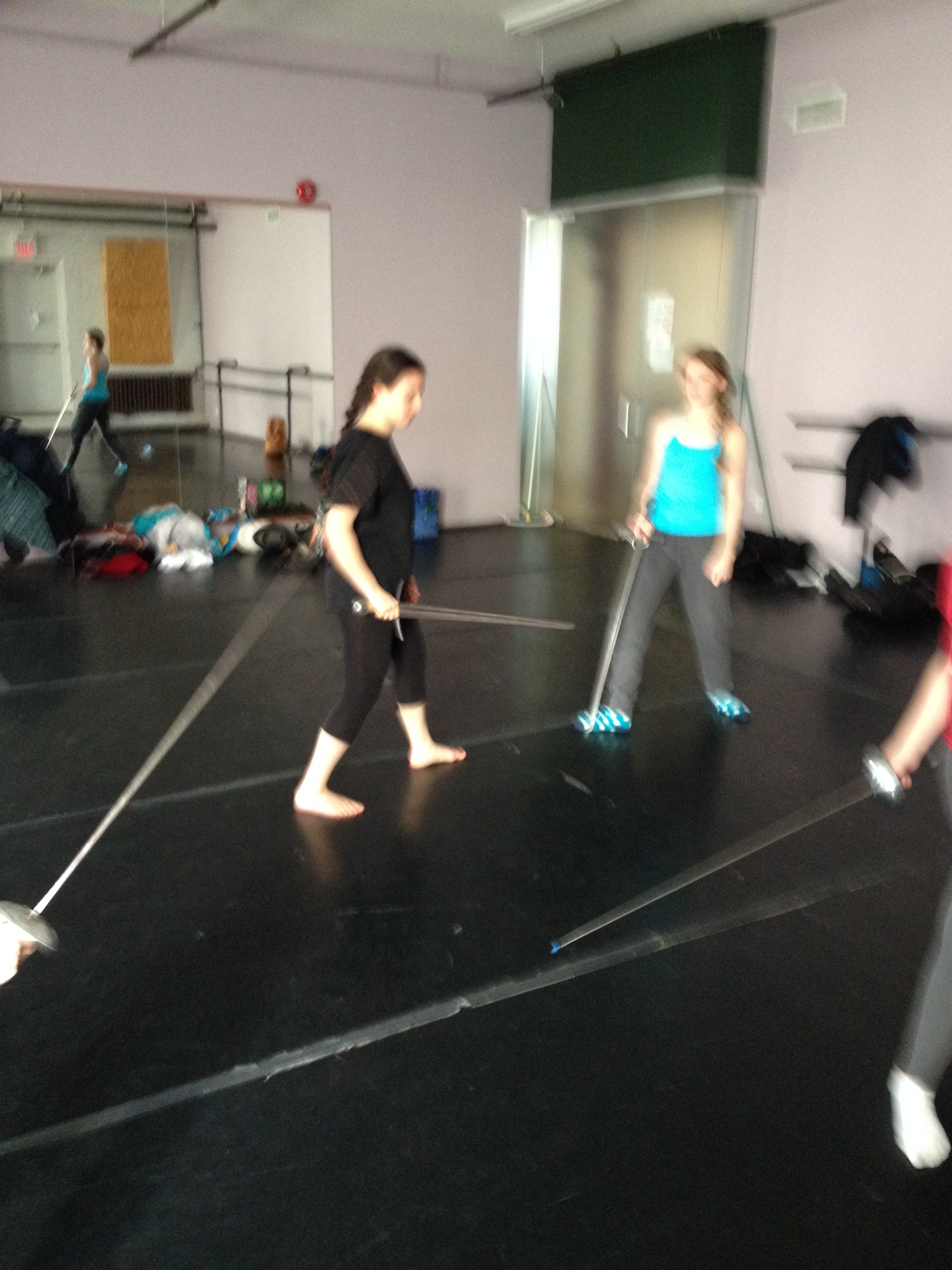
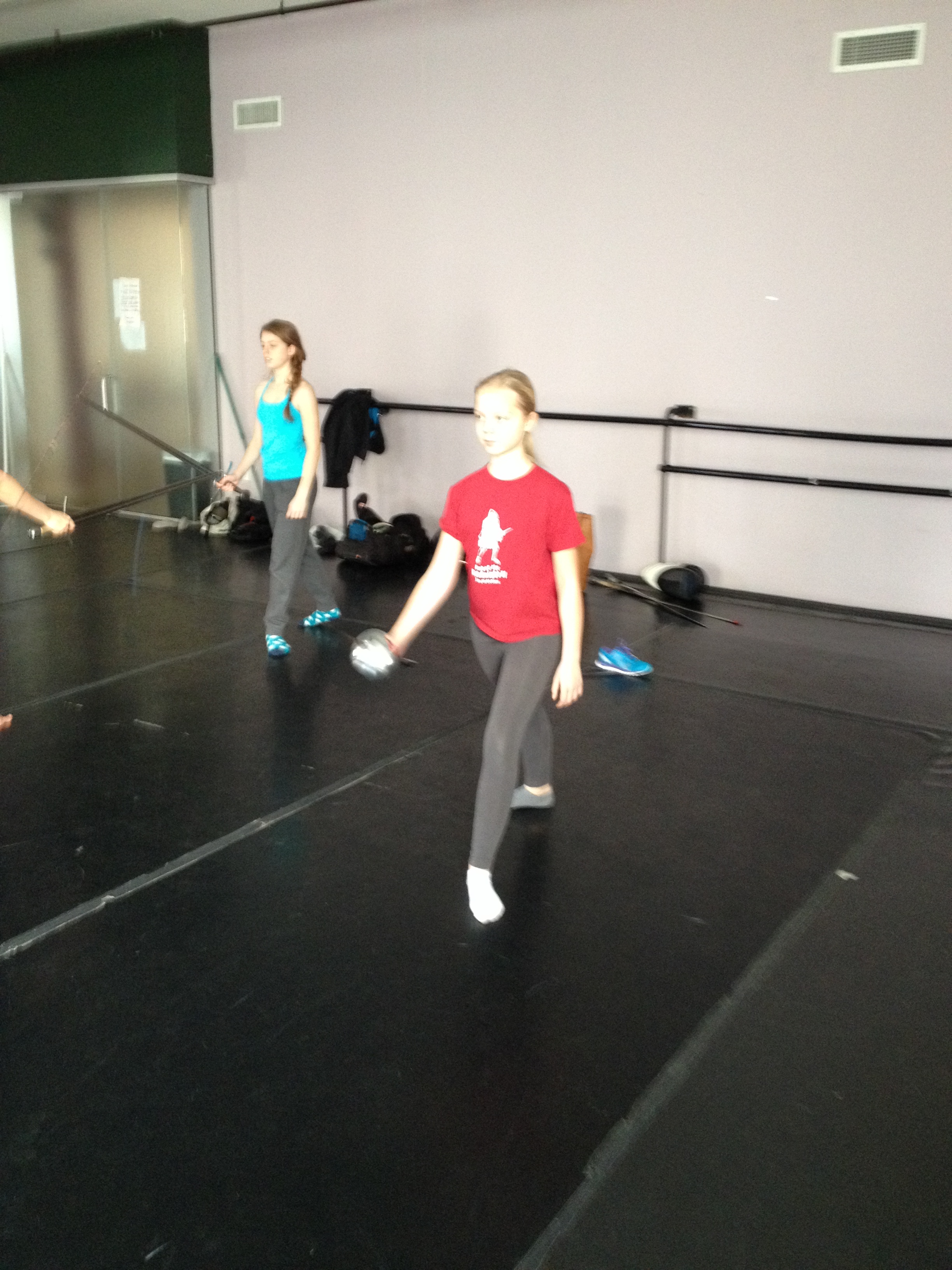
Hannah and Aurora Simmons with arming swords. Aurora's turn comes next week.

Hannah and Aurora Simmons with arming swords. Aurora’s turn comes next week.

The results were disquieting, and changed the way I see the martial arts of the past and the qualities and training of pre-modern warriors.  Hannah went through the entire 12 week basic children’s fencing corpus in an hour and a half.  Some of you are nodding–others, perhaps, fencing teachers, assume I’m a dreadful instructor.  But both Hannah and my own daughter,(an eleven-year old fencer who has been dancing since age three) do not need to repeat body postures more than twice.  If they are shown a drill, they learn it.  They don’t discuss, they do not posture about their own knowledge (displaying a lack thereof).  They do not complain. Most of all, however, they exactly mirror what they see.  So, for example, Hannah mastered the long lunge the first time she did it.  There was no casting about for balance at the end of her reach, and no fumbling recovery.  The amusing corollary to this is that if you, the teacher, have a bad habit, you can assure yourself that it will be instantly transmitted.

This is stunning.  The speed with which children take to the art of arms suggests to me that no modern adult athlete taking up Armizare–or Pankration or Bolognese or Kenjutusu–can possibly match the art of learning, the bodily discipline, or the enthusiasm for practice of a twelve-year-old.  It explains a number of things that had made me wonder in the Medieval manuals…  in Fiore, I often look at the complexity of the plays and wonder how often a swordsman encountered an opponent as well trained–and how often, for example, he even remembered under pressure how to counter a punta falsa.  But Hannah and my other dance children suggest to me that they would, in fact, remember their sword lessons, for ever.  I recently had an opportunity to train one child four days in a row.  I structured our first lesson so that he would get a review of things he’d seen with my friend Greg Mele in February.  Apparently I was the one who needed review– he remembered everything, down to foot placement and even what errors he’d made in class.

Aurora Simmons and Sean Hayes at Days of Knights

Aurora Simmons and Sean Hayes at Days of Knights.  Greg Mele is int he background,and somewhere are my various squires and pages… working…

Ah… but if they all began training at age eleven of twelve, I think I can see it differently.  And the other thing that emerges is how very much better the children of aristocrats must have been at war then the children of peasants–because training matters.  Training is not just good for itself, but for self-discipline and confidence.  Both excellent virtues, in battle.

And this leads me to the part that writers about these people probably need to grapple with.  Because ultimately, it is about character.  And youth and training form character.  Young people who practice their arts for fifteen hours a week are going to have different motivations and different ideas about pain, endurance, pleasure, fitness, and even morality.  They will make decisions that would be very different from the decisions of untrained people.

Antonio Cornazzano, a sometime mercenary man-at-arms and the author of one of the earliest books on dancing, suggests that a his well-trained princess should be able to read Latin, to deliver oratory extempore in that language, and to dance a long dance of her own composing to music of her own composing and accompanied by her own singing.  That would be your thirteen year old princess, and it suggests that being a princess could be pretty hard work.  Or… just… practice.

Some students, trying a Bolognese posture... well, a modern ballet posture, too, it turns out.

Some students, trying a Bolognese posture… well, a modern ballet posture, too, it turns out.

And really, for all you aspiring knights, swordspeople, and martial artists… and baseball players and dancers… it is really all about practice.  Practice at home.  Practice while you walk.  Make practice an essential part of your life, and you will be a vastly better practitioner than if you merely go to class once or twice a week.  Class isn’t where you learn.  Class is where you learn what to practice the rest of the time.  You think practice is boring?

Here’s Hannah:

I practice 10 3/4 hours a week.  I’m going to estimate I spend 7 hours a week thinking about dance.  (That sounds crazy!)  Occasionally I find practice boring, but there are always an infinity of things that can be improved and tweaked, and perfected, so it takes a lot to make something actually boring.

My favourite form of practice is probably how I do it with my private coach. We’ll take a variation that I’m learning and just work on every little detail for an hour straight, or we’ll start with a small exercise and build it up and keep working on it until it’s practically an entire piece. This way of learning is great for everything, technique, presentation, stamina, conditioning….

I’m going to guess that the knights of the fourteenth century and the hoplite class Greeks of the 5th c. BCE felt about the same about their arts…

If you note, my characters all train.  Tom Swan visits swordsmen in every town he travels to…sometimes so I can name drop, but also because I want the reader to see that good swordsmanship, jousting skills, horsemanship–people in the past worked on these every day.

And it is what I do myself, of course.  But then, I started fencing when I was eleven.  🙂

Next Up– The Pen and Sword Tour 2015!  Want to come to Greece, see a lot of sites and battlefields, play with some period weapons,and eat some great food?  Oh, and I teach a sword class…  That’s come out here on Saturday, I think.  If I pressed the correct buttons…

Oh, and a small note:  I own a copy of Antonio Cornazzano’s book on war, and my historical reenactment ‘Not-For-Profit’ (called Hoplologia) intends to pay to have it professionally translated and then we’ll make it available as a PDF free on the internet.  We’ll be cloud funding and looking for donations in a few weeks.  Hope you are interested.  There’s good stuff in Cornazzano.  And we want to make history live, don’t we?

Robin Carter (Parmenion) Guest Blog

Standard
7c4d673d-9935-44cd-988f-c72e753dba9c

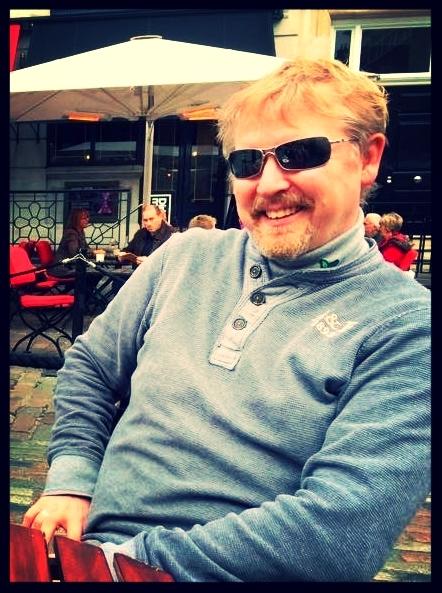
Robin Carter AKA Parmenion

Why Historical fiction?
My journey to become a reader of Historical Fiction is one that started firmly rooted in Fantasy.
My early reading of series such as Narnia (The Lion, The Witch and the Wardrobe etc.) began my exploits in all things magical, before I entered the teenage wasteland and stopped reading for a few years, wasted years now from a reading perspective, but enjoyable ones none the less.

When I became a single parent aged 19 I found myself with time, more time than I wanted, my days were taken running from here to there with all the tasks that small babies create. But evenings could have become couch potato TV heaven. Instead I turned back to the library. Here I found a new set of friends, David Gemmell, Tad Williams, Julian May and many others.

n6205

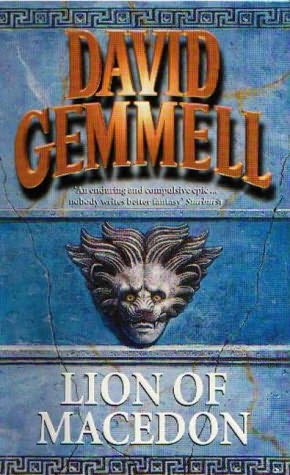
Within a space of months I found myself with a lack of new reading, I had read everything that appealed to me in fantasy and didn’t have anyone to point me in the direction of anything new, I found that the reading had made me more inquisitive, had driven a desire to need and know more. I started to deconstruct what was behind the stories. I would re-read Gemmell, mainly because books like Lion of Macedon were lighting a new fire, one that the school syllabus had done its best to quell, History!

[CGC Side note…  I found Lion of Macedon in an airport bookshop in the Azores in 1990.  I think my S-3 stopped there for fuel…  we were doing an exercise… anyway, I only know the book seized me for three days!  Robin Carter and I bonded over our shared loved for this book :)]

Back to Robin…

At school we didn’t do the Romans, or the Greeks, we didn’t learn British history, our civil war period etc. It was very much Industrial revolution and political history, the thought of the spinning jenny still gives me shudders. All the things designed to put young kids off, to not capture those young minds and set them aflame with a thirst for more. But writers like Gemmell, even in a fantasy environment made me stop and think; The drenai faced the Nadir, were these based on anyone? Clearly the Nadir were the Mongol hordes, did Gemmell depict any accuracy or was it all fantasy? When I spent time checking I found the other nations represented, most nations of the world existed in this world, Swirling Arabs, the Scots and so many more. Then there was Gemmell’s Lion of Macedon, originally written as Historical Fiction, but changed to fantasy because from a publicity angle it could not be released under the Gemmell name, but again it made me want to know more about Alexander the Great and his generals.

So I started looking for Historical fiction, something that would grab me, as yet I didn’t know what but I knew I wasn’t ready for the world of Non-fiction, and reading for the sake of self-learning.

This is where cover art is so very important, the old phrase “never judge a book by its cover” well its rubbish, it’s the very first thing you judge a book on, and any publisher who forgets this does so at their peril. The bookshops have limited shelf space, and thousands of books, so you need something that stands out, online book shops have no lack of space, but you cannot find what doesn’t catch the eye. So i’m amazed I ever found Simon Scarrow, one thing Under the eagle didn’t do was stand out on the shelf, but I was shopping in Ottakers at the time and they had a great habit of featuring books they liked, Simon had been for a signing at the store so the books were prominent. A plot with two squaddies against great odds set in a Briton about to be conquered by Rome, that was me hooked, (good blurb is the next must for a book). Then came Conn Iggulden, his books, had to my new understanding much more publisher backing, they were positioned front and centre and coupled with the catchy cover so you could not miss them. Add to this due I was already well hooked by Bernard Cornwells ‘Sharpe’ (both TV and books)

I also joined Simon and Conn’s web site forums, it was wonderful, the ability to converse with the authors to learn about the books, the characters and what led to their inspiration. It pushed my hunger for more books. I had also by this point been selling collectible books for a few years and started to learn the power of social media, word of mouth advertising, gaining a group of like-minded readers. I wanted more books from these writers, but to get more books they had to sell more books. So by creating demand I was feeding my habit. From these authors I found many others, writers they enjoyed, ones who inspired them, readers with similar tastes, people who gave a monkeys if I liked a book based on previous recommendations. I finally found a decent telling of the 300 with Stephen Pressfield, the history literally dripped from the pages. All the time, every book improving my understanding of the classical world, but also improving my deeper knowledge, my word base and understanding of politics, weapons, fighting skills, ships, seamanship, armies and so much more. Mainly it increased my knowledge of the genre, the authors, the books to recommend and the people who wanted to hear about new books.

The online world of Historical Fiction led me to many new authors, Ben Kane, Giles Kristian, Simon Turney, Tony Riches, Paul Collard and many others. The most surprising thing of all with these new authors was that they were all fans as much as writers, we all shared a love of the subject matter and while I am not a member of the writers fraternity but I had my place, I could help them reach a wider audience at the same time as enjoying their work. The relationship between the reader, reviewer and writer is somewhat symbiotic. I’m lucky enough that now I get to call many of these writers my friends.

I thought for a time that this was as much enjoyment as I could wring from books, but then I found new joys, I was asked to test read a few books, to help shape them, to point out any mistakes or continuity errors that existed (at least the ones I could spot). This was a great experience to be part or the writing process, and in a few cases to be in the book as a character (the unexpected rewards for the work are ones that really put a smile on my face), Then the next step on from that to be asked to feedback on how the interplay of characters works, or doesn’t, if the positioning of segments of the plot works, if characters feel real etc. to really help shape a book. This was the greatest compliment of all and the next best thing to being able to finish my own story. Every time I’m asked to do this it’s a humbling experience, I know when I’m writing I hold onto the work, I’m not sure if I can release it for criticism and if I did it would be to someone I trusted, it’s that that goes through my head when I’m asked, and drives my desire to always do my best, and hope I have given enough from my amateur background, I have lately asked if I can see the feedback from the professional editors so I can see what I missed, what I might have fed back better/ clearer, there is still so much to learn. I think if I had my time again I would have loved to go into publishing.

Now instead of having to ask to review a book and hope I am lucky enough to get a copy suddenly I am being asked to review books, it is still a humbling experience, and one I take seriously, I don’t work for the publishers, my view and opinion doesn’t shape if I will get sent a book to review, the publisher respects (I hope) that I put the effort in and that I have a sizable amount of people who seem to read similar books and so take my review as a lead to buy a book (or not), yet I cannot bring myself to write a review slating a book, knowing how long it takes an author to write and research a book I have always thought that my personal taste should not mean a potential loss of sales due to a bad review. My lack of review may speak loudly, but at least people can make their own minds up. I want to lead people to great books, my job isn’t to warn them away from books. This I think is the difference between a reviewer and a critic.

I find these days that I want to be more informed in my reviews and reading, and this has led to a new evolution, into the re-enactment circles. I have not joined a group as yet, I hang at the fringes (mainly because time is limited) but the amount to learn from the great minds in this arena is significant. One major source is Christian Cameron’s Hippeis Online Agora. Not only is Christian my favourite author, but also probably the smartest man I know. He attracts people who want to challenge the preconceived notions of history and do so by trying to recreate them, to learn by doing. It’s a fascinating process to watch and one I dearly want to be involved in, and to this end I’m taking up archery this year, thanks to another member of the Agora, Chris Verwijmeren, a fantastically knowledgeable and giving chap, he has found me a bow and made me some arrows, (I know made, amazing isn’t it!! ) and I know will be there to support me as I learn (my beginners course starts in April), this appears to be the way things are with Re-enactors, the need and desire to share ideas and information, to learn to adapt, to try and do things to see if they do work, to share a theory to see if they can prove it. They build from diagrams, from murals, from carvings, anything that might give a clue to form and function. All of this gets fed into books written by people like Christian Cameron , David Gibbins, Simon Turney, Ben Kane, Anthony Riches and so many others, it’s what makes these books so real, and the experience so tangible.

All of this means for me (I hope) a bright future, a future of great books across both Genres (well at least 3 …did i mention how authors like David Gibbins, a Marine archaeologist who is bringing real history, research and exploration into Thriller novels. Seriously read his books they are excellent.) For those who love books remember to be involved, leave a review, come along and read the blogs, visit the author web sites and forums. There is so much out there, and links to so many groups events and educational pieces.

So… sorry for the huge brain dump, but Christian freaked me out when he asked me to do a guest blog, and I wasn’t sure what to write about. In the end I chose what I love, books, and why I got involved. I’m still working on my great idea, I hope one day to have my name on the cover as an author. For now I will love the cover quotes and being a character in some great books (ps… anyone who wants to make me a character, please do, I love it…I don’t mind a little dying 😉 [CGC here — OK, Robin, you asked for it.  Traitorson 4 ‘Plague of Swords’ and you will be a character…]  and if you are new to this then reach out to someone for help. I know I love to help debut authors, there are many others out there in the different genres who want to help. It’s an amazingly supportive world, where authors/ experts work to help each other, its not a competition for shelf space.

thank you

(Parm)

Robin Carter (Parmenion) 

Parm lives and works in the UK.  He runs a really good blog that is also a clearing house for new and excellent HisFic and sometimes fantasy titles.  I sometimes think that without him, no one int he world would ever have read any of my books.  By the way, as you read this, I’m fishing with my dad in the Adirondacks.  Or perhaps tying flies with my daughter.

IMG_0144

Good History Writing — In Praise of Ben Kane

Standard

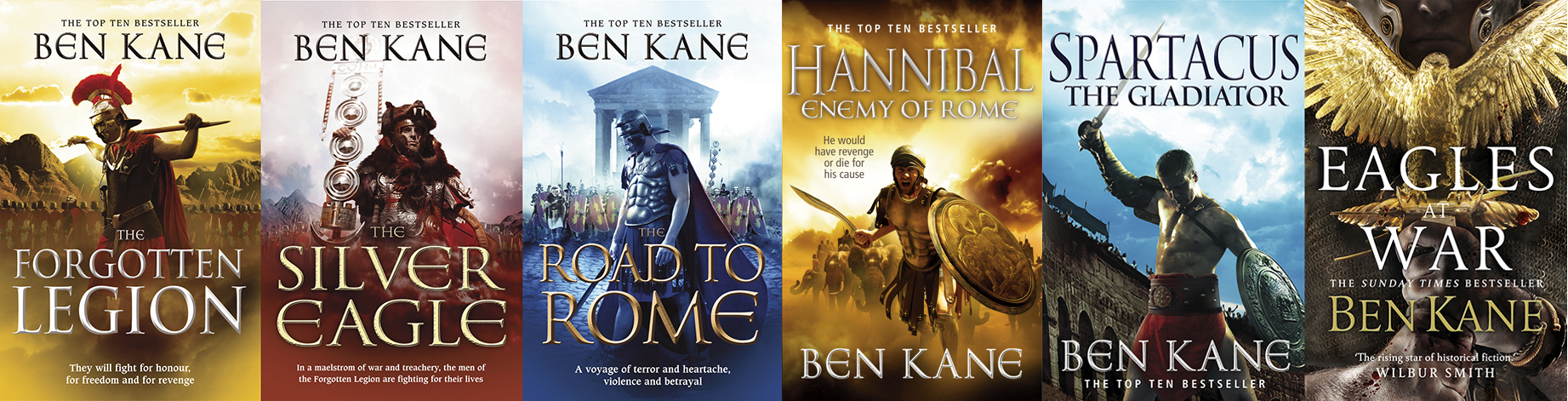
BEN KANE BOOKS

http://www.benkane.net/

I love Ben Kane’s books.  I look forward to them eagerly; I get them in hardcover; I’ll eventually meet him and get some of them signed.  (Getting all of them signed seems unlikely, given the decline in international baggage allowance and my near-constant need to get armour into my baggage.  A problem that I suspect Ben Kane shares.)

Why?

Because he is as devoted to authenticity as anyone who writes in our sub-genre of military historical fiction.

ben

That’s Ben, in Roman Legionary kit, pinched from my friend Robin Carter’s blog.  In fact, Robin will provide a guest post this Friday, as I’ll be in the Adnacrags–er, the Adirondacks.

But… why does authenticity matter?

Well, at least for me as a reader, it’s like this.  Ever see an episode of ‘Sherlock’ on BBC?  When I’m reading Historical Fiction (or fantasy, to be honest) and I come to something I know to be untrue — historically… and friends, that’s just as valid in fantasy, and if you read this blog you already know why–if I hit one of those moments, I have an alarm in my head that sounds like Benedict Cumberbatch saying ‘boring.’  It is boring.  Falsity is boring.  It wastes my time and my effort and entertainment time in reading.

Stirrups in Early Imperial Rome?  Trousers tucked into boots in fourteenth century England? Unbelievable swordsmanship–untiring horses, eternally loyal friends, ancient world or medieval girlfriends who don’t get pregnant nor worry about same, cotton garments in ancient Greece, limes in food in Greece, arrows shot from the wrong side of bows with the wrong grip, chitons called tunics, plate armour that can be ‘pulled on’, unriveted chain mail, happy slaves, warrior races, superior elves, evil gay people…

The list is endless.

Ben Kane never lets me down.  I cannot remember a moment in a Ben Kane novel where I softly put the book down and hope I won’t remember this bit when I come to pick it up again.  He never causes me to say to my wife ‘Doesn’t he know that legionary crests are detachable?’ or ‘Oh, God, he thinks chain mail is attached to the plate armour?’

Now, honestly, I can also praise all those things real reviewers praise.  Reviewers like Parm (Robin Carter) speak meaningfully of plotting and character and motivation and all that author stuff.  And I agree — Ben has great plots, he does a brilliant job of putting you there and making you believe the story and the characters…

Look, I am an author, and one thing you learn when you are an author is that every reader is different and some won’t like you.  Some will like you for odd reasons and goodness, I hope Ben does not read this and wince.  But the truth is, I don’t really need a great plot to enjoy history.  I know how it ends anyway.  What I want is immersion — a few hours where I’m there.  I could be buying horses in a Celtic horse market, or sneaking up on a Roman outpost, or plotting rebellion against the bloody Romans…  or maybe marching for hours as a legionary with my feet hurting because my hobnails are finally working their way through the bottoms of my caligae.  That’s what makes me a happy reader.  Immersion.  the sense that I’m there.

Now, in fact, I am not one of those readers who snarks at the least deviation from the events of history.  This may shock some of you, and I’m sorry, but we don’t actually know very much about what happened on ancient military campaigns.  We have a handful of histories, all written by people with something to sell — trust me, Thucydides was as much a politician as Tony Blair or George W. Bush, Livy was no better, and Polybius and Diodorus Siculus… well, the less said the better, really.  On most of the key events of the most important military campaigns of the ancient world, we have one or two accounts written in some cases a hundred or two hundred years after the fact.  Osprey books and the like tend to give campaign histories as if they are biblical fact, but we all know the bible isn’t to be taken at face value, right?

There are very few ‘facts’ when we ask hard questions about where horse fodder came from for Caesar’s German cavalry.  Or even, how many of them there were.  But we do know a little of what they wore and what weapons they used, and we can even get pretty deep into what they ate and even what kind of horses they rode.  Those are the details that we know, so when they are missed, its boring.  The day to day plot of the campaign?

Its not simple.  We don’t know the hows, and in all too many cases, we don’t know the whys.

And that, my friends, is why it’s such a joy to be a novelist instead of an academic.  And why, in a long, possibly over wordy nutshell, it’s a joy to read Ben Kane.

     I asked Ben ‘What skills and life experiences add to the authenticity of your description of the past?’

He replied, ‘Thanks to my training as a veterinarian, I know all about surgery (think animal sacrifice, divination, medical treatment and combat). A summer spent in the Kenyan bush as a student means I know how to slit a throat (a goat’s can’t be too different to a human’s in that regard), and how to butcher a carcase. I learned about hunting with bows and arrows from Maasai warriors. The more than 800 kilometres that I have marched in Roman military gear (including hobnailed boots) have hugely informed my opinions on how legionaries lived. Being a father has taught me how to write about children, in some way at least! ‘

How cool is that?  It is life experience that informs writing–not just reenactment experience, but real life as well.

There are, thankfully, quite a few writers whose work satisfies me completely, and in this blog I’ll touch on them from time to time.  I’ve already mentioned Simon Atkinson Turney (that’s SJA Turney) –you can flip back and read my review of his Ottoman Cycle.  And, over the summer, I’ll probably write more, about some other current writers I really admire–CJ Cherryh leaps to mind, and Glen Cook, and Giles Kristian, and…

Writing about Magic — Fantasy, History, and Electronic Warfare

Standard

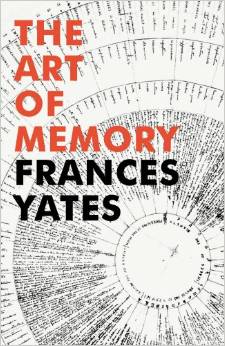
Art of MemoryDoctor Illuminatus

Lancelot GrailMedieval Craft of Memory

As you know, if you follow this blog, I don’t see the boundaries between Historical Fiction and Fantasy as clearly as my readers (or editors) might like.

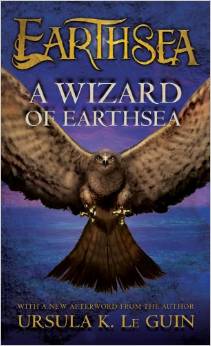
When I set out to design a magic system–oh, about thirty-five years ago, I was heavily influenced by a single book that I had just read–really, two books, one a fantasy novel, Ursula le Guin’s phenomenal ‘Wizard of Earthsea’…

Wizard of Earthsea

….and a wonderful book which promised me, when I took it from the library at age 16, that I would be able to cast real spells.  If you have never held a copy in your hands, I recommend that you buy one; it’s Isaac Bonewits‘ seminal ‘Real Magic’.

Real Magic

Now, those of you who read my books, or even my blog, must have discerned that I have a hands-on attitude to most things–I have to try them for myself, and magic is, I fear, no exception.  As Master Bonewits laid out for me everything from a love spell (very handy for the average sixteen-year-old male) to a curse–with some exceptional advise on the shortcomings of both…

I learned a great deal from my brief enthusiasm for the occult.  I learned a lot about the system; I saw clearly how important ritual was, and without any adult telling me, I suddenly saw the ‘power’ in the rituals I saw at church and how related they were to the rituals of ‘magic.’ My parent’s interest in the field that has since grown to be called ‘Performance Studies’ probably flitted in and out of my intellectual consciousness, too.

Aside from ritual, my flirtation with magic also revealed to me some of the basic ‘logics of ‘magic’.’  (Note how I am making no effort to define what magic is?  Yep.)  I noted that ‘like to like’, which is one of the base rules of magic, has a sort of sense to it that can run through almost everything we observe.  Curiously, in my lifetime, the study of DNA, and the forensic understandings of everything from fingerprints to trace DNA, suggest that the world actually does function on a sort of ‘like to like’ and that anything you ever touched does, in fact, forever carry a blueprint of you.  Funny, that.

To my mind, while JRR Tolkien and ER Eddison defined what epic fantasy would look like, and while Tolkien, in effect, established the heroic, (as opposed to demonic) mage as a standard character, neither master of the genre did much to explore magic.  And I’d go further and say that to me, Ursula Le Guin did.  She established a system–an organic, fairly believable system that allowed me,as a reader, to suspend disbelief and understand the powers and weaknesses of her mages.  She established limitations.

A small digression.  Of course, while we all like a system, I’m never happy when writers over-explain.  Anyone want to tell me how the world in which we live now actually works?  Please synopsize climate change since the last ice age in five sentences.  Prove you are correct.  Thanks.  (My point is that we still have doubts, discussions and debates about fundamentals of our own world and our own universe… why expect a writer to give you all the keys of ontology and cosmology in one go?)

Anyway… in addition to books, there were role-playing games.  The truth is, I designed my first magic system for a role-playing game, and both Dungeons and Dragons and ICE’s ‘Rolemaster’ rules worked easily with the concepts laid out by Le Guin and by Bonewits.

More recently, when I started to ‘get serious’ about Classics and the Classical world, and when I began to write the Historical Fiction (Fantasy?) series called ‘Tyrant,’ I had gotten interested in philosophy, and more particularly, various contentions from 19th century Germans and later philosophers about ‘Being’.

What the heck does that mean?

It means that when I decided that to make Kineas authentic and real, (whatever that means) he had to believe what other Greeks believed, not what I believe.  This may seem banal to you, but it’s a hard boundary to cross.  It is pretty clear to me that Greeks believed very strongly in omens and dreams–in events which, occurring in the natural world, pre-figured other events in the world of men.  Astrology is the greatest survival of this system, and I was very lucky to have access to a dedicated and rather brilliant modern Astrologer, Julie Simmons, for some basic education on how Ancient Greeks might have seen the world.  So… throughout the series, the gods participate directly in characters dreams; characters read auguries, watch birds, and get results.  They cut open animals as sacrifices, make invocations to gods… and get results.  Why?  Because, quite frankly, that’s how Alexander and Julius Caesar and a number of other ancient people thought the world worked, and ‘being’ a cavalry commander in the Hellenistic world involves some belief.

So… when I came to write the Traitor Son series–to return, as it were, to the world that I’d created as a teenager, I didn’t really have to ‘reform’ the magic system.  It was fairly fully realized.  But I had learned a fair amount of history since age sixteen,and I had some of my own.  I’d seen some magic in Africa, and I’d run across hermeticism (as above, so below, like Astrology).  And then, just as I was ready to begin writing the Red Knight, I found Francis Yate’s brilliant, odd, difficult, fun book ‘The Art of Memory.’  I challenge you all to read it for yourself, but I’ll admit that all my memory palaces and my concept of the place of ritual in spell-casting came suddenly, almost full born, (like Athena from the skull of Zeus. Had to say that) from my first night’s reading.  I followed Yates with Mary Carruthers (The Book of Memory and the Medieval Art of Memory)…

The Book of Memory

And my ‘system’ was changed.

S-3

That’s not me, but it is the only picture of an S-3 Viking TACCO station I could find on the web.  Now, aren’t you already wondering if I’ve cut and pasted the wrong two articles together?  What can this possibly have to do with the evolution of a system of magic?

In 1990, I had the great pleasure (and it was) of serving in VS-31 (the Topcats.  I still have my ball cap).  We were onboard the first US Navy CV to come on-station against Iraq and (way back then) Saddam Hussein, and our aircraft (designed for anti-submarine warfare, and very good at it) were suddenly pressed into service conducting somewhat impromptu electronic warfare support all along Iraq’s border with Saudi Arabia (and this was let me add, hours after Iraq’s invasion of Kuwait. )  This little moment in military history–hardly anything important–was a revelation to me, as my plucky little plane drank in signals from hundreds and hundreds of miles away and gradually, stealthily mapped the whole of Iraq’s air defence system.  Some nights, we’d light off our own incredibly powerful radar system and ‘shine’ it on their surface to air missile sites…  in response, they would come up–sending live signals that we could intercept, and allowing us to refine our targeting data.  Other nights they would ‘go down’ as some panicked–or very realistic–Iraqi officer took his active radar off the air to avoid detection and destruction.

Now, it may appear to you that I’ve left the world of magic behind, and, it may also appear that earlier, I dissed my beloved JRR Tolkien.  Neither is the case.  One night, while serving my pilot some chocolate chip cookies at 8K feet over the Iraqi border, it occurred to me that Gandalf says

“If there are any to see I at least am revealed to them. I have written Gandalf is here in signs that all can read from Rivendell to the mouths of Anduin.”
J.R.R. Tolkien

I probably spilled my coffee, it was so obvious to me that magic must work like electronic warfare.  And from that moment to the moment that I understood how the aethereal might work to the understanding of a hermeticist…

S-3B Viking  Photo by PH3 Todd Frantom

OK, that another view of an S-3 Viking… on another day a year later, flying far out from the carrier over the Mediterranean, a fairly senior officer spent the time to show me how ‘ducting’ works for electronic waves–radio waves, radar, and so on, which is to say that while we all imagine that radar, for example, travels line-of-sight, under certain weather conditions, a radar signal with ‘duct’ and get trapped at a certain altitude, bouncing up and down, so that it is possible to image an object hundreds of miles beyond ‘line of sight.’  Likewise, with a sonar (the S-3 also had sonar capabilities) it was possible to detect–or fail to detect–a submarine because of specialized conditions in the water–a steep gradient in salinity or temperature can bounce a sonar signal, as all readers of Tom Clancy know.

As I write the opening pages of Traitor Son book 4 (Plague of Swords) I’m going back to this world, and I promise, without spoiling anything (I hope) a magical confrontation that will bear all the signs–and tactics–from electronic warfare, from Bonewit’s ‘Real Magic’ and from years of trying to refine the system.  I want it to be rational and comprehensible.  I want the reader to be able to suspend disbelief and say ‘Of course Harmodius can do that’ not ‘oh, how convenient, the nun has super powers.’

Which leads to my last comments and some more books.  For the writing of fiction, everything (to me) starts with character, and not plot.  So what makes the mages interesting, to me, is who they are, and not what they can do.  Harmodius and Morgan Mortirmir and Desiderata and Thorn–and twenty other characters–have skills acquired through learning, and sometimes, have inborn talent as well, and I try (however ineptly) to show how those powers shape them.  Can you imagine having the ability even to light a fire with magery?  How would that change you as a person?  How would it be if you had the equivalent of a cocked but hidden AK-47 in your mind, always available?  Or looked at another way, how does it create character to study the art of memory and the exercise–the direct exercise–of power?  Is it like the direct exercise of violence, as soldiers and knights learn it?  Is it like science?  How does it effect….everything?

And finally… or maybe first–I have always loved Merlin–born to be the anti-Christ, the son of a demon and yet refusing his evil role.  The great mage, the king’s support, the wise councilor.  I strongly recommend that fans of Arthurian Romance give some time to reading the Lancelot-grail reader, by Norris Lacey (well, edited by him) because these are translations of the thirteenth century French romances from which the Morte D’Artur sprang.  There’s a great deal there, and I try to return to it for inspiration all the time…

But that’s another blog for another day–the Arthurian mythos and the Iliad and other tales…  next week, a guest blog and some more craftsmanship that should boggle your mind, inform your reading, or help your writing.

Damn, I didn’t even MENTION Ramon Llull.  Heh heh heh.  Another time…

Writing about Crafts — Interviewing Jiri Klepac

Standard
portret

Jiri Klepac

This week, I thought I’d interview another armourer.
Now, perhaps you are all bored by armour, but to me, it is the most complicated costume artifact ever. Let me put this in perspective as a writer. I wear armour 20-30 times a year, and almost every time I wear it, I learn something—something about fit, perhaps, or fatigue avoidance, or maybe just a better way to lace the plates to my arming coat, or a better place to put my hands. This process has slowed, but it never stops, and the process itself has a sort of meta-learning—I now have an ever-better notion of how much training it required for a knight to be able to wear, and maintain his harness. And how long it takes to put it on or get it off.

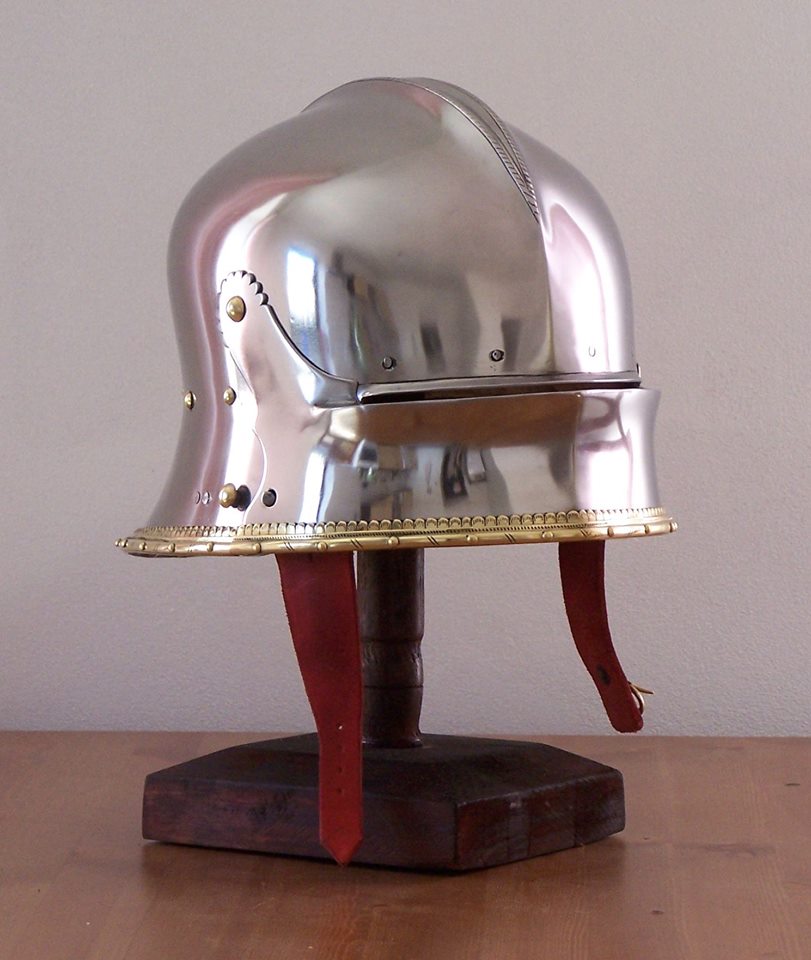
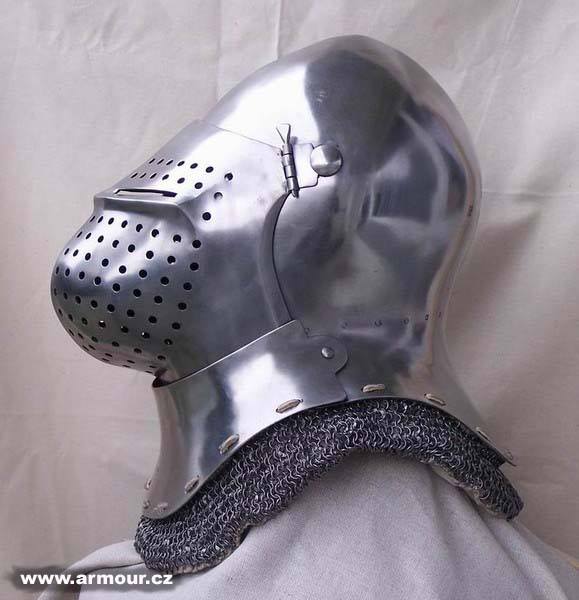
Me at Days of Knights in Kentucky.  At this point I've had ten bouts and I've also served as a referee (still in harness) so tired.  Arms and gauntlets by Jiri Klipac, helmet by Craig Sitch, legs by Mark Vickers, and breastplate by Peter Fuller.
There’s a piece out there in Youtube land about how hard it is to wear armour, and some researchers at the University of Leeds put out an article too. And their findings vary between the banal (wearing armour makes you tired) and the slightly absurd—the French lost Azincourt because they were wearing armour… hmmm. The truth—at least according to me—is that wearing armour is a skill. I hope that any volunteers in studies have the skill. And that fit matters terribly—incredibly—so that as knight in perfectly fitted legs has an incredible advantage on foot against a knight whose leg armour pinches. Add to this a matter of fitness—I find that every single effort I make towards personal fitness is rewarded in harness. Every pound of weight I take off is less I’m carrying—because I’m carrying 90 pounds of plate and chain, that’s why. All the rope-skipping and jumping jacks and running—is required for my legs. Wow, you want strong legs in harness. And so on.
Oh, and by the way, there’s a size determinant too. A big man—like Edward III or Bad Tom—has more muscle carrying his armour. There is a definite power-weight ratio—the bigger man’s bigger armour isn’t really much heavier, but his muscles are that much stronger, and thus, he’ll fight longer. In armour, ‘to the big it is given.’ Size does matter.
Anyway—Jiri Klepac is ‘my armourer.’

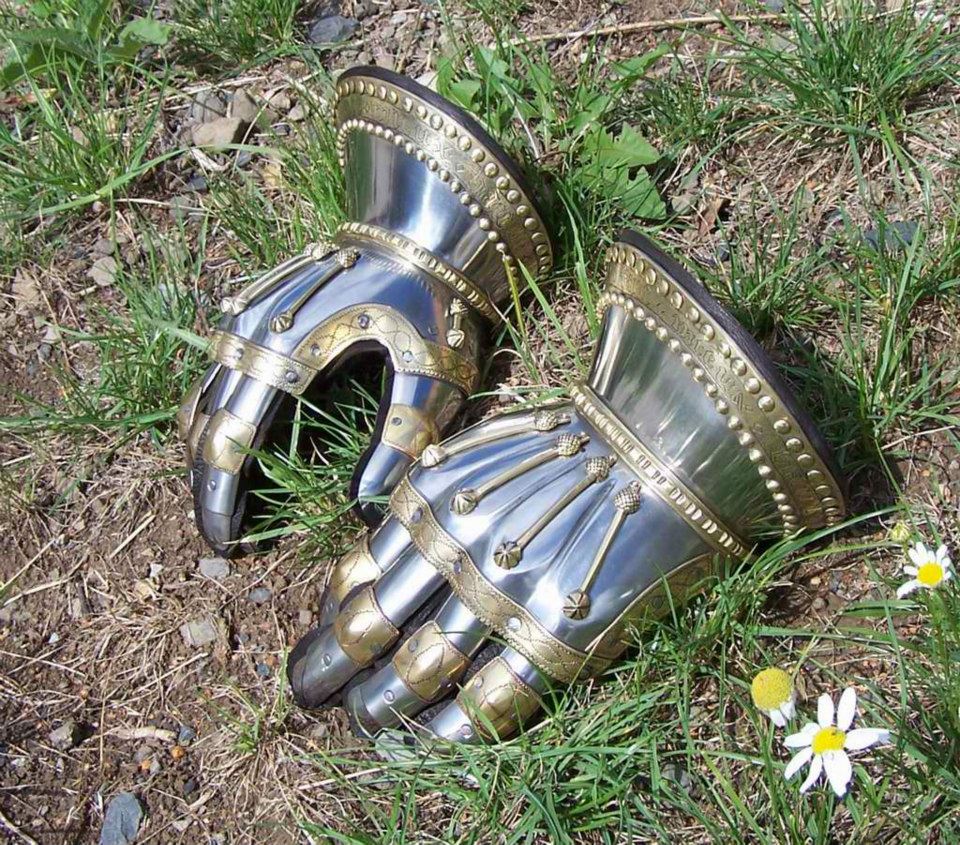
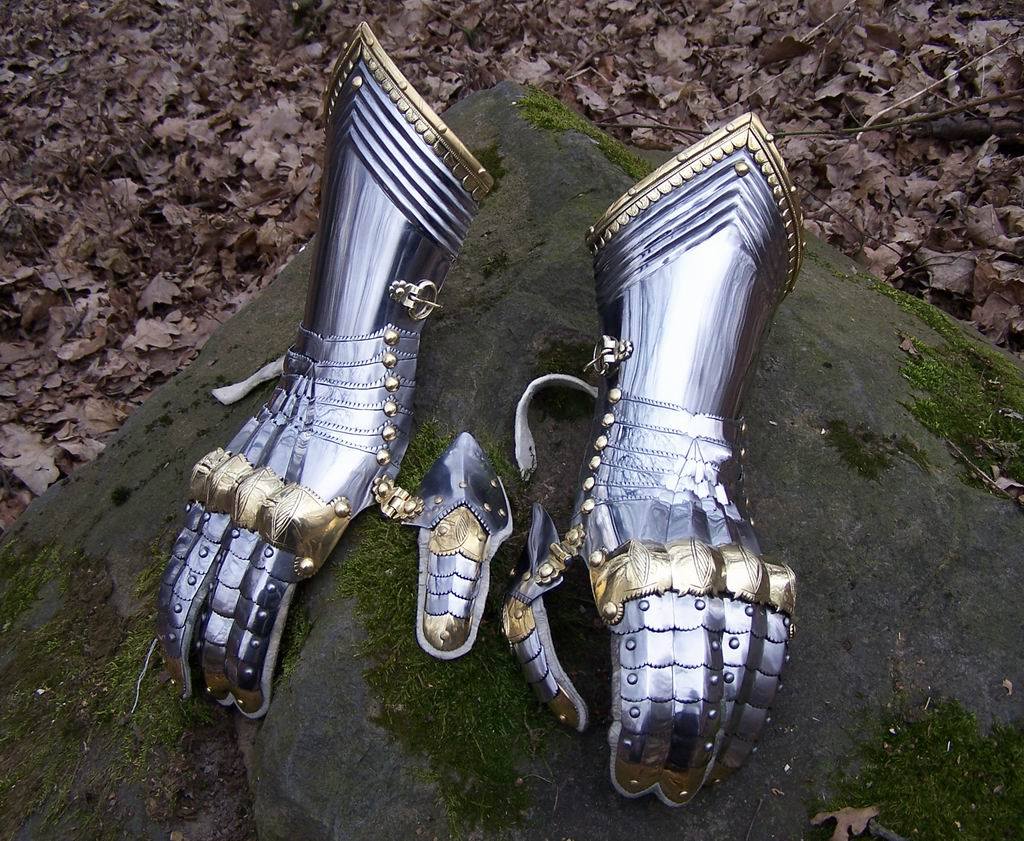
My gauntlets.  Oh, and the Captain's, too.  Hardened steel, my motto (Geoffrey de Charny's) engraved on the cuff band.  Light as air, strong as faith.

My gauntlets. Oh, and the Captain’s, too. Hardened steel, my motto (Geoffrey de Charny’s) engraved on the cuff band. Light as air, strong as faith.

That is to say, he has made the most important part of the harness in which I fight, except the helmet. To my mind, he is the most aesthetically talented medieval armourer in the world, and perhaps the best overall, although I’m probably not the right man to judge, and Robert Macpherson, Craig Sitch and half a dozen others (like Jeffrey Hildebrandt) might well deserve that honour. (And I like all their stuff, too.  Mac made my first harness and Craig made most of my Greek stuff.  They’re both brilliant).  As an aside–who’s the best?  It’s like books and sports teams.  A lot of beauty is int he eye of the beholder.
Because I couldn’t stand in Jiri’s shop and annoy him all day as I did with Jeffrey Hildebrandt, I chose to interview him. I thought all of you might be interested in what a master armourer had to say about his craft and his work.

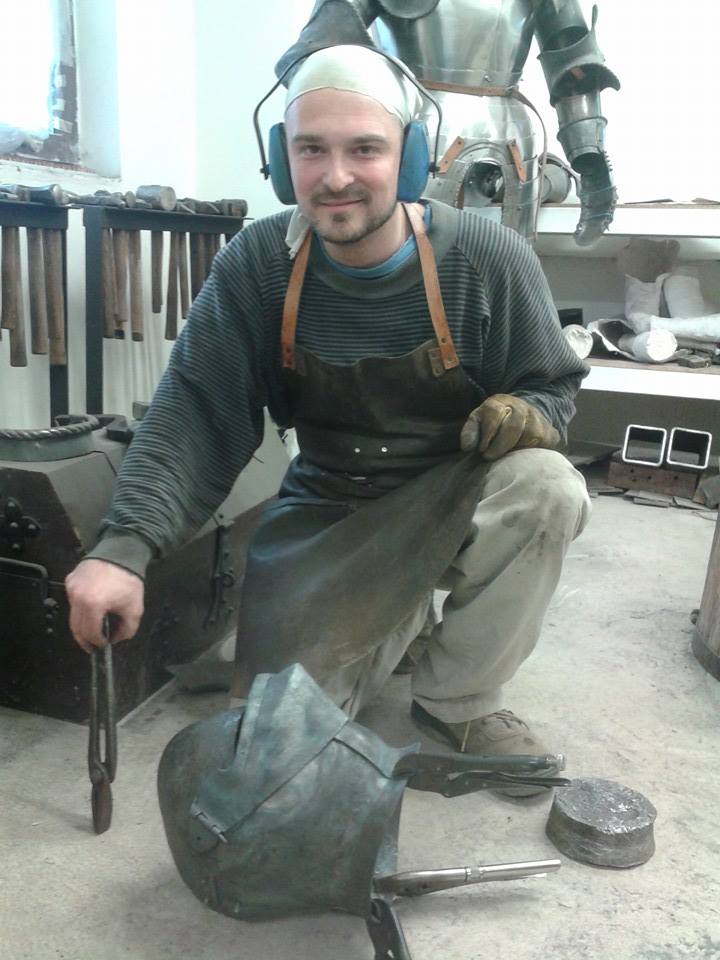
The man himself, in his shop.

The man himself, in his shop.

1) How did you become an armourer?
1a) I became an armourer due to the lack of money and expensive taste for armour for my own use. After some time I realized I liked the production of armour itself. More than using it actually.

Black from the hammer, so to speak.
2) What formal training did you have?
2a) No formal training, 20 years in trial and error school. I have a bachelor degree in economics. I have read a good number of books armour smithing, sheet metal working and art. I spent literally years watching original pieces of armour. I have seen many great craftsmen of various crafts working. And realized that it is not much about the hands but mind to make your working process effective and also about seeing the piece already finished in your head. No matter if this is armour or a table.

1604860_472571969536026_25032147_n
3) What did you have to teach yourself?
3a) Alpha to omega basically. I keep learning and re-considering my technology pretty often. Developing my eye in considering the shapes continuously. I needed to learn seeing the aesthetics of the period from the angle of the people living in those days

249728_222328014560424_8727288_n
4) What part do you love best? 5) What part do you hate?

4a and 5a)I usually struggle with the current project and looking forward the next one It is not about what I do, but how. I don t prefer any particular part.
6) What time period, if any, is your favorite? Is this artistic, stylistic, or practical?
6a) I like mostly real fighting stuff pieces, mid 16th German and mid-15th Italian. For its simple lines that look pretty easy to do, but are very hard to reproduce properly. I like rough pieces made by craftsmen who knew what they do. You can see they were trained well by their teachers and trained in one particular style of armour only. We are much more distracted today, making conical helmet one day, Milanese BP other day and cuirassier next day.
7) Do you wear harness yourself?
7a) No more, but I used to. I needed to sell my own armour after I was scammed badly three years ago

11173512_669727379820483_919123203_n
8) What is one thing you’d like a first time customer to know?
8a) that they really have to be patient to get a piece by me

10535675_552065678253321_5004550152252756312_o
9) What is one thing you wish all customers did?
9a) shape themselves into the body form matching the armour style they are about to have built. It is often very painful to compromise function and aesthetics.

10592774_552064398253449_5659304258521538931_n
10) Anything you’d like to say? Anything at all. Politics? craftsmanship?
10a) I am not very much a man of words, especially in English. Also my politic opinions should not be connected to the craft. I might say that I wish everyone being as happy in their professional life as I am as an armourer. Hard work, but lot of self-realization.

In closing, you can find Jiri Klepac at jiri@armour.cz

His prices are quite reasonable.  His wait time is long–he is currently looking at November 2016–like all the good armourers out there.  Want something perfect?  Get it from a master.  And wear it for the rest of your life.

But be patient.  One of the things I like best about Jiri is his honesty.  He will update you on his progress on your project–or tell you about his failure or his delay.  I love this.  But the customer bears half this responsibility.  Don’t nag.  Be aware that this is master-craftsmanship, and that replicating the great art and technology of the past is not a matter of programming to fine tolerances.  It is a matter of art and patience and even a little good fortune.  Give your craftspeople the time, and they will do great things.

Want to see Jiri working?  An old Czech TV spot.

Next up–a few words on magic.

Writing about war–tactics, decisions, and the edge of battle

Standard
It's not battle.  It's just foraging....

It’s not battle. It’s just foraging….

Yesterday I began book 4 of the Traitor Son series–which for now, I’m calling ‘A Plague of Swords.’  I’m starting a week late because I did some fun things like visiting my friends in the USA and spending a day with Jeffrey Hildebrandt.  But now I’m ready to get down to some serious writing.

A great deal of all my writing has to do with what I call the ‘edge of battle’ or the build up to battles.  I think this is because I am fascinated by the process that leads armies to clash–perhaps I find this more fascinating than the actual clashes.  When I wrote my first historical novel–Tyrant–I had Kineas, my protagonist, say that he didn’t love war, he loved the preparation for war–the training and the planning.

I suspect that’s me.

I’ve been reading military history since I was ten or eleven years old.  At some point–about age forty–I lost patience with any book that claimed to be about ‘decisive battle’ and didn’t want to talk to me about culture, economics, weather and logistics, because my own experience of war and my observations when visiting the battlefields of the American Revolution (for many years, the war I knew in the most intimate detail) had revealed to me that battles are very seldom about heroism or even about tactics or training; mostly, they are about logistics.

My questioning of the primacy of tactics and technology began with the Vietnam War.  Even as I was growing up, shooting deer and having bee-bee gun fights, my uncle’s younger friends were returning from Vietnam, and it was clear to me that our side had everything–except overall victory.  In fact, I would go as far as to say that we won all the battles, too.

To an eleven-year-old, this made no sense.

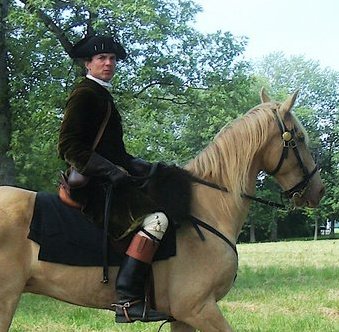
That's me commanding a British Army.  reenacting can teach a lot of lessons about communications and logistics.

That’s me commanding a British Army. Reenacting can teach a lot of lessons about communications and logistics. Did you know you see more from horseback than on foot?

As I began to ‘get serious’ about the American Revolution, it became increasingly clear to me that the British got to play the same role as the USA in Vietnam–they had a highly professional, brilliantly well-trained and usually well-led army and they won most of the battles.

On the other hand, they were at the end of a supply chain thousands of miles long, and like Vietnam, the fighting in America was deeply unpopular at home, not least because it was very expensive, and British taxpayers had not yet recovered from paying for what we OUGHT to call World War One — that is, the 1755-1763 conflict called the ‘Seven Year’s War’ in Europe and the ‘French and Indian War’ in America.

Another day, I’ll comment on the apparently consensual nature of warfare and how it is really a cultural artifact like dance and gourmet food.  And how I’ve noticed that the West, for all our vastly superior tactics and training, hasn’t won a lot of wars lately.

For today, I really want to look, as a writer, at the ‘evolution of a battle.’

I don’t think I’m going to shock you to suggest that most, if not all, of the historical fiction books I write–and some of the fantasy–climax in a major military engagement.  To me, the interest in such a book is the forensic examination of how two–or three or five–armies come to clash, and why–at the macro and micro level.

So–for any given situation–why fight a battle?

Warfare tends to go through peaks and troughs of ‘decisive battle’ activity.  The merest glance over the literature spawned by the ‘Revolution in Military Affairs‘ debates will show that decisive battles (which, let’s face it, are hardly ever decisive except for the men and women who die in them) are usually a product of change in military hardware and a de-emphasis on fortresses and sieges.  BTW, just to get your thinking caps on, while modern air-warfare may look incredibly unlike siege warfare, anyone who has ever faced an IADS (integrated air defence system–all those pesky SAMS and linked radars and so on) is facing a situation that Vauban would have understood perfectly.

There is a tendency to assume (as an author) that your two armies go for each other like boxers in a ring or dogs in a dog fight–but that’s seldom the case.  In fact, usually one of the antagonists is all too aware of some shortcomings–inferior manpower, bad logistics, poor material readiness, poor training–and wishes to avoid battle.  It is unsurprising how few really stupid generals there have been in history.  Many made serious mistakes–but many committed to battle because all the other options had run out.

In the ancient and medieval worlds, where armies were seldom professional–and sometimes this was true even of the Romans, right, lads?  Generals preferred to fight late in the season when all their young levies and raw recruits had had a few months to march, practice, and get tough.  Ideally, most generals would prefer to fight a string of minor engagements from a small skirmish to a large scale fight over foragers (people out gathering food) to build skill and morale.  That’s in Livy, Caesar mentions it, and it was still a useful way to approach training your men as recently as WWII.  In fact, in a  nutshell, there’s the plot of 1/3 of the military HisFic novels out there.  Raise a group, train them, get in ever larger fights until you build confidence and expertise, win the big battle.

But… what if the enemy simply refuses to FIGHT a battle?  Or–and I can quote hundreds of examples–what if the enemy fights ten battles, loses them all, and refuses to give way?

What if, even as your plucky band of military heroes increase their skills and fighting prowess, they’re also encountering massive fatigue and shattering trauma and despair from losses and from bad food and limited sleep.  What if the whole campaign costs too much money?  And the king tells you to pack it in?  While you are ‘winning’?

In fact, war–most war, including modern war and Roman war–is about money and cultural tenacity (something that the Romans had in spades).  How much will country ‘A’ pay to ‘punish’ country ‘B’?  How long will country ‘A’ sustain it’s forces in the field?

(Mil His aside–historically, did you know that more than 80% of battles are won by the home team?)

It is tempting to imagine that armies win battles with tactics.  An enormous amount of ink is spilt by writers and by wargamers about ‘wedge’ and ‘volley,’ about ‘charging at a gallop’ and ‘the thin red line’ and the ‘French Column.’  It is possible that these things may, on occasion, be decisive.  I have serious doubts, frankly.  I have a suspicion that the concentration of military historians on tactics (and technology) has to do with their own military training and its emphases, and with a desire to establish a ‘military science’ that can overcome all the mud and blood and fog and horror.

But… the English Longbow and the Roman Legion both lost from time to time (and in the end!).  And I’d like to note–as an author–that when they lose, it doesn’t matter if they were outnumbered–it was the business of their king or their senate to get them there in adequate numbers, and commit them intelligently–that’s all war.  It doesn’t matter that it was raining that day–it rains on this planet, and a military system that requires sunny days is–doomed.  It doesn’t matter if the ‘better’ army quits and goes home because they ran out of money, food, or political will.  All these things are part of war, and war doesn’t care who is ‘better.’  As an example, I am always disagreeably surprised when someone tells me that the German’s had the ‘better’ military in WWII.  They lost–horribly.  They made terrible decisions based on a deeply flawed and utterly immoral concept of the conditions of the battlefield and they got ploughed.  The terrible decisions are as much part and parcel of their cultural assumptions and their ‘war machine’ as the Tiger Tank and the Bismark.  It all comes in one package.  All the decisions come home to roost.  Every time I plan for the ‘bad guys’ in one of my novels, I remember Hitler and the German General Staff.

In fact–here we go, writers–the fascinating thing is that all victories and defeats are the product of human decisions.  And that’s what makes a good military novel at least as much fun as a good murder mystery–it’s all about people.  The leaders–the war lords, the kings, the legates and the generals–make the critical decisions whether they know they are doing so–or not.  Too often, the can be reduced to decisions about the ‘day of battle’ but I thought it might be fun to trace an entire campaign season.  My hypothetical country is a lot like Medieval England, and my hypothetical year is roughly 1350.  Our main characters are the King of England and his son Edward, the Black Prince.

The campaign season starts–in parliament.  No kidding, it starts in parliament, and the single most important starting condition for our fearless king is that parliament has voted him the means to wage war–money.  We could side track here into forced loans, loans from Italian bankers (the Riccardi of Lucca, anyone?) the wool staple, and on and on.

Let’s keep this light-hearted.  Our army needs money, and that comes from voted taxation, in the main.

Second, once money is voted–after all that human interaction and all that debate and grubby loan-taking–we start raising troops.  Our leader now gets to make critical decisions about what troops he takes into the field–and if he makes the wrong decisions, he”ll have the wrong troops.  Will he lay a major siege?  Or will he fight a field battle?  Is this year going to see a cavalry heavy, fast moving chevauchee through France?  Or a naval fight like Sluys?  Or the Siege of Harfleur?

BattleofSluys

All decisions.  And once taken, irrevocable.

Now that our prince and his father the king have built his army, he must both take it to France (this is the 100 Year’s War) and supply it while there.  Getting it to France was top prove an incredible bottleneck for the English throughout the war–and in fact forced a huge amount of their ‘grand strategy’ because they needed ports with logistics centers and major fortifications…  At any rate, our heroes need a fleet of vessels just to get all the army the king can afford (of course, there’s foreign mercenaries and subsidies to the Gascons) over to France.

Where in France shall we land?

What are we trying to accomplish? (Another digression–I laugh aloud when modern military professionals tell me that Medieval war was ‘stupid’ and barbaric.  Medieval kings like Edward III went into the field with strategic goals and a solid understanding of their material resources.  They planned campaigns based on their understanding–sometimes flawed–of the enemy and his capacity to resist.  I feel this compares favorably to many of the military campaigns waged in the last twenty years.)

Let’s assume our heroic king’s son and his army manage to reach France.  Let’s assume the King’s heroic son–our main character–goes to Gascony, an English enclave in period with a superb port (and a major portion of the English wine trade).  Now we have to supply that army.

Now, we can choose to make a chevauchee (a giant fast moving raid–really, a terrorist attack) because it allows our troops to supply themselves from the surrounding countryside.  But chevauchees don’t always accomplish anything besides the deaths of a lot of peasants and nuns and so on. (NB that our characters BELIEVE that the chevauchee–the terrorism–proves to the peasants and to the enemy lords that they cannot protect their people and thus forfeit their chivalric/political right to rule.  While this may sound specious, it was apparently grounded in feudal political ‘fact’–there are examples of French peasants going to their knights and, in effect telling them to just go get killed to prove themselves worthy.  See how cultural this is? It’s not about efficiency… Anyone see any parallels to current conflicts?)

But if we choose to march out and lay siege to a major enemy fortress, we need a lot more supplies–there just aren’t enough peasants with enough food to supply our army unless we keep moving.  This is one of the classic problems of Medieval warfare–if you stop, you starve.  Taking a major town (unless you take it by luck, by escalade or storming) is a major commitment, and you will lose a huge number of your troops to disease.

Right.  Our prince chooses the raid–the chevauchee.  And off our army goes into La Belle France.  Finally, at the end of a huge chain of assumptions and critical decisions, we are finally marching against the ‘enemy.’

Who, to be fair, has had to face all these same sorts of decisions but is on home ground.  But he doesn’t know where, or when, we are coming, and his preparations are complicated by another English army forming in Normandy and by serious taxation problems, a crisis in public confidence…

I will not belabour this fictional campaign any more–it is pretty clear I mean the Poitiers campaign, and there will eventually be a battle, although it will not be on the day chosen by either commander, and by the time it is fought, the English will be in full retreat and the French, in effect, in pursuit.  I am merely going to assert that the Black Prince and his Councillors–the officers of his army–have had to make hundreds, if not thousands, of critical decisions about things that appear to have little to do with war–about the delivery of arrowheads to fletchers in the Dordogne, about the purchase of ponies to mount the English archers, about the pay of spies, about scouting, about where to cross rivers and where to pitch camps and what towns to take and on and on.  All good for writing.  All about character and motivation.

There is another way to write this–from the point of view of a cook or an archer or a groom or a sex worker.  They don’t usually have a clue what’s going on–even today, in modern war, let me tell you… the complete lack of horizon among the grunts and whores and grooms and slaves can make a very dull book–or require some major acrobatics just to inform the reader ‘where’ we are on the historical map.  Some writers do this very, very well, and I’m playing with it now, in the Traitor Son series.

And we aren’t to the battle yet.

Crafts and Craftspeople–Jeffrey Hildebrandt–writing about the past

Standard

DSCF3002 chapter 3 - the red knight

Those of you who have the UK editions of the Red Knight know that the cover and the internal illustrations are not ‘generic’ and represent characters and scenes from the book. The chapter heads were drawn by my friend Dimitry Bondarenko, and some of them are portraits of people and artifacts and costumes that inspired characters (and armour) in the book.  Perhaps the most oft-repeated image from the books is of the Red Knights ‘falcon-beaked’ helmet, which I confess is my own fighting helmet, a late 14th century bassinet based on an original and made by Craig Sitch, the master armourer at Manning Imperial in Australia–one of the world’s great craftsmen, as well as a pillar of the world reenacting community, a fellow historical armizare practitioner, and one of my favorite people.

But today’s article is actually about the process of the fabrication of armour; about craftsmanship, and what it means to the people who practice and consume it, and how all this effects writing.  In specific, although I’ll reference a number of other armourers, today’s article will spotlight Canada’s own Jeffrey Hildebrandt of Royal Oak Armouries.

Cheryl Attic finished 03

Attic helmet by Jeffrey Hildebrandt

So–first a word about authenticity.  I believe that an attempt to experience the past is only as valid as the total of all your knowledge and the care you take in replicating that knowledge in terms of material culture and skills.  As a broad example, if you believe that an ancient Greek shield weighed about 20 kilos, and you make one that weighs 20 kilos, and you practice with it–all your experience and your reconstruction of fighting styles based on this experience will, in fact, be invalid if someone else proves that the shield only weighed five kilos.  A twenty kilo shield is barely supportable by an athletic, strong man, and can only be used passively.  It must be hung on a strap.  It is exhausting.  A five kilo shield can be used aggressively, carried all day, held up high sometimes and down low others…  All those things that you thought that you’d learned about the Greek hoplite turn out to be invalid because your equipment was wrong. (NB This is an HYPOTHETICAL example.  I suspect an aspis in 500 BCE weighed about 6 kilos but I can’t prove it .  Yet. 🙂 )

Eastern 'Turban' helmet by Jeffrey Hildebrandt

Eastern ‘Turban’ helmet by Jeffrey Hildebrandt

For those of us who experiment with the fighting styles of Medieval knights, this is a crucial, and expensive, world of past technologies, fit, form, style, and most of all, craft skill.  You can buy armour fabricated in India or China and it is made to some standard sizes and you, the customer, have absolutely no control over how it was made–how good the steel is, how thick or thin the protective areas are…  or, most of all, how it fits.

At the other end of the spectrum, there are working armourers in North America and Europe who build armour for discriminating collectors, reenactors, and the (small) world of the armoured fighting community.  They make armour to order, much as it was done in the past, albeit with modern tools, computer images of old armour, libraries of data on originals, oxy-propylene, modern cutting sheers and a host of other technological improvements–and yet, when these craftspeople get down to the fine art of recreating a complex curve, it’s done with heat and hammers and anvils and shaped stakes, exactly as it was done in 1380.  And what they make is, in terms of make, thickness, weight, ‘wearability,’ and fit–as good or better than the originals. The best makers can translate the armour on a statue or in a painting the way a costumer does with cloth–except that cloth doesn’t need three dimensional flexibility and most costumes aren’t worn for sporting events….

chapter 1- SauceAurora Simmons is one of my oldest friends, and Dmitry Bondarneko used her as his model of Sauce, who, you’ll notice, is not wearing a helmet.  When this drawing was done, Aurora didn’t have a good period helmet of her own.  And recently, I discovered that I had in my basement a really nice bassinet ‘shell’ or basic helmet, without a visor, made by Craig Sitch back in 2010.  It’s a long story.

At Jeff's Shop CGC 023

However, as I was going to spend a day with Jeffrey Hildebrandt, and we wanted to see him work on something, the solution seemed obvious–a distinctive visor or face plate for Aurora’s helmet.  Now–one last aside–Aurora is herself a jeweler, a skilled metalworker, and so she wants to finish all the metal herself.  Most people do not!

Jeffrey was kind enough to enter into the spirit of the thing, and there we were, getting Sauce a new helmet.  If you take my meaning…

The visor on a helmet turns out to be the most complex set of three dimensional shapes that an armourer would face in the late 14th century.  I had not known that.  But it set Jeffrey an interesting challenge, and he and Aurora began by looking through his impressive image catalog.

At Jeff's Shop CGC 009

Very quickly they chose an original–in a museum in Germany, I believe, and they proceeded to the shop.

At Jeff's Shop CGC 021

This process led to what was (to me as an author) a fascinating conversation about ‘identity’ and helmets.  We all noted that every single ‘pig faced’ bassinet seemed different from the others.  I realized (I’d never thought of it before) that helmets are very recognizable when everyone has a hand made one, and that it was by ‘helmet beak’ and not by heraldry that I often identified friends and adversaries in melees.  Was that why they were all different?

I don’t know.  But (lesson one from the day) people can identify each other in armour, by helmet design.  Cool.

There ensued a fun conversation about cones and… gasp… math.  Yes–those cones that have conic sections when you do calculus.  It turns out that forming a visor begins with making a pattern based on a cone, and guessing–in Jeff’s case, intelligently guessing–where to move all the metal to end up with a visor.

This is where Jeffrey made the first remark I loved.

‘Steel is fluid,’ he said.

‘Metal is plastic,’ answered Aurora, as if they were monks in some metalworking order.

Right–skilled metalworkers have muttered this stuff around me all my life.  Then Aurora explained to me (for the fortieth time) the difference between raising and dishing.  In effect, when you dish, you hammer things so that they get thinner.  Stands to reason, right?  And this expands the surface area…

Fair enough.  Raising, though–causes things to get THICKER in that you use a hammer to pull the metal together and contracts the surface area.

Really?  Yes, really.

The pattern

The pattern

That's me, using the shear, which I loved.  Jeffrey says they had these in the Middle Ages.

That’s me, using the shear, which I loved. Jeffrey says they had these in the Middle Ages.

Jeffrey has already welded the cone.  Aurora has already ground down the weld.

Jeffrey has already welded the cone. Aurora has already ground down the weld.

And now we're back in the Middle ages, with heat, and hammers...

And now we’re back in the Middle ages, with heat, and hammers…

In this case, pictures are worth thousands of words.  Even as Jeffrey described the process of raising, he was executing it.  He did one side, and he had Aurora do the other.  I found it remarkable how fast the visor began to take the complex shapes of the original.

Pretty much looks like a visor already

Pretty much looks like a visor already

And at this point–all the careful calculation ended, and everything became art.  Again, as a writer, I was fascinated–for a while, my craftsman–(craftspeople, really) had been all about measurement and making patterns.  Now, before my eyes, Jeffrey made it all about–well, about hand-eye coordination, and skill, and long practice.

jeffrey Hildebrandt.  That's not posed--he's thinking.

Jeffrey Hildebrandt. That’s not posed–he’s thinking.

What I saw was that Jeffrey would stare at the visor, comparing it to the drawing for a moment–and then apply heat and work, rapidly, on one area.  Then quench it (put the whole visor in water) wipe it dry (because high-heat water turns to steam and burns you through your gloves) and stare at it again.

This process was, in fact, incredibly rapid.  After a while, he’d add commentary, mostly to Aurora (who understood the process far better than I) about how he needed to contract the area above the eyes to make the visor fit the helmet (oh, yes, it has to work!) or to make the snout symmetrical.  Often, he’d make marks with a white stick that proved to be a soapstone pencil.  Soapstone leaves marks that are not burned away by heat.  And goodness, there is a lot of heat involved.

oxy propylene (or oxy acetylene) replaces the two apprentices, the bellows, and the charcoal.  it's also faster and more accurate.

oxy propylene (or oxy acetylene) replaces the two apprentices, the bellows, and the charcoal. it’s also faster and more accurate.

And there it was.  four hours solid work, and it was done.

Which is to say, it was still black from the hammer.  It will take Aurora hours of planishing (that’s the careful work whereby you make the surface very smooth with a hammer) and polishing to make the helmet and the visor mirror bright.  And then Aurora will have to make a liner, sew it in, get a chain aventail, rivet on verveilles (the brass super-rivets that hold your maille to your helmet) and probably a cloth liner for the maille, and then rivet the visor to the helmet with heavy pivoting rivets after morticing a pair of hinges…

No problem.  Another day, I’ll do a piece on Aurora and her skills and her jewelry.  This is Jeffrey’s day, though, and I found his work incredible.

Jeffrey has been a professional armorer for less than three years.  Before that he was a biologist.  His skills–from metal moving to enameling, engraving, repousse, etching–all his metalworking skills are excellent.  He challenges himself constantly to work at the edge of the envelope and try new techniques and learn new skills.

I asked what his favorite period was.  He said ‘I love the sixteenth century,’ but after a pause, he said, ‘I really jump around.  I love to do things that are completely new.’  Speaking as an author, I agree–I love all of history, and there’s something marvelous about the moment when you dive into a new period–pick up the first broad secondary source and start the plunge.

With Jeffrey I could see the width of his interest.  On one table was a beautifully executed, very simple sixteenth century pikeman’s helmet.

See?  Even the liner is correct.

See? Even the liner is correct.

While at the earliest part of the spectrum…

My 6th century BCE bronze Thorakes.  It was made for me, and it fits me perfectly.  MINE!

My 6th century BCE bronze Thorakes. It was made for me, and it fits me perfectly. MINE!

Is this stunning 6th c. BCE Greek breast plate that just happened to be sitting there.  Okay, it was made by Jeffrey for me, and I’ll be wearing it at Marathon in Greece, and for the rest of my life, I hope.  It sure fits!

I feel I have to include this for completeness…

Yes, that is enamel work...

Yes, that is enamel work…

Jeffrey had this in his office.  It is the Sutton Hoo shield device.  Someone will have this on their shield.  But not, I think, in 1385.  Still, seeing the reality of it made me think of art forms and the Faery Knight.

But what it all really made me think of was the process of fabrication and how personal it was; the relationship between a knight and his (or her) armourer.  Armour is part of you–it’s not something you ‘buy’ but something you wear and possess and inhabit, like a car or a house.  Something that is both protective and decorative, something that requires more maintenance than most people give their cars, something that can, with effort, last forever.  People who make this marvelous stuff have to make metal fit with the same care that I can cut cloth.  (That’s another blog).  And metal doesn’t stretch.  Metal has to fit.  If it doesn’t fit, it can hurt.  And once you sink all that money into a full armour…

Don’t gain weight.

And at another remove, we can’t ever really go into the past, but people like Jeffrey Hildebrandt make it possible to get closer–to learn things you cannot learn without wearing the right stuff, made the right way.  Over the next few weeks, I’ll talk about other superb crafts people–Aurora Simmons, Jiri Klipac, Leo Todeschini, Craig Sitch–but I wanted to start with a full project and a full day, and a lot of photos, just to give a notion of what goes into making a suit of armour.

This was just one visor.

All done but the polishing and planishing and piercing all the holes.

All done but the polishing and planishing and piercing all the holes.

Oh, and when Aurora is done, I’ll show you the final helmet.  Can you see the subtle differences from mine?  SO the next time we’re fighting on the same side in a melee–I won’t hit her.

I hope.

Whores and Heroines–writing about war and women

Standard

common womenCavalry MaidenTigressUlrich

This is not, strictly speaking, a book review of ‘Common Women’ by Ruth Mazzo Carras or of ‘The Cavalry Maiden’ or ‘The Tigress of Forli’ or Ulrich’s superb ‘Midwife’s Tale’ although I truly recommend all four books.

It is more of an essay on writing about women in the midst of war.  I’m going to try to keep this as unpolitical and coldly analytical as I can.  But I have to say, up front–I’m a feminist, and the story I’m about to tell can be pretty awful.  You can stop here, if you like.

War is terrible, and yet many men enjoy it.  Certainly, a great many people enjoy reading about it.  And I confess that I study it and (sometimes) enjoy writing about it.  But to the women of the past–and this cannot be too much emphasized–war was probably the most horrible thing they could imagine, especially when war came over the borders and into their homes and lives.

We live (thank God) in a very different civilization. We have come an enormous distance even from the world of the later Middle Ages.  Women are, in most cultures, no longer property.  Most women in our civilization have broader horizons then the process of bearing children and then protecting them and rearing them until they are adults.  But I think it is only fair to say that for the majority of women in history, bearing children–willingly or unwillingly–was the horizon of their lives.  And forced sex and forced child rearing–rape, and even child murder–were the natural outcomes of war.  That’s what war meant, to most women.

This is not to say that some women didn’t live and even thrive in the environment of war.  For example, almost every Italian source that speaks of Sir John Hawkwood’s ‘White Company’ (or any of his other military companies) mentions the company’s women, who were clearly as dangerous and outrageous as the men.  Women served heroically in the Czarist Russian Army against Napoleon–one of my favorite books in the secret military history of women is ‘The Cavalry Maiden’ by Nadezhda Durova who served as an officer of cavalry.  Women fought in sieges–after all, when a city was sacked, women lost everything–and Blaise de Monluc describes two uniformed companies of women at the siege of Sienna in 1555 (in suitably misogynist terms) while Thucydides, who has no time for women whatsoever, can’t stop himself from mentioning that the brave Plataeans took women with them to defend their city in 427 BCE against the Spartans.  The Lady Orsini, wife of the Prince of Lesvos, owned her own armour and led sortie after sortie against the Turks during the 1442 siege of Mythimna on Lesvos in Greece, winning against the odds. The Austrian camp followers of Marshal Browne’s army in 1757 apparently defeated two regiments of Prussian hussars who had hoped to sack the baggage train with disciplined musket fire.  A single British camp-follower with a musket–a ‘very comely woman,’ as the writer calls her–captured three of Ethan Allen’s soldiers  outside Montreal, single-handed, in 1776.  The Scythians–well, I think everyone knows what an Amazon is.  Or was.

In fact, even a cursory study of military history will show that women have served–heroically–in war for as long as we have records of war.  And where they are absent, I will wager this has more to do with men like Thucydides wanting to keep the ‘Art of War’ as a boy’s club than with women’s ‘weakness.’  Women make great soldiers.  It’s such a banal thing to say that it’s almost offensive to have to say it.  I was privileged to serve in the first generation in the US Navy of women on combat ships.  My OCS class was dominated by women who were, let’s face it, mostly a cut above the material provided by the male gender in my class, and the top performing officers I saw at most duty stations were women.
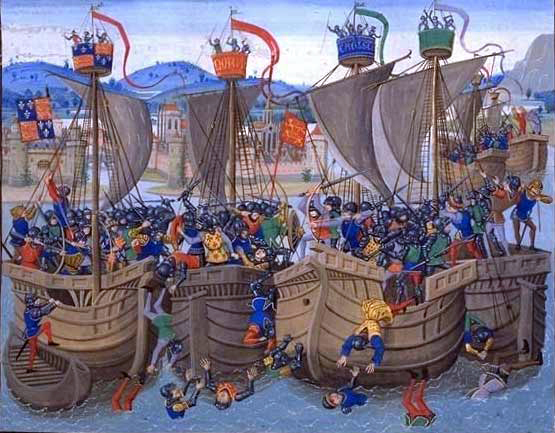
Sadly, women warriors have never typified women’s experience of war.  Most women who followed armies did so as laundresses, cooks, and sex-workers, willing or unwilling.  Their unromantic lives were dirty and dangerous, and full of hard work around a lot of men already marginalized by violence, and while for some it was probably better (god help us) then village life, for others it must have been a living hell–rather like being kidnapped by a bike gang.  And then there was always the possibility that the other side might triumph in battle, and storm the camp.

Need I go on?

‘Common Women’ is a difficult book, but one worth reading if you are going to write about women in army camps and cities.  It is about prostitution and Medieval attitudes towards whoredom, and it is not pretty.  It describes what the lives of such women were like, at least through the eyes of the courts and the church.  It suggests–almost commands–that we accept that women did not own their bodies–that men owned women’s bodies. Although I don’t ascribe to every theory in the book, it’s worth noting that the author goes a long way to making the lives of these women real and their perils and place, or lack thereof, in society, comprehensible.

Why does all this matter?  Well, it’s about authenticity.  I find it–interesting–that people (not just men) with cheerfully read about a young man pressed into military service (we call them child soldiers now…) and we delight in this person’s gradual rise, through successful violence, to command and power.  But we’d probably feel sick to the stomach if the same book were about a young woman’s life as a captive sex-slave, gradually rising through a sort of vicious survival instinct to the ‘power’ of keeping her unwanted children alive in the desperately violent world of an army camp in the later Middle Ages–until she died of the plague, or some bright light like the Chevalier Bayard shoved her and her children out into the snow for being ‘useless mouths.’ Or ‘bad for morale.’

I’d also like to note what a friend commented to me the other day about Fantasy as a genre.  We now call it ‘Fantasy Honour Killing.’  Ever noticed that if a heroine in a fantasy novel gets raped, she has to die?  Like, what message is that supposed to send?  Historical figures like Catherine Sforza prove that women were much, much tougher than that.  Elizabeth Lev, the author of ‘The Tigress of Forli‘ has done a fine job of collecting the historical data around a woman whose heroism (oh, she wore armour and fought, too) was mostly in her tenacious survival–an abusive husband, terror, war–none defeated her.  When Cesare Borgia raped her, she did not conveniently die.  Ten days later, she was negotiating with the pope.

Catherine Sforza -- The Tigress of Forli

Catherine Sforza — The Tigress of Forli

Statistics suggest that 20% of modern women and 5% of men experience sexual abuse. They go on to live their lives.  My point is, writers, that we can do better than ‘Fantasy Honour Killing.’

But perhaps the best work of ‘women’s history’ (which to me is part of something called ‘History’ and not at all limited to women–homo sum: humani nil a me alienum puto.  But I digress) is Laura Thatcher Ulrich’s Midwife’s Tale.  In this book, Ulrich dissects the diary of a farm wife who is also a midwife to reveal for us the entire world of women in rural 18th century Massachusetts and Maine, and through her (Martha Ballard), to get an idea of how women have probably lived throughout history–raising children, weaving, working, and living.  It not all rape and murder.  Sometimes there’s light and fun and barn dances and heroism, to. (and an incredible amount of sheer work.  40 yards of linen in three days?  Ariadne ain’t in it.) I won’t presume to ‘review’ a book that won the Pulitzer Prize.  I’ll just say it’s one of the three best works of history I’ve ever read.

As I sit down to begin the fourth book of my Traitor Son series, I return to a fantasy world with a great many women in it.  I have tried to write them from all walks of life and many different stations–from Amicia, who was once an Outwaller wife and shaman and is now a celibate nun, to the Abbess, who was once a King’s mistress, and Sauce AKA Ser Alison, who was once a prostitute and is now a knight.  But there are other women–Blanche the Laundress, who has to deal with sexual harassment every day merely to do her job, and Sukey, Mag’s daughter, who lives on the edge of acceptable behavior while managing camp women who are, I hope, at the more cheerful end of the spectrum of sex-workers and laundresses that history shows us.  It is not my duty as a fantasy writer to make all their lives one horrible smear of misery.  But I think I do a disservice to the reader if it is all a ‘bit of fun’ for those nice clean knights.  I want the reader to see that a good military company might depend on women exactly the way a modern squadron of fighter planes depends on its maintenance personnel.  That the ‘love interest’ has a life or her own.  Actually, I want to accomplish even more than that–but that’s a start.

In historical novels, I think my shading of the lives of women has gotten darker.  It is more difficult for me, as I learn more, to resist the urge to tell you, the reader, just how hard women’s lives were.  I found the Sack of Alexandria excruciating to write, because it was all one great war crime.  I try not to write rape scenes–for a variety of reasons, and old fashioned bad taste is one–but I am tempted, sometimes, just to shock the historical reader into a visceral understanding of what the ‘sack of a city’ meant to the inhabitants, and what ‘being sold into slavery’ suggested for the surviving women.

But–I have also enjoyed very much writing about Brauron, the Sanctuary of Artemis that seems to have functioned as a woman’s school and vacation spot and summer camp during the late Archaic and Classical world, and it cheers me to know that young Athenian girls and women could ride horses, shoot bows, and dance.  And that when the Persians came and destroyed the place–they all escaped.  And returned, and rebuilt the temple complex.  Maybe that’s symbolic.

Oh, by the way.  The Pen and Sword Tour for 2015 is on, and Brauron will be on the first day of the tour.  Come on–you know you want to come…