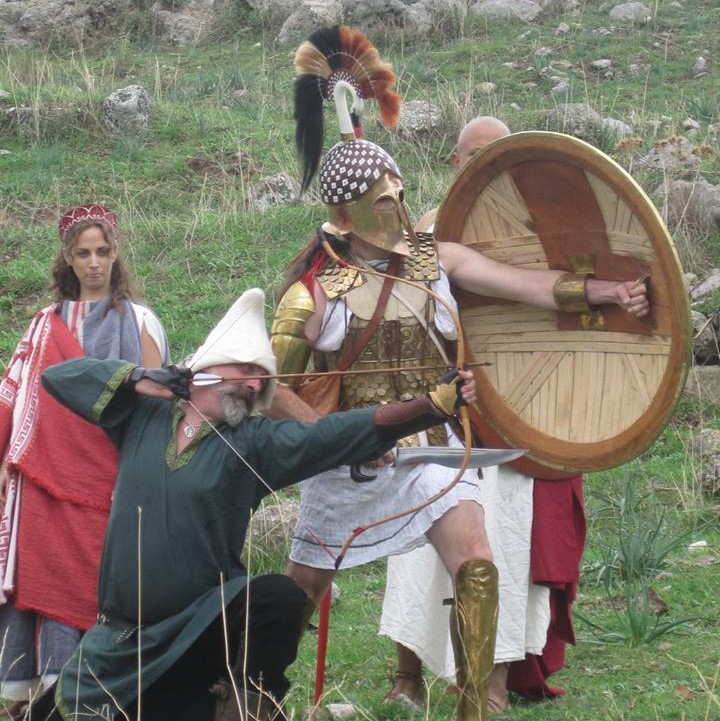
Siamo arrivati a Roma!

Standard

IMG_4571

Right. Since my last post, I have learned how to use a Microsoft Surface.  Now there will be photos.

That is out intrepid band on Monte Maria overlooking Rome and the Vatican.  It was a great moment, even with some very sore feet; we walked up Monte Maria and when we reached the top, there it all was.  Two thousand years of history stretched out at our feet.

We started walking at Bolsena, a magnificent medieval town just south of Tuscany, about 100 km from Rome as the eagle flies and more like 150 kilometers by way of the Via Francigena, the medieval pilgrim’s path which we (mostly) followed.  We did the whole thing in medieval kit, with medieval clothes and shoes.  My shoes and Alessio’s were made by Graziano dal Barco.

Truth in authorship requires that I confess that we took a train 8 kilometers to avoid a suburb; walking on pavement is not really very fun or very Medieval.  Also, we received a 30 kilometer car ride from Claudio, the very excellent host at our B+B ‘Etruscan Garden’ in Sutri; we stayed there one night and they treated us like Etruscan gods.  He and his wife Sarah live in a 12th century house which, by the fifteenth century, was the post house for the Roman post; Tom Swan would have stayed there running errands for the pope and Bessarion.

IMG_4538

Of course, I didn’t take any pics of their 13th c. house… this is me and Jon Press in the gate of Sutri.  In the rain.  The rain fell and fell, which is why Claudio offered us a ride, which we accepted with gratitude.  Then we walked another 20k to assuage our guilt.

By the way, my half cloak, by Monica at Sartoria Monro (look for her on Facebook) was nigh-on miraculous, shedding water in every storm, and we had more than one.  It got soaked; I did not!

But, as usual, I digress.

Our fourth day we awoke at the magnificent Casali del Pino, an agrotourismo center (that is, a farm with a restaurant and hotel attached) about 12km from Rome.  It was superb; I can’t say the same for the stretch of road and trail from Formello to La Storte, which was ill-marked and at times brutally uncomfortable; about two miles were covered in crushed volcanic rock, which had to be good for some serious penance; then we got to walk through a Roman suburb on garbage day (did I mention this yesterday?) and truly, there are some things that a tourist doesn’t need to see; perhaps the smell was medieval, but I’m not sure.

At any rate, we rose this morning, and with the help of the wonderful woman staffing the Casali del Pino, we went to the train to avoid 5 kilometers more of garbage day and detrained with an 8K walk to the Monte Maria park.

IMG_4563

And I also admit that there is very little about the walk to Monte Mari from the train that is medieval; I used Google maps and a carefully downloaded digital layout of the pilgrim route to manage where we walked.

I think that in many ways this is an allegory of reenacting.  There is always compromise; there is no ‘pure’ experience of the past.  There are wonderful moments when the path is good and the wild boar is moving in the forest and the flowers are beautiful, when you can easily imagine that you are  a pilgrim in 1380; in fact, it is even easier to imagine in the discomfort of heavy rain in deep woods, with the trail turning to slick mud under your smooth-soled 14th century turn shoes.

But other experiences are more ambiguous.  Staying every night in an excellent bed and breakfast and drinking excellent Italian coffee each morning, or eating superb restaurant meals (most) nights, was not in any way the experience of the Medieval pilgrim, yet to attempt to have, say, only medieval food, or to do without coffee would seem odd in a recreation where we are walking along a motorway through a Roman suburb, or waiting for passing carts to stop so that we can cross a road.

Fresh water was a constant matter of interest, and that was, in fact, an historical care. Some stretches of trail catered to pilgrims and provided wells and spigots; the Bolsena to Montefiascone stretch, famous as one of the most difficult, had enough water for an army.  Supposedly easier stretches had no water at all, and poor signs or none at all; it amused us that as we entered the City of Rome, the Via Francigena signs ended and the maze of Roma streets was left to the pilgrim’s own (electronic) devices.  All roads may lead to Rome; not all roads lead THROUGH Rome.

IMG_4604

Tomorrow if the digital gods allow, there will be another report from Italy.  After all, there was a tournament as well as a group of pilgrims; and the duomo of Orvieto deserves a blog by itself.  Maybe two.


Vado a Roma

Standard

via WP for Windows app.

This week, I’m walking to Rome.  I’m with my friends Jon Press of England and Alessio Porto of Verona Italy and so far we’ve covered almost 150 kilometers, although I freely confess we took a. train for 12 kilometers and we got a ride for almost 30.  Laugh if you like; we did 38 kilometers the first day, in Medieval clothes and more importantly, Medieval shoes.  If you don’/t know, medieval shoes have no support and no heel; they are very comfortable for walking on medieval surfaces, like a nice hard packed dirt road, but they are not quite so much fun for walking on asphalt.  In tract, today’s last 5 kilometers walking through a suburb of Rome with no sidewalks and it happening to be garbage collection day was… less than a perfect medieval experience.  Hmm.  Or perhaps in some ways, a very pure medieval experience for a pilgrim.

Regardless, I have learned more about the Italian countryside walking from Bolsena to here (about 12 kilometers from Roma proper) than I ever would have believed.  Yesterday I walked through a forest with signs warning me of the danger of wild boars; I crosses a stream and saw deer tracks. This is more the experience I would have expected in the Adirondacks than 45 kilometers from Rome.  The views are constantly spectacular, and the churches and medieval towns are beyond stunning; each is better than the last, so amazing that none of us are jaded yet. 

Ah, a word of explanation is required.  First, there are no photos in this blog because, although I have many and they are beautiful, word press (the app I’m using on my Surface) will not allow me to upload them, and today’s kilometers make me too tired to want to fight Google for more info.  Second, you may wonder why I didn’t blog the last two days; apologies, but the WiFi has been terrible to non-existent, and several items of equipment that worked in Toronto do not work in Italy; this experience reminds me very much of military operations in my youth.

However, let me assure you that over the next few weeks I will flood you with pictures of Montefiascone, Viterbo, Sutra and Rome, not to mention Bolsena.  I now know what post house Tom Swan should stay at in Sutra in 1457; I now know what it would be like to draw a long sword in a Medieval Italian street.  In fact, I’ve been learning so fast I haven’t processed it all yet!  So bearer with me and hopefully, in time, I’ll give you a report on being a pilgrim in 1380.  With pictures.

The Experience of Armour

Standard

1524302_10204105950392784_4865245999673221116_o

With thanks, as usual, to Celia, champion photographer to the armoured fighting class. BTW, neither of these gentleman are me.  That’s Greg Mele of the Chicago Swordplay guild against Marc Auger of the Barrie Swordplay Guild and Hoplologia in Toronto.  You can just see Jon Press, my awesome squire and marathon runner, in the background between them.

In four days, I’ll be fighting in Verona.  I spent most of today prepping my armour.  OK, I also went to the bank and got euros, and I did some legal stuff so my wife could bring our daughter out later, after her exams, and I jumped through various other modern hoops.

Then I went to the basement.

Waiting for me were several simple jobs. In describing them, I hope I help readers and writers understand the sheer complexity of system that is a harness, or suit of armour.

First, for some weeks, with help from Handmade Revolution Jeweler Aurora Simmons, I have been replacing the straps on my corazina or brigandine.  Today I made repairs, re-riveting in places where the fabric had separated from the metal.

Jiri 2016 057

Care to guess which buckles and straps are before and which are ‘after?’

At any rate, I’ve worn this piece of armour precisely twice, once to fight, once to look pretty. I’m repairing it.  These repairs take hours.  And they are not the fault of the maker. Repair is endemic to armour.  Much of a late 14th c. harness is laced to your body; laces break.  They have to be repaired or replaced; often they just vanish.  (I always take about 30 extra laces with me.  They are called arming points, or points.  They go to the sock multiverse… you know the sock multiverse?  So you send socks into the washer and dryer, and there are fewer socks after the laundry than before.  The missing socks are in the n dimensional space called the sock multiverse, and it appears that arming points go there too.  Hypothesis, but not, I admit, proven fact.)

Today I also riveted on a tiny ring.  You’ll never see it; it’s at the base of the back of the corazina, and it allows me to lace the point of my rondel dagger scabbard to the middle of my back.  This is, for North Americans, EXACTLY like a gunfighter tying his holster to his leg.  Tying the bottom of my scabbard means that when I go for my dagger, it will draw smoothly.

In storybooks and Hollywood, no one ever worries about a smooth dagger draw.  (Actually, no one ever binds an opponent’s sword arm and goes for their dagger, so why worry?).  In my recent life experience, fumbling dagger draws is my daily bread.

10604541_10204962658443809_7252867672868158250_o

That’s me, about to plunge my rondel dagger into Sean Hayes, while he is about to try and get the ligadura or arm lock on me.  See anything interesting?

The scabbard is still on the dagger.

Because I have ripped it off my belt.  I’m 53, I’m not that strong, and I’ve just ripped the damn thing off the mounting rings on my fancy plaque belt because for whatever reason, the dagger wouldn’t leave the scabbard.

But wait, there’s https://www.facebook.com/plugins/video.php?href=https%3A%2F%2Fwww.facebook.com%2Fpetra.hall.18%2Fvideos%2F10153633692971608%2F&show_text=0&width=560” target=”_blank”>more. If this link works, you should see me fighting with Andrew Lowry at our spring practice event (I’m really not good at video) and at second 40 or so, you’ll see me fail to draw my dagger; it’s fallen from the sheath. That’s right, friends; I’m fighting to the death (really, to the ‘fun’ but you get my thought) and I HAVE NO DAGGER. In this case, and somewhat novelistically, I manage to re-arrange my bind and stab my opponent in the throat with the butt spike (slightly padded rubber knob) of my pole axe. As I then tell Andrew, this WILL occur in a novel… it’s so damn painful to have your opponent in a lock, go for you dagger and..and…and.  You can’t see; you have only your practice to tell you where the dagger is.  And where the hell is it?

And the exciting decision point; keep looking?  Or let go?

Anyway, these are just two of my adventures with daggers. There are others; recently I perfected a very safe dagger, which I loved; I broke it on a friend… the draw was good, but the dagger itself was faulty. Sigh.

And this matters, because I can’t use rubber bands or duct tape.  I have to make my dagger scabbards the way they were made in the Middle ages; wood and leather and maybe a metal chape (the pointy end) for a rich guy.  And I fully admit I tried super-powerful magnets once.  Nope.  Lost that dagger, too. And rare earth magnets are not at all Medieval.

Because I seek that experience… the real thing…

Yet how my dagger hangs on my belt and whether it is available to use is a matter of life and death.  In 1380.  And I want to share that experience (minus the death; no macho here).  And because I train to use the period techniques; what we call Armizare, or the martial art of fighting in armour, my dagger is a very important weapon, because it is what allows me to face bigger, stronger people in close.  They go for grapples and throws.  I try and stab them. (Paper, scissors, rock.  Long sword or spear, dagger, wrestling).

So I spent a lot of time in the basement working on a new dagger scabbard for a new dagger. And then putting it on my belt, over my corazina, and then riveting that little ring to the back of the corazina so my scabbard cannot flit upside down and drop my dagger on the ground.

Fighting in armour is a game of inches.  It is about fitness, but also fit.  It is about freedom,. but also about limitation.  How far can I swing mys word?  Can I take this guard?  How much speed does extra protection cost me? Can I reach my dagger?  Can I draw my sword? Does something hurt? Usually it is greaves; they hurt your instep unless they fit perfectly,and they did in ancient Greece, too.  Or gauntlets; they have to fit.  perfectly.  If they don’t, you won’t be in pain.  You just won’t fight very well.

Helmet fit?  that’s not just comfort, that’s vision.  The difference between ‘can’t see much’ and ‘can’t see a damn thing’ is vast. Breast and back fit?  If not, your reach is limited and your breath is cut off.  Legs fit?  If not, you can’t walk; can’t glide, or make a passing step, or move confidently. Arms fit?  I once fought 10 straight fights in arms that did not fit.  Despite the best efforts of my noble squire to tie them higher, every blow I threw caused the base cannon of the right vambrace to slam into the base of my hand. By the end of one fight, I can be seen on video actually flinching from the pain I’m causing myself.

Fun.

And then, say it all fits.  Say the miracle occurs (or you know Jiri Klipac or Jeffrey Hildebrandt or some other miracle worker).  Now, every time you wear your armour, you need to repair it.  And of course, you cannot change weight; nor bicep size, nor quad size.  I mean, you can; there is actually some forgiveness, but no lifestyle change.  And constant upkeep; tinkering to get everything just right.

There are other folks who fight in armour in different venues and systems, like the Battle of Nations, and the Society for Creative Anachronism.  They have different rules (howl all you like, happy to explain) that do not exactly reflect the realities of Medieval combat.

(Aside.  All Martial arts sparring is a simulation.  No simulation is accurate.  Every form of simulation makes a set of compromises to reduce risk of death and injury and cost.  The SCA uses rattan instead of steel.  The Battle of Nations forbids thrusting. My form, Armizare, uses steel weapons and allows thrusting and grappling and wrestling, but we discourage full weight blows, allowed by SCA and BoNs, and we require a high standard in armour; full face protection to a very fine level and maille protection at all joints and gaps. This raises the price.)

I’m not on this pulpit to speak against either the BoN or the SCA; actually I belong to the SCA and I have many friends in the BoNs and have fought quite happily with many fighters in both orgs.  I’m here instead to speak of a similarity; armoured combat. The experience of wearing armour is a remarkable one; the feeling of invulnerability is not false, and neither is the staggering energy expenditure.  The constant balance of cost, fit, weight, and protection is an historical experience, even if you have neoprene arming garments; there are a spectrum of levels of material culture excellence, but all of them involve a fair commitment of time, energy, fitness and safety. From them, armour wearers can glean a fairly broad spectrum of experiential data about the life of armoured warriors in the past; they can also play games with weapons that you simply cannot play without armour.

Like stabbing people in the neck with a steel dagger.

And finally, people don’t fantasize about ‘knights in shining armour’ for nothing.  You look…fantastic.  Almost everyone does.  THIS MATTERS.  Napoleon’s Old Guard wore dress uniforms into battle; Royal Navy officers did the same.  Looks do matter, and very few things look better than a complete suit of shining steel.

Except maybe a silk velvet covered corazina.  I had a point a while back… probably time to go polish armour before I think of something else.  Next blog will be from Verona. Oh, and please pray for the rain there to stop.  Thanks.


Attack, Attack, Attack? Understanding “Vor” & “Nach”

Standard

Another excellent blog on the idea of priority and the difference, if I may say so, between the mentality of sport and a real attempt to be in the mindset where the weapons are deadly and you have only one ‘life’ and not three ‘hits’.

Bill Grandy's avatarThe HEMAists

by Bill Grandy

meyerVor and Nach. These two terms are constantly referred to in the various Liechtenauer teachings. On the surface the definition seems simple: The person who has seized the Vor (the “Before Timing”) is usually described as the fighter who has made an attack, whereas the person in the Nach (the “After Timing”) is the person who is forced to defend. Time and time again the treatises tell us to seize the Vor, and to not be the person who stays in the Nach. By this logic, it would seem safe to assume that to win, one should attack first and keep attacking at all costs, right?

View original post 1,402 more words

My Summer Recreating the Past

Standard

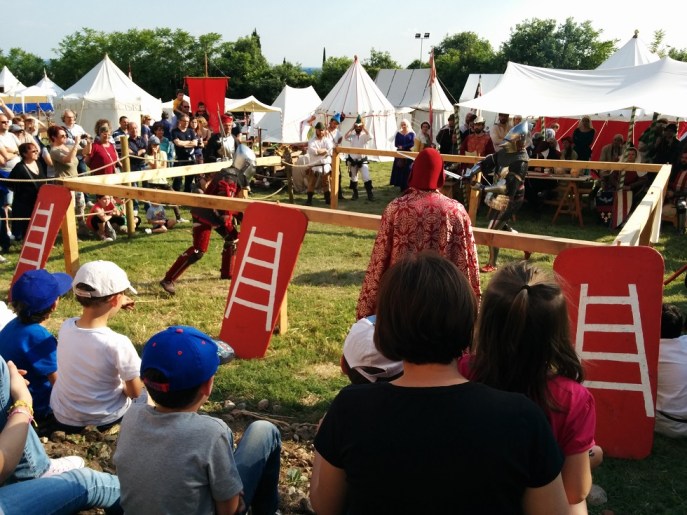
tents and ropes

That picture is of the Torneo del Cigno Bianco, or the Tournament of the White Swan, held every year in Verona, Italy.  This year, the Torneo will be held from 3 June 2016 to June 2016.

I’ll be there.

I’ve spent a year recovering a shoulder injury, and also making my harness better; that is, upgrading my armour so that it is both more authentic to my chosen period (1385) and a better fit for my body and my fighting style.  I’ve worked with Andrey Galevsky and Jeffrey Hildebrandt and Aurora Simmons and Craig Sitch and perhaps most of all, Jiří Klepač to make all my armour and all my other kit as authentic and beautiful as could be done with the time and money at hand.  There will be pictures, once I have it all on…in Italy.

But the Torneo is not just a peak experience because of the armour or the fighting.  It’s immersive.  For two or three days, in Italy, I get to live something of the life of a Medieval knight-errant; from food and dance to the buildings and the lists, there’s very little to take your mind out of the Middle Ages except possibly the tourists.

But even the tourists are wonderful; full of enthusiasm, and excellent questions about wearing armour or the danger of fighting in the lusts (not that great, by the way) or the difficulties of transporting it all on airplanes (fairly difficult, I admit) or the problems of using the toilet.  Oh, yes.

They are fun, and public education is one of the major reasons I do all this, so I’m happy to have them there.  They also add to the immersive experience, because when you fight in front of five hundred people, it’s a very different experience from fighting in front of ten or twenty; the crowd noise is remarkable, even through your helmet.  You also realize that fighting looks very different to the crowd than it does to you.  I remember in a past tournament, landing a very pretty blow in my opponent.  He (unintentionally) then landed a very late hit to my helmet; that is, he sort of ‘swung after the buzzer.’  The crowd roared for his blow, which ‘looked’ better than mine.

In fact, a very Medieval moment.

So, three days at the Torneo.  Three days for which I have prepared for months, if not years. I’ll post a blog with pictures after the last day.  And then…

Well, and then, with my friends Jon Press (who plays one of my squires) and Alessio Porto (man-at-arms) and no armour whatsoever (but in Medieval kit) we will walk to Rome as pilgrims.  Now, I freely confess that we are NOT walking from Verona to Rome.  I’d like to, but I don’t have 45 days.  I have 5 days, so we’re only walking from Bolsena on the Tuscan border to Rome.  The distance is 136 kilometers. We will be walking on the Via Francigena, the Medieval pilgrim route from France to Rome that men and women have followed… well, since before the time of Christ.  The route is ancient, and follows the same road that, for example, John Hawkwood‘s White Company (under various names) moved between Rome and Tuscany fighting for various masters.  The same road that William Gold takes repeatedly; that Tom Swan rides up and down almost every story. I’ve seen it, but I’ve never walked it; never eaten the food or drunk the wine.  And 30 kilometers a day will also, I suspect, be an experience.  Living in my Medieval kit for five days of hard walking (and no modern change) should raise some eyebrows, and will no doubt have less than ideal moments (rain without gortex) but that, too, is part of immersing yourself in a time period.  Medieval people in wet weather were wet.  Not wet through, unless they were awfully unlucky; wool is good stuff, especially if it has some lanolin left in it.  But in Tuscan heat, we may be as wet from the inside out as the outside in.

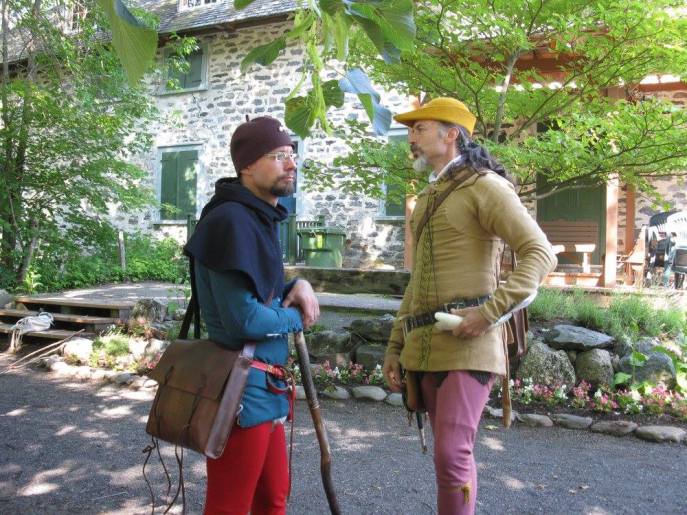
11411846_10206563984673965_8203214927292303639_o

Those are my Pilgrim clothes.  That’s Lotbiniere, Quebec, and I’m with my friend Bernard Emmerich.

So… another immersive experience; no less physically challenging, and in fact, has required the same amount of preparation, both physical and in terms of kit.  No weapons, no fighting, no pretend; real canteen, real clothes, real shoes, real 30 kilometers a day. I make this point at least in part because I think that reenacting vastly over-emphasizes conflict and war; people had a lot of other things to do in the past. Pilgrimage is an entire subject unto itself; fascinating because of what it says about the human mind, and about contact with the spiritual and the past; in a way, all reenactment is a form of pilgrimage.

And of course, we are ‘actually’ going to Rome. I’m ‘actually’ an Anglican, but I have no hesitation in visiting and venerating the Christian holy places of Rome, both as a reenactor and as a modern person.

As a writer, I will blog every day from my inn, hostel, or B+B about the day’s walk, and sites along the way.  I’m allowing myself 5 photos a day.  It’s a mindset thing; when I’m walking, I can be very much immersed int he countryside, even when 18 wheelers grind their gears or use their air-brakes; but once I get my Iphone in my hand, I’m out of my experience; I’m a tired older man in wool and linen on a hot day.  So I prefer to keep the device to a minimum.  In the evening, at a modern B+B, I’ll be happy to sit back and post a few paragraphs on the experience. I hope you come along and enjoy it, or even laugh quietly.

After Italy, I’m going to England.  I don’t actually expect to be in any of the various pasts while I’m in England, but I will be at the ‘Reading the Wall’ conference in Newcastle-on-Tyne June 15-17 as a speaker. I’d be delighted if you wanted to come; I’m speaking the first day with Garth Nix (!!) and I suspect that he, at least, is worth the price of admission.  If you read this blog, you may already have heard all that I have to say! Tickets for the keynotes are available here.

sycamore-milecastle

Sycamore Milecastle on Hadrian’s Wall

I’d be delighted to see any of you, and in fact, I’ll have time Wednesday and Thursday to meet people and talk, whether about books or reenacting or philosophy or whatever comes up.  Religion? Chivalry?  And really, I want to use this opportunity to say that one of the reasons that I enjoy the Torneo and the pilgrimage and the conference is just that; meeting kindred souls and talking, which may, after all, be my favorite activity.

After The Newcastle conference, I’ll be spending ten more days in the UK with my wife Sarah and daughter Beatrice, and we’ll be int he Lake District, which, if you don’t already know this, with Hadrian’s Wall, is a major feature of the Traitor Son books.  The land north of Albinkirk in the Red Knight’s world is a blend of the Lake District and the Adirondacks of upstate New York; in fact, if you imagine that Albinkirk is Penrith or Kendal (roughly) and that instead of flattening out into the borders, the terrain merely gets rougher and more mountainous, you have it.  As I’ll be getting ready to write the final volume of the Traitor Son series (book 4, Plague of Swords, is done and edited and in the very last stages, so my various reenactments and then a week in the crags of the Lake District will be the final preparation for ‘Fall of Dragons,’ the series conclusion).  And also for the next William Gold novel, part of which will happen in Medieval Cumbria (and the rest in Italy). (Book 3, The Green Count is already done and in)

Plague oif swords

Honestly?  I love this cover and just wanted to put it up again 🙂

And for fun, here’s one of the places that inspired Traitorson:

bea's camera camp scotland england 2013 293

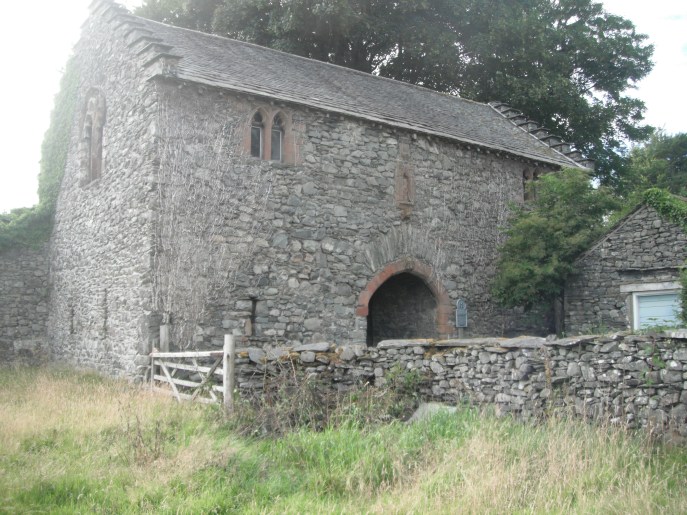
The Old Hall in Hawkshead.  Also Lady Helewise’s manor house outside Albinkirk.

bea's camera camp scotland england 2013 348

This is the island on Coniston Water that inspired Arthur Ransome to write Swallows and Amazons. If you have not read Swallows and Amazons, you really must!  But… Coniston Water was where I really saw how similar the Adirondacks were to the Lakes.

OLYMPUS DIGITAL CAMERA

The Castle of Ticondonaga

Here’s Fort Ticonderoga, ie the castle of Ticondonaga.  See how it could sit on Coniston Water?  Even if it is in the Adirondacks?


IMG_1677

And finally, here’s a view of the hillside and valley where a certain hedgehog washerwoman lives and works, and clearly a place Beatrix Potter loved.  My family love it too, and Lady Helewise’s manor sits down there among those feels. it is, as you will soon read, a difficult place to land a Griffon..

I have several other reenactments and immersion events planned for the later summer, but I’ll deal with those in a separate blog.  For now, it is enough that I’ll be blogging (not at this length) almost every day starting June 3rd.  I hope you come and read it.  If you do, you’ll probably be able to see into the process by which I learn history, create fantasy, and write.

And I hope to see some of you on the way!


Reading Froissart in the Adirondacks

Standard

Last weekend, I went to the Adirondacks to visit my dad.  His cabin is one of the most comfortable places in the world, despite the lack of running water and electricity, or perhaps because of it.  There’s no internet, and there’s time to read. I took Froissart, a very long, very tangled, and sometimes downright falsified Chronicle of the world of the later fourteenth century.

I first read Froissart in the Adirondacks, around campfires, when I was fourteen.  that same summer I also read James Fenimore Cooper‘s ‘Last of the Mohicans’ and then, like any Harry Potter fan, I gobbled my way though all the Leather Stocking tales, and then read ‘The Spy‘ and … on and on.  Froissart and Cooper.  I’m pretty sure, somewhere in my neural pathways, you can deconstruct the Red Knight in those campfire readings; I can only say that despite Cooper’s racism, sexism, and florid, overly-descriptive pace, his books were full of wonders — almost as good as Tolkien — and they were the perfect thing to read, propped on your elbows by a camp fire.  And so was Froissart.

Can you influence a book by where you read it?

Froissart is not supposed to be fiction.  On the surface, Froissart wrote a chronicle of his times, a strict narrative history of the causes and consequences of the ‘Guerre de Cent Ans.’ It is a remarkable document, not least of which because it contains so many patent falsehoods and dramatic creations and downright lies; even more remarkable, as the writer was himself an eyewitness, at times even a player, and he knew… knew directly… the great men and women of his day.

It’s a damn confusing read. And that’s really what this blog is about.

Ah!  Digression #2.  Where have I been?  Well, I’ve written almost three full books so far this year; the Green Count, which is Chivalry III; Rage of Ares, which is Long War 6; almost 55K words for the ‘Song of War’ Trojan War team up (with Simon Turney and Russ Whitfield and five other great writers) and four new Tom Swan episodes.  Honestly?  When I write that much every day, six days a week and sometimes seven, I’m curiously uninterested in writing a blog.

Anyway.

What makes research complicated is exemplified by reading Froissart.  If you are a professional historian, you may wince now, or stop reading, but here’s the thing…  there are really shockingly few facts to history.  That does NOT mean there is no truth.  It simply means that arriving at the truth is not easy.  I could spin you a whole bunch of allegories, but let’s stick with Froissart.

I happen to have the ‘Thomas Johnes’ 1805 edition of Froissart in English.  because I’m sort of serious about this period, I also have the ‘Lettenhove‘ 1869 edition in the original Medieval French. I can read Medieval French if I’m careful and have a computer and good glasses; I read English a lot more quickly, so I tend to read Johnes’ translation and then look up things that seem dead wrong, unlikely, or useful for reenacting or my novels; then I look in the original French.

So the first note I have to make on research, and the fascination I have with the whole process, is the sheer quality of Johnes research.  It doesn’t have to be Johnes; he cribbed notes from other authors; merely that in 1805, well-educated folk had already cross-correlated Froissart with Villani‘s Florentine chronicle, for example.  This with only manuscripts to work from, no translation, no computers, and, in fact, without even 3×5 ‘index’ cards.

Can we all just think about that for a moment?  If you wanted to check up on what Villani thought John Hawkwood was doing, you might, in 1798, have had a devil of a time finding a copy of Villani in England, and let me add that there’s still not a good reliable translation of the whole, so you’d also have to know Italian, a language that still eludes a lot of modern Medieval scholars.  Ok, I admit I’m beating the dead horse.  But they did some awesome research back then.  They traveled, they read in foreign languages, fighting bandits and probably drinking good wine.  Research as an adventure…

Lettenhove, for example, is thoroughly indexed; so much so that a day after I discovered that William Gold, hero of my Chivalry books, existed, I also knew where to find every single reference to his life in Froissart. Oh… did I forget to mention that William Gold occurs in Froissart?

He does.  Four times.  And this brings me to the second of my many points about research (or is this the third) which is that most people call it ‘research’ when they read a modern secondary source. I’d just like to note that ‘research’ is a spectrum.  For me, at one end of the spectrum is direct contact with the past; walking the battlefield of Plataea MYSELF, or handling a late 14th century mercenary contract and trying to read it. At the other end, the easy end, is reading some magisterial secondary source, like William Cafferro‘s biography of John Hawkwood.  That’s easy.  Really, really easy.

Because, for example, when he refers to William Gold, he calls the man ‘William Gold.’

Whereas in even a transliteration of a period document, his name is Guglielmo Cogno, or possibly Guglielmo Inglese, or maybe William Cook, William the Cook, Guglielmo Gott, Cocco Inglese…

And then, in a manuscript, like this condotta, or military contract, his name looks like this…

unspecified

I’m sure you found it right away.

Uh-huh….

Listen, I’m not good at reading period documents.  My undergraduate professor and still my mentor on all things Medieval, Professor Richard Kaeuper at University of Rochester, called these documents ‘the skin you love to touch.’  And I do.  It’s not because they are easy to read, and it is ALMOST NEVER because I’m learning anything that people don’t already know. In fact, in almost every situation, reading an original document is very like that time in High School when you duplicated a famous chemistry experiment.  You may learn something, but you seldom learn anything new.

I’ll tell you a secret; it’s the key to understanding Froissart in the Adirondacks, and to understanding why Froissart is a great source and a terrible liar at the same time.

Original documents are gateways.

They prove that the past is real, that history happened, that William Gold, whatever they called him, was, in fact, a professional soldier and knight. Like monuments, Hadrian’s Wall, the Parthenon, and the Great Wall, they allow us a glimpse of the past; a concrete, tangible connection.  Certainly, they can be falsified.  Or altered.

Parth

In fact, if you look at this image of the Parthenon, you’ll see some new stone; they are, in fact, repairing this superb monument.  Are the repairs ‘accurate?’ (Yes).  But not the same as the old stone, somehow… a different colour, and a different feel… but the whole remains, forever… the Parthenon.  (Maybe my favorite historical site; maybe Hadrian’s Wall.  Can’t choose.)

Or take the AeropagusSocrates walked up these steps, and so did Aristides and the Apostle PaulMiltiades, Themistokles, Arimnestos

480x320-areopagus1

If that doesn’t move you, nothing I have to say will.  Miltiades climbed these steps.  And yet… maybe those molecules are worn away.

Or not…

Froissart was there.  He’s like the steps of the Aeropagus; he’s a gateway into the reality of the 100 Year’s War, and his lies, distortions, and mythologies are themselves evidence.  He lived the glory and horror of a terrible war and he tried to make sense of it, and the sense he made is (literally) an Arthurian Romance studded with senseless violence, rape, and occasional acts of chivalry. You might be surprised about what he tells the truth about… he never sugar coats the horror; when women and children are slaughtered, he tells you.  It’s the sheer greed and ambition of the major players he can’t abide, and so he changes events to make them fit the sensibility of his age,and that is, in fact, deeply authentic.

If you read Froissart to learn more of an accurate chronology of events, for example, in the Jaquerie, you may be doomed to disappointment; you may decry his lack of interest (the revolting peasants are basically so many thuggish orcs, to Froissart); you’ll have to tally all his statements with other narratives, with town records and other chronicles.  The same is true of that pillar of greed, ambition, and human evil, Charles of Navarre (who Dick Kaueper once suggested ‘must have left a trail of slime behind him wherever he traveled); Froissart loathes the man so much that he never explores his many treasons, and the chronology of Charles’s dark actions makes little sense; possibly because it made little sense of his contemporaries, or to Froissart.  A modern source like Sumption’s 100 Year’s War series can present a clearer path, a simpler story, but Froissart was there.

But for all that, reading Froissart and understanding what he has to say requires possessing a fair amount of other knowledge; reading secondary sources, having access to documents to help the reader overcome bias or falsification, even just an understanding of dating systems.  Even with all that, there may not be one answer; not everything can be resolved as fact. Did these two knights meet in the spring of 1366 or 1367?  One source says one, one says the other.  Which is true?  Is this because of a calendar issue?  Have we changed the way we calculate Easter or Whitsunday? What reignal year is ‘Edward 39’ and does the reignal year start on January 1st?  Did the chronicler believe that the year started n January 1st, or on Easter? (This all related to a recent research problem I had).

Why am I telling you this?

It is popular to deride history and say ‘the winners write it’ or ‘stories  from the past.’  In fact, neither assertion is really true; Froissart, for example, was a Hainaulter; his people fought for both sides in the 100 Year’s War, and his chronicle, the most widely read in period and to this day, attempts to be unbiased.  The historian of the Peloponnesian War, Thucydides, was Athenian; they lost, and yet there is no Spartan history of the war.  History is often written by people who were interested in the outcome, and they inevitably have bias, but then, so do many scientists.  We need to read past that bias to understand the past.  That’s just part of the job.

But I also want readers to understand that, beyond the fictionalization of history that I do because I write novels, whether HisFic or fantasy, History itself can be full of fiction; or simply, deeply ambiguous.  I cannot tell you how often a reader had contacted me to tell me that I was ‘wrong’ about some ‘fact’ in a novel;  I’m here to tell you that while I make errors, I am also aware that history is full of flaws.  History is NOT a simple secondary source like an Osprey book, full of neatly coloured pictures of clean warriors and well-encapsulated summaries of the actions of history, provided without meditation or apology.   History is a vast matrix about human existence and human memory; a tangled forest of perceptions, understanding, ambiguities, with empty voids where there is no data at all, and dangerous bits where sources directly conflict, and any historian, however casual, has to pick their way across the forest, find a trail, and try to discern if it is the ‘right’ one.  There is truth; something certainly happened.  But ask fifty modern American to describe Donald Trump and you are in the midst of the tangled thorns of the perception of experience, and therein lies the fascination of Froissart. And all original, documentary evidence.

I enjoyed my time with Froissart, but eventually, the Adirondacks themselves beckoned, with genuine trackless forests, thickets, and tangled thorns… and trout.  And I went fishing.

Fishing

The Truly “Universal” Parry

Standard

My favorite swordsmanship article this year. Thanks, Greg!

The Freelancer's avatarThe Freelancer

By Gregory Mele

n medieval European swordsmanship the greatest commonality of technique is found in the teachings of the one-handed sword. Whether it is a cross-hilted “arming sword”, a falchion-like messer, or the later, complex-hilted weapon of the Renaissance, there is a fundamental substrata of guards, wards and basic actions and tactics that transcend “school”.

In Ms. I.33, our oldest surviving treatise (c.1300), the author writes that there are “seven guards that all fencers uses”, and these seven are nearly identical to the seven presented by Angelo Viggiani, almost three hundred years later. Along the way,  we can trace the same positions as fundamental to the one-handed swordplay of Fiore dei Liberi (1409), Hans Talhoffer (fl. 1450s – 1460s), Antonio Manciolino (c.1523) and Achille Marozzo (1536).

There is no real mystery in this; these seven guards, or some variation therein, are the positions that one simply *must* move through with…

View original post 1,697 more words

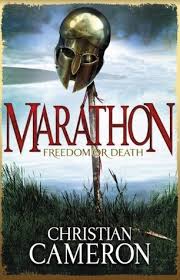
Marathon-Freedom or Death by Christian Cameron

Standard

Of course I appreciate such a positive review! I’ll just take this moment to add that the last book of the series, ‘Rage of Ares’ is finished and will go to the publisher Friday, while William Gold III, tentatively titled ‘The Green Count’ is on page 520 today.

tigers68's avatarHistorical Fiction reviews

marathon

In my review of Killer of Men I stated that I wouldn’t take too long before reading Marathon.  Where does the time go?  Three months?  My only excuse is that I have read some really good books in the interval.  🙂    Now that I’ve finished Marathon, I make the same prediction regarding the next book in the series, Poseidon’s Spear…well, we’ll see how that pans out.  Anyway, Marathon…is just another example of the author’s remarkable storytelling.  I was continually amazed with his knowledge of the era and the way that knowledge was used to not only enhance the story but to also teach the history of that time and place; much of which I already knew but it never hurts to relearn things that have lain dormant for decades.  This is not only played out in the events of the war but also in the everyday lives of the…

View original post 74 more words

Finishing the Long War — On parting with old friends

Standard

A long, long time ago, in what sometimes seems like a different world, I sat down, full of passion, to write the book that eventually became ‘Killer of Men.’  And today, in a coffee shop, I sat down to write the last lines in what will probably be the last book of the Long War series.  Six books.  About a million words, and almost ten years.

12189508_527647250736908_2675289067121279631_o

It was the most exciting intellectual journey of my life.  It involved more original research than I ever expected to do to write historical fiction.  It changed my philosophy of reenacting; reconstructed my view of the world, altered my own take on philosophy profoundly, and allowed me to drain away some PTSD.  Oh, and I took up a new martial art.

So I hope you will all understand that it took a major effort not to weep as I wrote the last lines.  I have spent a lot of time inside the head of my Killer of Men.  And I’ve spent an enormous amount of time trying to recreate elements of his world, from the philosophy of Heraclitus to the proper construction of Archaic Greek armor and shields.

I learned, or relearned, the difference between reading and research; reading is where you can follow a good path that other scholars have worn for you, moving from tome to tome and taking what you need as a write of Historical Fiction.  I’m not ashamed to say that’s what I did with Kineas and Alexander; the heavy lifting was done.  I just read the sources and then the secondary works.

And then I discovered the late Archaic.

There’s one source:  Herodotus.  There are other sources who may be valid; Cornelius Nepos, Plutarch, Diodorus Siculus, Thucydides, Pausanias.

But basically, there’s Herodotus.

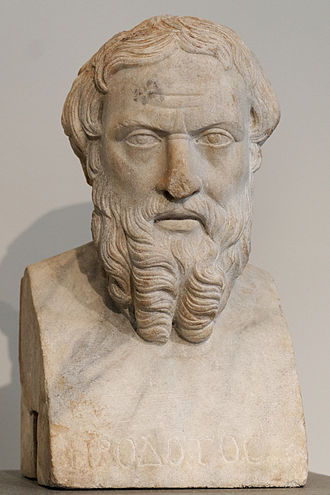
herodotus

He invented modern history.  And he wrote the first history in the west; the first attempt, I would argue, to give an unbiased account of the world around him and how it came into being.  Herodotus believed in many things we don’t believe, including omens and prophecy, but he also had a sharp scalpel when cutting away crap.  One of my favorite factoids about Herodotus is that Plutarch thought he was ‘too fond of barbarians’.  In fact, if Plutarch had known the term ‘revisionist’ he’d have applied it to Herodotus.

Isn’t that interesting?  the first historian in the west was highly critical of the ‘heroes’ of his generation and the generation before him.

At any rate, when I came to the late Archaic, I knew so little about it that I dove into the source material…

And there wasn’t any.

You think I’m joking?

Here are two random problems encountered in my first day writing..

What did Archaic Greeks wear?

How did they light a fire?

Surprise!  It’s ten years later.  I think that my friend Giannis Kadaglou and I know as much as there is to be known about Archaic Greek costume, and we still can’t fully agree as to how an upper class man of 500 BCE was dressed.

And I still don’t know exactly how a 500 BCE housewife, or priestess, or servant or slave lit a fire.

My friend Nicolas Cioran calls it ‘the journey into complete darkness.’  It’s an excellent phrase.

So… to help me learn, I thought I’d join an ancient Greek reenactment group.

Side note.  In 2007, when I entered on this journey, I ran a group that did a British unit in the American Revolution; we had about sixty members, and we were part of a larger organization with perhaps five thousand members. It seemed a simple matter to find some expert Greek living history group, and join them.  I’d learn a ton, find out who Greeks started a fire, and move on.

But… there weren’t any.

By 2008, I’d discovered that, not only were there no Ancient Greek living history organizations in North America, but also, that no one planned to reenact the Battle of Marathon in 2011, when it would have it’s 2500th anniversary.

Favorite Historical Period

OK.  We fixed that.

By which I mean I found a lot of like minded people; there WAS an expert Greek reenactment group, in England, called the ‘Hoplite Association’ and there was this guy in Greece… who was young enough to be my son… and seemed to know a great deal; there were a lot of really good reenactors in Australia, and in France and Spain…I met Giannis for the first time in 2009 and he slept on the couch in our apartment in Athens and after three days, my daughter thought he was the coolest person in the world and my wife and I pretty much felt the same. He became an instant best friend.

Favorite

That’s me at the head of my file (Dave Dudek, Anders Rene Wiik , Mike Brennan) and Giannis at the head of his: Giorgos Kafetzis, Konstantinos Dimitriadis and Jevon Garrett.  You can’t see them behind us because our drill is so good…

And at the same time, my original best friend, Jevon Garrett, got cancer.  Going to Marathon and Greek reenacting developed an edge, because Jevon was going come hell of high water, even if it was the last thing he did.

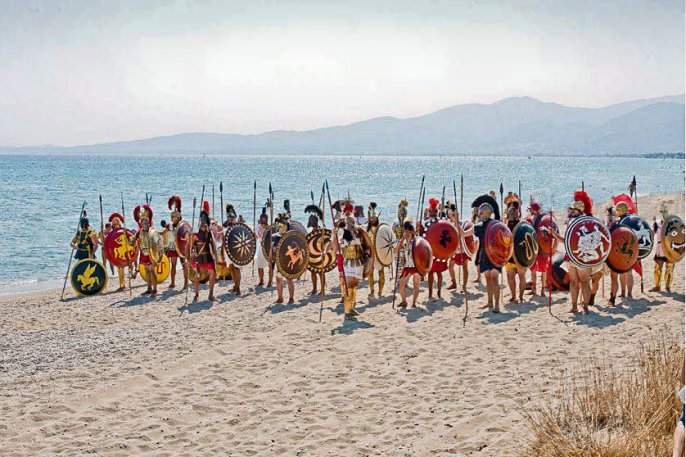
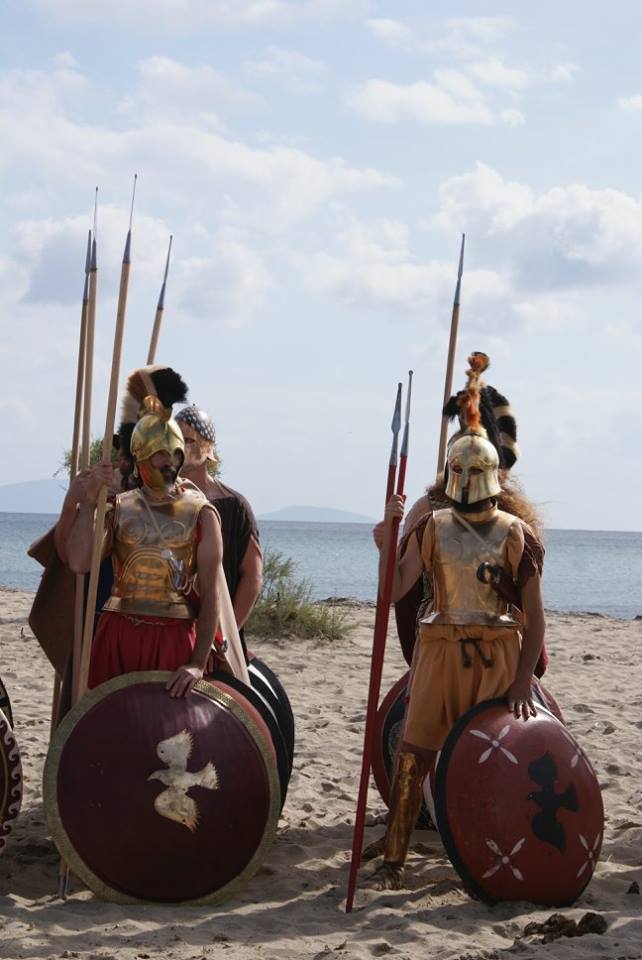
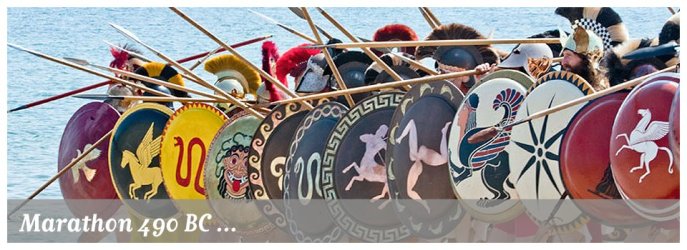
So we had a reenactment of the Battle of Marathon.  There were fewer than a hundred of us, and the quality of kit ran a huge gamut from not very good to really very good.

308196_10150398524871204_476775234_n

And it was glorious.

And at the end of the event, I knew a heck of a lot more than I’d known at the beginning; about living as a hoplite, and about herding cats…  And, remarkably, I learned that I could, in fact, actually get people to travel five thousand miles to reenact something.  Even the air freight and use of pallets to ship our aspides (Ancient Greek pl. or aspis, the hoplite shield — no link to the Wikipedia article because it’s lame ) was a useful learning experience.  For something.

Side note?  Jevon did not die.  Still with us, in fact, and just reenacted Marathon again in 2015.

By the time the dust settled on Marathon 2011, I’d written two of the Long War books and I owned about fifteen thousand dollars worth of books.  And yes, there are libraries, and no, most of them don’t actually have the books I need.  Most serious research on Archaic Greece is in Greek or German.

And the learning never stops…

By the way, there will be a separate blog JUST on the Battle of Plataea, because for that, I did actual research; that is, original work coming to different conclusions from others in the field.

But in 2014, we had the first Pen and Sword tour.  That was the brain child of my friend Aliki Hamosfakidou, a travel agent in Athens.  (By the way, if you are interested, we’ll have one in 2017 and it will go to Northern Greece, the Macedonian tombs, and probably Istanbul and Troy.  Just saying…).   So a few of my friends ( have I mentioned that I write about my friends?) joined, and then there were these fans…

All of whom are now my friends.  Many of whom were in the phalanx at Marathon 2015.

Anyway, we went all over the Peloponnese, to places I’d never been before, and I learned more and more as I looked at more terrain, more battlefields, more armour, more vases…

10395811_778081802248280_2006788406022530135_n

Pen and Sword at Plataea in 2014…

There we are… well, there’s Jevon, just visible,and Smaro, and Chris Verwijmeren, from whom I learned so much about archery…

Archery!  I know a fair amount about spear fighting and sword fighting… well, I do now.  But archery?  It’s a whole different world, and there’s so much to learn.  You need a guide…

And of course we looked at Salamis.

Marathon 2015 451

And then I went home and wrote the book.

That’s how it happens.  Look, I’m a method writer.  I have to go to the places and wear the clothes.  And eat the food and ride the horses and drink the wine…

And then, four times, Plataea.

Marathon 2015 811

More friends, more fun, another tour, and we walked the ancient site and the battlefield, which is, I can tell you, about the size of Gettysburg or Waterloo.

Marathon 2015 799

No signs, no signposts.  Not even a marker.  Just our two expert guides, and two slightly less expert guides (the latter are Giannis and I) and a lot of walking, and a bus.

It was glorious.

And in the end, I wrote a book about one of the great battles in history, and about having friends.  I am lucky, amazingly lucky, to have so many friends, and when I found out that one was very sick, I tried to finish the ‘Rage of Ares’ as quickly as possible.  Just in case.

It went out today.

And.. I left the door open.  Just in case you’d all like to hear one more story about Arimnestos of Plataea, who was, in case you haven’t noticed, a real man.  He’s in Herodotus.  And Pausanias too.

Because really, I don’t want to say goodbye.  I’ve learned so much… there’s so much more to learn, and so many more friends to make.  And at the very least, I hope that in 2021, we’ll all be at Plataea, reenacting.

But until then…

Goodbye, Arimnestos.


Faith,Piety and writing about religion

Standard

Religion is culture.  Culture is religion.

Hey, I didn’t create those phrases.  But they are useful ways of approaching writing about religion, and understanding religion in fiction and reality.  So why does every culture seem to have its own religion?  Why is English Protestantism so different from American Protestantism, why is Iraqi Sunni Islam so different from Iranian Shia Islam? Why is Kenyan Ismaili Islam so different from each?

Leaving aside the purest matters of faith and belief, and from a purely historical viewpoint, the differences are societal and cultural.  As people form different cultures, they develop different spiritual needs.  And viewed through the cold, unrelenting lens of anthropology (which, to be fair, has turned out to be a cold, racist lens, but there’s still merit in many of its pronouncements) the needs of a culture may begin with quaint peasant dances; eventually those dances are codified into which ones are ‘right’ and which are ‘wrong’ and then, at some point, the rightness reaches a state at which the dance is ‘sacred.’

Or, just possibly, the Imams and the grim Geneva ministers decide that all dance is profane, secular, or downright ‘sinful.’  Meaning, for example, that it allows young men and women promiscuous contact that can interfere with the orderly direction of the culture, at least as promulgated by the Imams and the ministers, all of whom, you note, are men.  That’s for another blog.

It is not my intention in today’s piece to discuss the many failings of organized religion… except, in fact, to comment that most of the failings ascribed to religion are in fact biases inherent in culture.  Religion is, in a way, the most codified, most rigorous form of culture (and that’s why it generates so much art), but it’s still merely a reflection of society’s needs and desires.  It is human; it is about the systems that govern human animals.

What I’m interested in, and what, by extension, I rather hope all of you are interested in, is the writing of religion in historical fiction and in fantasy. So let me start with the sort of broad, sweeping statement that would annoy me in someone else’s blog.

For most of human history, people have actually believed in the divine and the supernatural.

There it is.
Piero_Strozzi

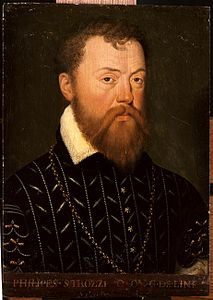
I mean, it is always possible to find atheists and near atheists, and to comfortably give them modern belief systems.  Piero Strozzi comes to mind.  His brother was the Prior of Capua and a Knight of Saint John, and he was once proposed to the pope as a cardinal, but he was apparently an absolute atheist, and on his death bed, when asked if he would renounce sin and acknowledge God, he said something like ‘If there is a god, which I very much doubt, he is a gentleman and will be no more impressed with my late conversion than I with his late appearance.’ For a 16th century Italian, that’s some serious atheism. He’d be an easy, modern character to write, and in fact, Dorothy Dunnett did a great deal with him and his religious, piratical brother.

Such men and women have existed in every generation. in every culture.  I can catalog for you a number of major Christian thinkers who seem to have lost their faith or questioned the existence of god, especially across the Middle Ages and into the fifteenth century; I could, if I wanted to stir up controversy, name a major Islamic thinker who appears to me to have eschewed all forms of theism at the end of his life.  Such men and women existed.  Finding religion irrelevant and even silly or irrational was not invented in the last fifty years.

But…

Let’s have a little look at why we read historical fiction, shall we?  Isn’t it to immerse ourselves in the past?  Isn’t it a desire to experience, if only indirectly, the ‘other country’ that existed somewhere and to which we can otherwise never go? (And in fact, is this not the very same reason we read fantasy?).  So when we give a medieval character a modern, rational-materialist ethic or morality, aren’t we kind’a cheating?

And even if that person existed, isn’t she more of an outlier?  Perhaps an interesting character, but hardly a typical one. Dorothy Dunnett used Piero Strozzi for contrast.  Not as a norm.

And… even more so, in a fantasy environment where the Gods are immanent I mean… isn’t it patently silly to be an atheist when god keeps appearing at your elbow? Or dropping rocks on your army? (I will return to this thought in another blog, too).

I began my writing career (leaving aside spy novels and Washington and Caesar) with the Tyrant series and Hellenistic Greece.  And that immediately confronted me with a vast array of possible attitudes for my protagonists, because, in fact, the Hellenistic era was rife with both cynicism and piety. And new spirituality — the messiah, for example.  (Not ‘The Messiah’ either, but a plethora of them.  A trend.)

Ah, time for an excursus on piety versus faith.  To me, as an historian, piety is about the rigorous practice of ritual and matters of religion; praying to Mecca, crossing oneself, bowing one’s head every time the name of Jesus is mentioned, performing one’s ritual sacrifice with precision, so that the blood flows nicely over the altar, rattling away with that prayer wheel….

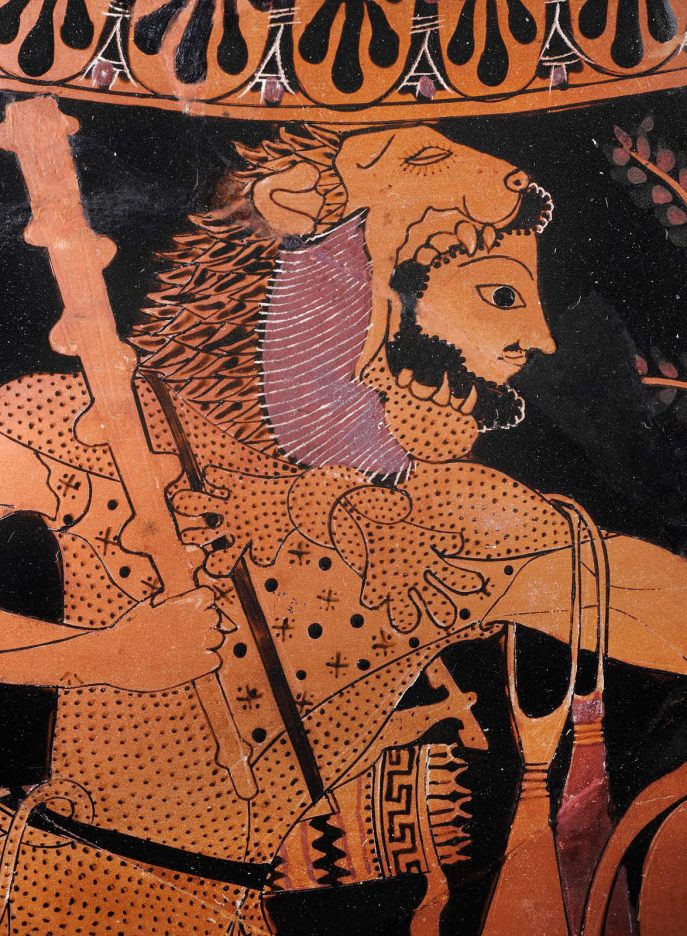
This is and is not the same as faith.  To me, faith is the actual feeling of belief in the divinity and/or supernatural.  Each can affect the other, but they are different,and where faith can exist independently of culture (for example, a Persian in 6th c. BCE Anatolia might suddenly develop a belief that the Greek hero Herakles played a major role in saving him from disease), we usually see piety as deeply embedded in cultural practice (look at Italian Catholic ritual practice and then at French or English Catholic ritual practice, for example).
Herakles

And a character in Hellenistic times might well perform multiple acts of piety, sacrificing animals for example, because of the important social issues surrounding piety.  (I recently read an article that argued that Roman religion was entirely about piety; about ritual performance). In Ancient Greece, to publicly perform some rituals was to be a priest, and priests were often high ranking aristocrats, directly related to and descended from the god they worshiped.  Ritual performance reinforced social status and, of course, provided proof of the performers descent from the Gods, a nice package.  And by the way, when you are descended from Herakles, how exactly do you decide that you don’t believe in Herakles?

Because to disbelieve in Herakles would lead to a cascade of other collapsed beliefs.  It would mean that you no longer saw yourself as descended from the gods.  That might further imply that you had no particular right to rule other men or own slaves.  Or fight wars of dominance.  You would now have to redefine your relationship with the supernatural, with the natural order, with other men and other women.  Because being descended from Herakles was at the very heart of what it meant to be YOU. And when you ‘admit’ that there is no Herakles….

You are someone else.

You are no longer the same person you were moments ago, and you are going to find this experience pretty traumatic.  I have launched off on this little side-road in religion and belief mostly to remind all of you about character, motivation, and plot; and why religion plays a major role in belief and thus in motivation; how the collapse of belief would be a horrible experience, and force a massive and perhaps pernicious reshaping of character.  All my rational materialist friends will now cry foul and tell me that it will lead naturally to a more honest and rigorous examination of the world, but as an historian, I’m going to say that in Hellenistic Greece and Renaissance Italy, what I see in the end of belief is a stunning void in ethics and a shocking expansion of selfishness and greed.

Modern corporatism, anyone?

And of course, when people ask questions like ‘Why does x religion believe something so stupid as y, and why don’t they just fix that’ the little historian in me comes out and says… well, it probably had an important role in culture, once, and  even though that role is now lost, the belief system remains and is important to many people at an almost instinctive level. Like eating pork. Or…
lossy-page1-135px-Martin_Luther_by_Cranach-restoration.tif

closer to home…  Protestant and Catholic Ireland.  I’m going to say, as  someone who enjoys the ‘game’ of historical theology, that most modern Irish men and women — and their North American descendants — could not tell me in ten sentences what it was in the 16th and early 17th century that separated mainstream Catholic from mainstream Protestant theology. (NB, if Martin Luther was alive today, he would be a hyper-conservative Roman Catholic.)  And I’ll further posit that the great mass of those same people no longer practice EITHER form of Christianity.  And yet, my experience tells me that they cling to bias about the other group.  It has become cultural,. even though, in this case, it started as a philosophical/theological issue at the very most esoteric level.

I’ve probably beaten the heck out of this dead horse.  But for the sake of argument, the converse is often true.  So, for example, presented with an MP3 player loaded with the Latin mass of Thomas Tallis alternating with calls to prayer by an expert Muezzin, most western agnostics and atheists will nonetheless prefer the former.  Aesthetically.  For cultural reasons.

All the way back to my first assertion.  Most people in history believed in the divine and the supernatural.  To me, having posited this, it’s essential to write most characters as pious or at least ‘automatically’ or unthinkingly religious.  What one does in this way, however tempered, is to provide a glimpse of the mindset of the past; to allow our reality to be filtered by their belief system so that we see, even if through a glass darkly, something of the image system of the past.  With the Greeks, I spent a fair amount of time on philosophers, because my ideas about Greek religion, when they go beyond wine spilling and ritual practice, are bound up with my (modern, flawed) appreciation of the Greek philosophers.  But, like transmitting my reenacting experience of armour and battle, it does help you, the reader, to ‘be’ in the past for a moment, or a set of moments, even in a flawed way.

I am asked from time to time why the world of the Red Knight novels includes Christianity (and Judaism and Islam, if you’re looking).  There are two reasons.  One is still my secret, and is about my ‘cosmology’ of why and what this world is.  But the other is a matter of record.  I’m an historian of Chivalry.  I wanted my pseudo-Arthurian world to feel right and exist in the cultural world of Chivalry.  It is a truism of the study of Chivalry that there is no chivalry without Christianity.  It might look a little like chivalry, but it’d be something different.  There is a fad to Celticize Arthur, but to do so is to ignore most of the source material and to add some (to me) unsavoury concepts.  When I say ‘The Arthurian Mythos’ I mean the material of the French poets of the 13th and 14th centuries that ends up as the English ‘Morte D’Artur’ as collected by Mallory.  And boy does all that material pack a Christian punch.  I’d even go so far as to say that the early books in the cycle appear to be a Lay Christian attempt to write ‘Gospels’ for the Chivalric class.  In effect, they were creating a new religion.

I suppose that I, too, might have created a religion.  Or, in line with others, I might have merely re-written a religion that was, in effect, the same, but with different names.  Certainly this has been done in the Fantasy genre, with several different religions.  It seems to satisfy… but it doesn’t satisfy me.  Let me just try two thoughts on you.

Case one.  Casual blasphemy.

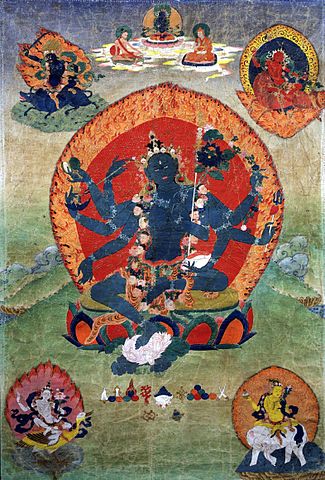
Casual blasphemy is an essential marker of military speech and has been for as far back as we have archaeology and graffiti.  And who can make up a pantheon of saints and martyrs as extensive and deeply imagined as the cannon of Christian theology?  Not just Christianity, either… what fantasy religion has the living, breathing sheer wonder and artistic insanity of 17th century Buddhism?
325px-Tara_thangka

Or 14th c. Christianity, I agree.  Either way, all those saints and demons give people so many different ways to swear; in belief and disbelief, in piety and in its opposite. But to read and understand blasphemy requires that you, the reader, have a deep understanding of the cultural norm, so that the nuance of the blasphemy resonates.

And (on to point two) how much exposition would it take me to tell you, the reader, about the crucified messiah who is and is not viewed as the militant sword-bearing leader of a religion that professes peace but makes war and idolizes its war-makers when they wear shiny armour?  How much pointless character conversation would it take to sell you that, however internally conflicted, Bad Tom and Willful Murder and Sauce all actually believe, in their spiritual core, in the tenets of this made-up religion, and the way it interacts with their professional violence making?

Especially since this hypothetical made-up pseudo-Christian religion would never have the depth of resonance for the cult of Chivalry that the real thing did.  Not to mention that King Arthur and his knights were all… part of the Christian mythos.

Poor, peace-loving Jesus.

These are deep, murky waters.  Even in writing this I found I was unwilling, for example, to offend with a really solid example of blasphemy.  But…  I’ll close with a couple of almost unrelated thoughts.  First, I’m writing the end of the Arimnestos series; pretty soon, I’ll begin writing a new fantasy series.  In the new fantasy, there will be four major religions and I’ll be creating each of them… they will be original… or will they?  I mean, there will be elements of religion as I understand it, created by me; but I’ll be heavily influenced by history and theology we know; Confucianism; Buddhism; Taoist belief; Islam, Animism, Zoroastrianism… and Christianity, of course.

Human beings have dealt with religion, divinity, the supernatural and the consequences of the supernatural in a great many ways.  I’m not sure I’m a sufficiently original thinker to actually go very far outside that box…  But whatever I create, it will be complicated, nuanced, and people will both believe in it and paradoxically, have blasphemies and indulgences.

But  for the most part, they will believe.  They won’t all believe the same things; like us, they’ll debate what actually happened, and some will see the divine where others see the natural.

Whatever ‘natural’ is.

The second of my three unrelated things is that I’ve been running RPGs since I was fourteen.  I’m fifty-three now.  That’s almost forty years of making shit up on the fly, and one of the things I was introduced to very early (my friend, the philosopher Mark Stone, is to blame) was the concepts of cosmology and ontology.  Or, in brief… the big WHYs.  Why is there a world?  Why is there magic?  Science?  Gravity? Steel armour?  Religion?  Seriously… you only have to run a role playing campaign for about fifteen minutes without thinking any of these through, and then suddenly a player asks as question and you are left facing the abyss.  I mention this because a few readers seem to imagine I’d never given thought to creating my own religions for Red Knight.  Really.

And I have been graced with friends who do religion and philosophy for a living, and as a major part of their lives. My writing is heavily influenced by philosophy and philosophical issues; sometimes by theology as well. Dr. Rajiv Kaushik introduced me to Husserl and his thoughts on experience and history (which even appear in this blog) and more recently, my friend Dr. Alice McLachlan has helped me think about art and culture and politics.    Not to mention various priests (Father WIlliam O’Malley SJ comes to mind, and Dr. Peter Robinson (who is an Anglican priest and family, too…) and deacons, like my friend Tom Uschold, who, to complete the circle, also marches into the field in the 18th century and the Middle Ages…

It’s not all swords and armour.  If you are going to write about the past… or create a world from whole cloth… it’s essential to imagine ‘being’ in that world, in that time, in that culture, in that belief system.

Or so says I.

The last and least important comment is that I am, myself, a person of faith.  To me, that’s neither here nor there.  I’m not, in fact, a devotee of Herakles and Hephaestus, but Arimnestos is, and I try very hard to make him pious and also faithful.  Arimnestos is in no way a Christian; merely a man of his time.  That’s writing. It’s like method acting.

Gabriel Muriens has a journey in the discovery of faith or lack thereof, but again, that’s writing; in the Western tradition of literature, that’s a good, solid, mainline Epic plot.

On the other hand, and to be fair, as an Anglican with high church leanings, I adore ritual, and I suppose that helps me write about hermetical magic.

So… in the end, as a writer, what matters is that religion is culture, and culture is religion.

By the way, This is my favorite religious painting; ‘The Virgin in the Rose Garden’ in Verona, Italy.  The lady at the top is the Virgin Mary, although if you look closely, you’ll see some Eastern influences. That lady at the bottom of the image is Saint Catherine.  Because her wheel is lying there in the ground with a nice late 14th c. arming sword.  There’s more symbolism in ‘The Virgin in the Rose Garden’ than you can shake a stick at; it’s at the crossroads of the worlds of Christianity and Chivalry, and oh, by the way, the artist was massively influenced by Iranian court painting –that’s Shia Islam; and perhaps by Buddhist painting, too.  Because, always, always, its way more complicated than it looks.

mizhelino_da_besozzo_o_stefano_da_zevio_madonna_del_roseto_castelvecchio_verona

Oh by the way, Tom Swan and the Last Spartans (Episode 1 of Book 3) is out today!